Quaker Upbringing and Radical Pacifism
Bayard Rustin was born in West Chester, Pennsylvania, in 1912, and raised by his Quaker grandparents. The Quaker tradition of nonviolent resistance and social justice shaped his worldview from childhood. He studied at Wilberforce University and Cheyney State College, then moved to New York, where he joined the Young Communist League briefly before leaving over the party's abandonment of Black civil rights for strategic reasons.
In 1941, he joined the Fellowship of Reconciliation (FOR), a pacifist organization, and began studying Gandhi's nonviolent resistance tactics in India. He went to India in 1948 to deepen his understanding. He became convinced that Gandhian methods — mass nonviolent direct action, organized civil disobedience, and strategic use of the media — could be applied to the struggle for racial equality in America. He was right.
Teaching King Nonviolence
In 1956, during the Montgomery Bus Boycott, Rustin traveled to Montgomery and spent weeks working with a young Martin Luther King Jr. — teaching him the philosophy and tactics of nonviolent direct action. King had guns in his home for self-defense. Rustin helped him understand why, strategically, nonviolence was more powerful: it put the moral burden entirely on the oppressor and generated the kind of media images that could change political reality.
"The only weapon we have is our bodies, and we need to tuck them in places so wheels don't turn."
Rustin co-founded the Southern Christian Leadership Conference (SCLC) with King in 1957. But he was repeatedly sidelined — by allies as much as enemies — because he was openly gay at a time when that could be used to discredit the movement. Adam Clayton Powell Jr. threatened to spread the rumor that King and Rustin were having an affair unless Rustin was removed from King's inner circle. He was removed.
250,000 People in 8 Weeks
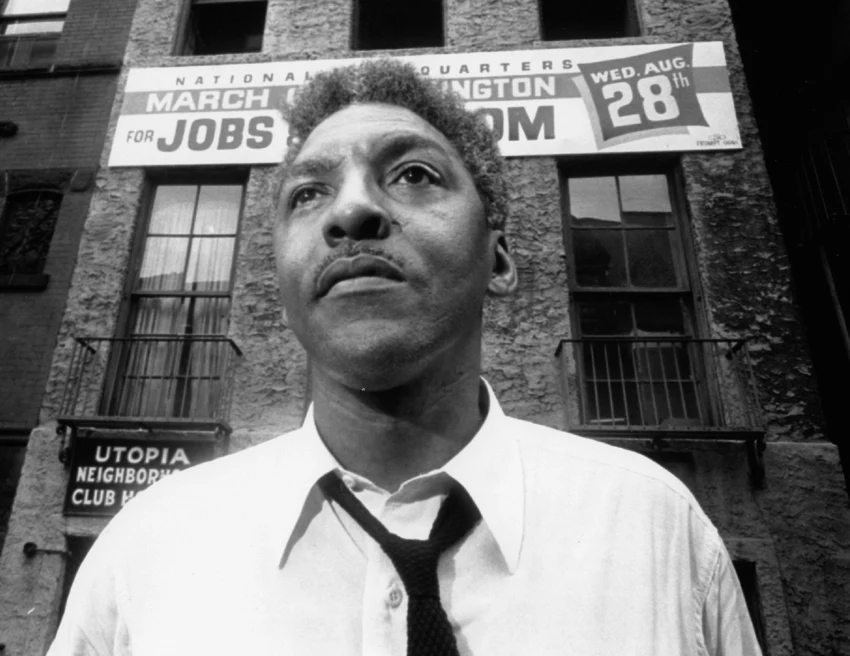
In 1963, A. Philip Randolph — who had been threatening a March on Washington since 1941 — finally called it. He designated Rustin as the lead organizer. In approximately eight weeks, Rustin organized the logistics for 250,000 people to converge on Washington, D.C., on August 28, 1963 — the largest political demonstration in American history to that point. This included 2,000 buses, 21 chartered trains, 10 chartered planes, portable toilets, food, first aid, and a sound system installed by the Army Corps of Engineers after the privately contracted system was sabotaged the night before.
The March was where King delivered "I Have a Dream." Rustin was the man who made it logistically possible to put 250,000 people in front of the Lincoln Memorial — but he was not allowed to speak.
Posthumous Recognition
Rustin died in 1987. He received the Presidential Medal of Freedom posthumously in 2013 — 50 years after organizing the March on Washington. New York State granted him a posthumous pardon in 2019 for his 1953 conviction under a California law prohibiting "sex perversion." The conviction had been used for decades to justify his exclusion from the movement's leadership.
His erasure from the civil rights narrative is itself a case study in how history is curated: the same movement that fought for dignity excluded one of its most essential architects because of who he was. The archive exists to restore what the official record chooses to omit.