Press · Counter-Record · Resistance

The Black Press: Ida B. Wells, the Chicago Defender, and the Counter-Record

The Black press has been doing what this archive does — keeping the record when no one else was keeping it — for nearly 200 years. Frederick Douglass launched The North Star in 1847 to document what slavery actually was. Ida B. Wells documented lynching with journalist's tools when the white press celebrated it and was run out of Memphis at gunpoint. The Chicago Defender organized the Great Migration by running train schedules. At every moment when the mainstream record failed, the Black press built the counter-record. This is its history.

Period1827 — Present
Entries7 documented moments
DomainPress · Documentation · Resistance
StatusLive
The argument

The Black press is not a niche media story. It is a primary source for the history this archive documents. The lynching statistics that historians use came from Ida B. Wells. The documentation of segregation's daily operations came from the Black press. The record of what the Civil Rights Movement actually achieved — and what it was fighting — was kept by Black journalists when white mainstream media was either absent or hostile. Understanding the Black press is understanding where the evidence for Black American history comes from — and understanding why, when the Black press weakened in the digital era, a critical piece of institutional memory weakened with it.

Era 1
Freedom's Journal to The North Star, 1827–1865
1

Freedom's Journal, founded by John B. Russwurm and Samuel Cornish in New York City on March 16, 1827, was the first Black-owned and -operated newspaper in the United States. Its inaugural editorial announced its mission with a directness that defined the entire tradition that followed: "We wish to plead our own cause. Too long have others spoken for us." The paper was founded in part as a response to the New York newspaper Enquirer, whose editor Mordecai Noah had been publishing anti-Black editorials. The founders decided the response was not to write letters to the Enquirer but to build a competing institution.

The paper covered abolitionist arguments, documented the conditions of free Black communities in the North, reported on violence against Black people, and provided a forum for Black political thought that existed nowhere else. It ran for two years before ceasing publication — a pattern that characterized much early Black press: significant in its moment, often short-lived due to the economic constraints of publishing for a community that was systematically denied the wealth accumulation that sustains media institutions. But its founding logic — "too long have others spoken for us" — is the logic of every Black press institution that followed.
The Black Press — Key Publications at Peak Influence
Publication
Founded
Peak Circ.
Primary Contribution
Freedom's Journal
1827
~1,000
First Black newspaper; "Too long have others spoken for us"
The North Star (Douglass)
1847
~4,000
Abolitionist flagship; documented slavery's daily operations; read in US and internationally
The Memphis Free Speech (Wells)
1889
~4,000
Documented lynching statistics; editor run out of Memphis at gunpoint; office burned
The Crisis (Du Bois / NAACP)
1910
100,000
Documented segregation, civil rights, Black achievement; lynching photo documentation
Chicago Defender
1905
230,000
Organized Great Migration; train schedules; documented Northern conditions vs. Southern Jim Crow
Pittsburgh Courier
1907
250,000
Led "Double V" WWII campaign (victory abroad and at home); national distribution
Jet / Ebony (Johnson)
1945/51
1.5M / 2M
Mass-market Black media; documented Emmett Till's murder with photographs; Black mainstream culture
Era 2
Ida B. Wells and the Lynching Documentation, 1889–1931
2
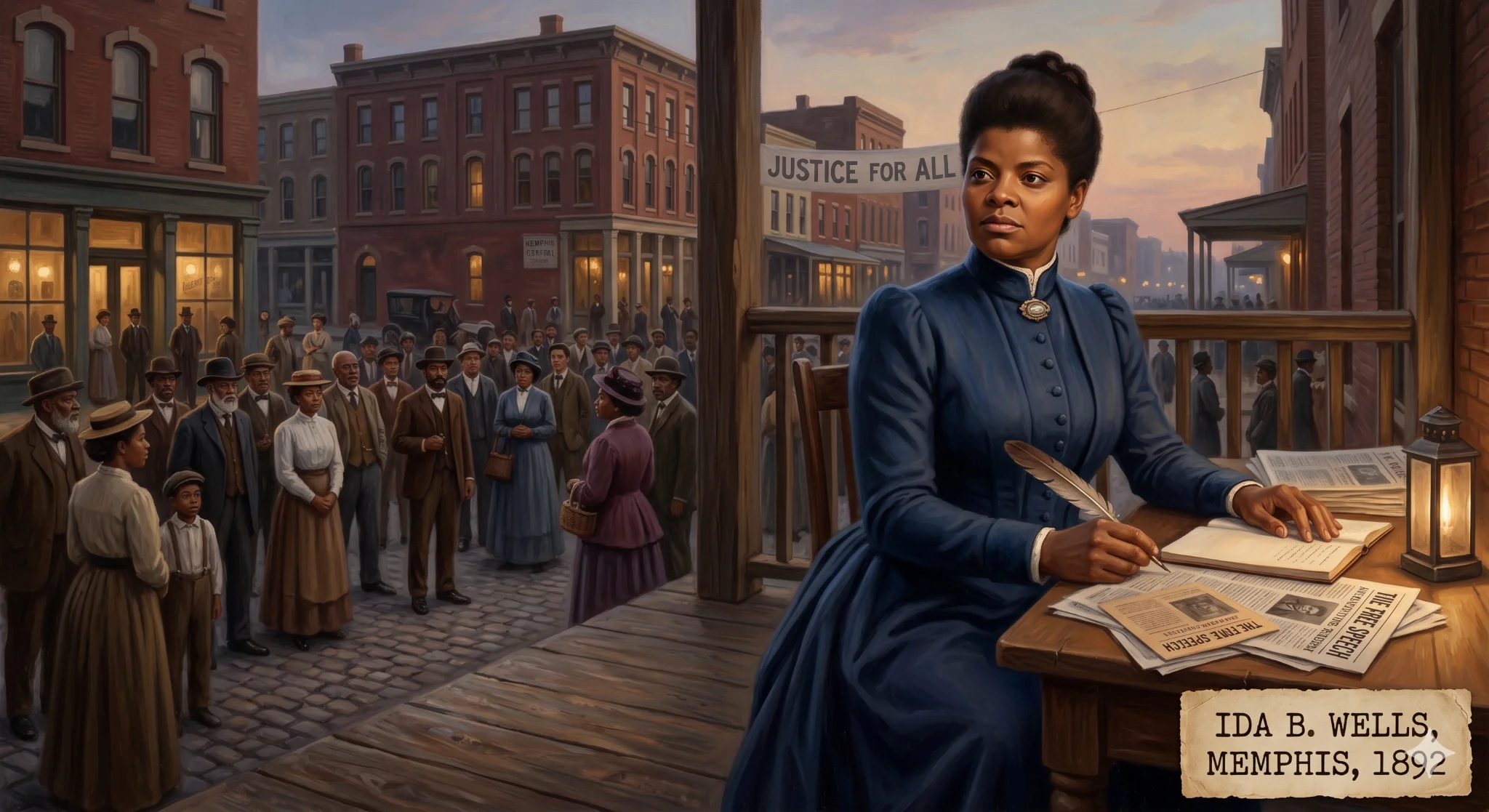
Portrait of Ida B. Wells, journalist and anti-lynching activist, c. 1893
Ida B. Wells · c. 1893
Journalist, activist, co-founder of the NAACP

Ida B. Wells began her anti-lynching journalism in 1892 after three of her friends — successful Black grocery store owners in Memphis — were lynched for the crime of competing too successfully with a white-owned store. The white Memphis press covered the lynchings approvingly. Wells investigated: she documented the actual facts of the case, showed that the "rape" justification commonly used to rationalize lynching was frequently a post-hoc explanation for economic or personal conflicts, and published her findings in her newspaper The Memphis Free Speech.

The response was immediate: a white mob destroyed the Free Speech's office while Wells was traveling. She was warned that she would be lynched if she returned to Memphis. She did not return. She moved to New York, continued writing for the New York Age, published two landmark pamphlets — Southern Horrors: Lynch Law in All Its Phases (1892) and A Red Record (1895) — and conducted a speaking tour of England that generated international pressure on the United States to address lynching. Her work established the factual record that all subsequent anti-lynching advocacy depended on: case-by-case documentation of who was killed, the stated reason, and what the evidence actually showed.

"The way to right wrongs is to turn the light of truth upon them."

— Ida B. Wells, The Reason Why the Colored American Is Not in the World's Columbian Exposition, 1893
3

Robert Abbott founded the Chicago Defender in 1905 with $25 in capital, printing the first issue himself. By 1920, its circulation had reached 230,000, making it one of the most widely read newspapers in the United States. Two-thirds of its readers were outside Chicago — the paper was distributed nationally through Pullman porters (Black railroad workers) who smuggled it into Southern states where its distribution was often illegal or dangerous.

The Defender's role in the Great Migration — the movement of approximately 1.6 million Black Southerners to Northern cities between 1910 and 1930 — was explicit and self-conscious. The paper ran the train schedules out of Southern cities. It published letters from readers who had moved North describing wages, housing, and conditions. It contrasted the daily reality of Southern Jim Crow with the conditions available in Chicago. Southern white employers and sheriffs understood the paper's impact: in some parts of the South, reading or distributing the Defender was a de facto crime, and Black people who received it did so covertly. The Great Migration was, in part, a response to what the Defender told people was possible.

Era 3
The Crisis, Emmett Till, and Civil Rights Coverage, 1910–1968
4

When Emmett Till was murdered in Mississippi in August 1955 and his killers were acquitted by an all-white jury in 67 minutes, the white press covered it as a murder trial. Jet magazine — founded in 1951 by John H. Johnson — published the photographs that Mamie Till insisted on making public: the open-casket images of her 14-year-old son's mutilated body. She said she wanted the world to see what they did to her boy. Jet's circulation at the time was approximately 300,000. The photographs reached millions.

The Emmett Till photographs are now understood as one of the catalytic events of the Civil Rights Movement — the visual evidence that galvanized a generation of young Black Americans who were approximately Till's age when they saw them. Mamie Till's decision to make the photographs public, and Jet's decision to publish them, was a deliberate use of Black media to do what white mainstream media would not: show what was actually being done to Black children in America. The acquittal was covered by white papers as a local Mississippi story. The photographs, distributed through the Black press, made it a national one.

5

W.E.B. Du Bois founded The Crisis — the official publication of the NAACP — in 1910 and edited it until 1934. In 24 years, he built it from a new publication to a monthly magazine with 100,000 circulation, widely read by both Black and white readers. The Crisis documented lynching statistics, reported on the NAACP's legal campaigns, published Black writers and poets during the Harlem Renaissance, critiqued Booker T. Washington's accommodationist politics, and provided a running account of what segregation actually meant in practice — the daily indignities, the legal architecture, the economic consequences.

Du Bois used The Crisis to wage specific political campaigns: he documented World War I's impact on Black soldiers and the continued denial of their rights upon return; he covered the East St. Louis race riot of 1917 (39 Black Americans killed) when white newspapers dismissed it; he published "Returning Soldiers" (1919), his editorial demanding that Black veterans who had fought for democracy abroad receive it at home. The magazine was the primary intellectual platform of Black America for two decades. Its back issues are among the most valuable primary sources for historians of the period — because Du Bois documented what was happening in the language of those living it, at the time it was happening.

6

The civil rights victories of the 1960s changed the Black press in ways that were simultaneously triumphs and structural threats. As mainstream white media began hiring Black journalists and as legal segregation ended, the audience and talent base of Black newspapers shifted. The Chicago Defender, the Pittsburgh Courier, and other papers that had been essential to Black community life when segregation meant there were no alternatives faced competition from mainstream media that now had some Black voices and covered some Black stories.

Advertising revenue — the economic foundation of print media — shifted as advertisers who had been unable to reach Black consumers through white-only media now had alternatives. The classified advertising that had been a staple of Black newspapers (job listings, housing, announcements) migrated to the internet. By 2010, most major Black newspapers had reduced publication frequency, downsized staff, or folded entirely. The Chicago Defender — once 230,000 circulation — became a weekly and then ceased print publication in 2019, continuing only online.

What the weakening of the Black press means for the record
  • Fewer reporters covering Black communities means less primary documentation of conditions the mainstream press undercovers or frames inadequately
  • The investigative journalism that documented police brutality, housing discrimination, and political corruption in Black neighborhoods before it was mainstream is less available
  • The institutional memory function — knowing the history of a community, tracking long-term patterns — is harder to maintain without sustained institutional presence
  • Digital outlets (The Root, Atlanta Black Star, AFRO) carry the tradition forward with smaller resources; social media has created new forms of counter-narrative but with less editorial discipline and longer-term institutional commitment
7

The primary sources that historians use to document Black American history are, in enormous measure, the products of the Black press. Ida B. Wells' lynching statistics. The Crisis's documentation of the NAACP's legal battles. The Chicago Defender's Great Migration coverage. Jet's Emmett Till photographs. The Baltimore Afro-American's coverage of the Civil Rights Movement. The Los Angeles Sentinel's documentation of the Watts uprising. These are not supplementary sources. They are, in many cases, the only sources. The white mainstream press was not covering these events with the specificity, the insider access, or the accountability to affected communities that the Black press brought to them.

The archive this site draws on exists because Black journalists, editors, and publishers spent 200 years keeping the record under conditions of violence, economic constraint, legal suppression, and community dependence. The Mississippi newspapers that found ways to keep the Defender out of Black readers' hands understood what the paper represented: a community keeping its own record. The lesson for 2025 is the same one Russwurm and Cornish drew in 1827: "Too long have others spoken for us." The Black press is not primarily a media history. It is a documentation history. It is the record of who kept the record — and why, without them, so much of what this archive documents would not be known at all.

Too Long Have Others Spoken For Us

White press ignores or distorts Black reality
The gap
Black press builds counter-institution
The response
Documents lynching, organizes migration, covers civil rights
The record
Historians draw on that record
The archive
Without the press, no archive exists
The stakes

The Black press documented what the media thread shows was being erased. Both sides of the same coin.

The media thread documents how the white press dehumanized Black Americans. The Black press thread documents how Black journalists built the counter-record. Reading them together shows the full picture of how history gets made and unmade.

Read: How America Images Blackness →