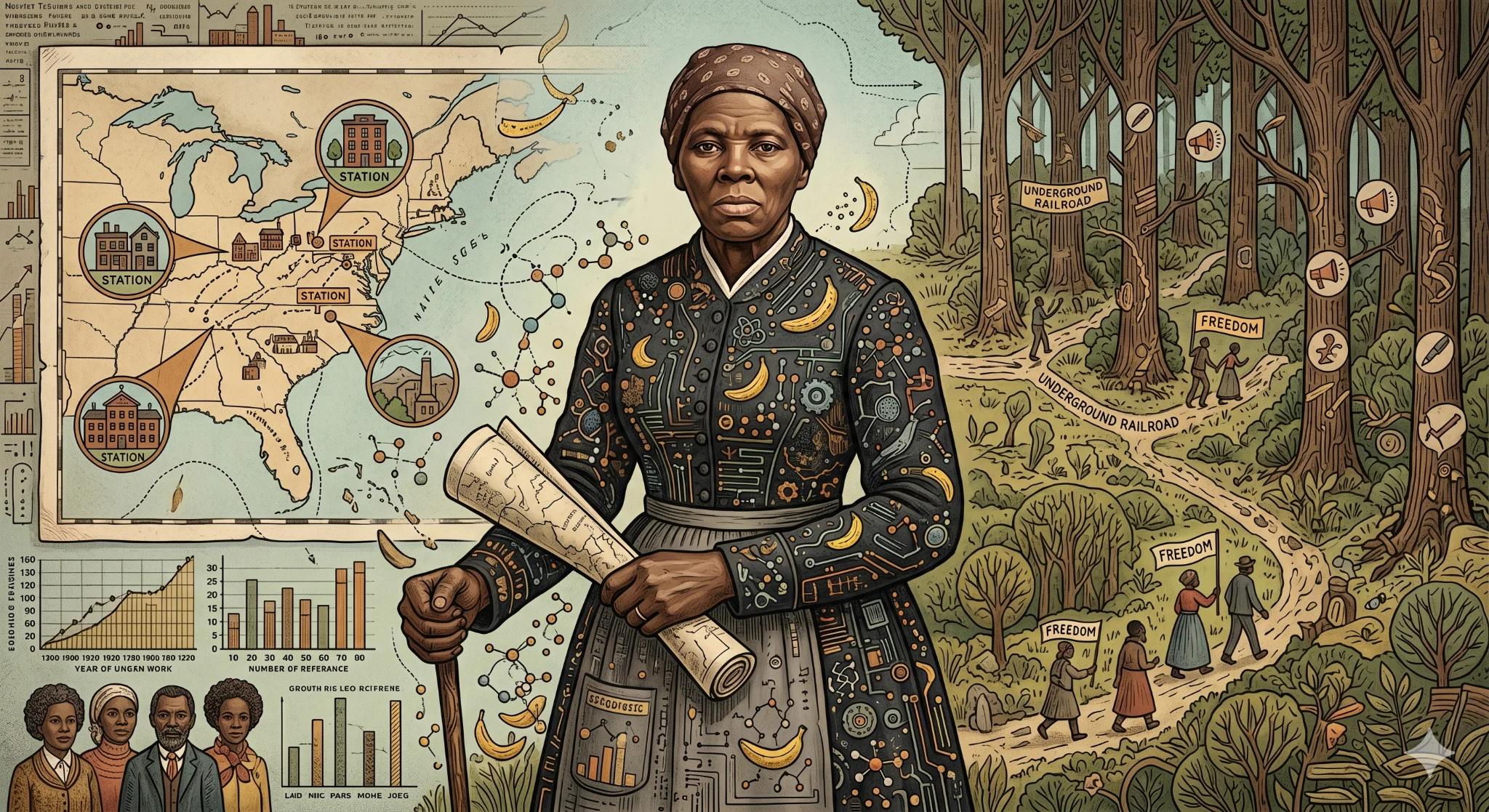
Born Araminta Ross on the Eastern Shore of Maryland
Harriet Tubman was born Araminta "Minty" Ross around 1822 on the Eastern Shore of Maryland. She was one of nine children born to Harriet "Rit" Green and Ben Ross, both enslaved. From childhood she was hired out to neighboring farms, where she suffered violent abuse. At around 12, she was struck in the head by a two-pound lead weight thrown by an overseer at a fleeing enslaved man — an injury that caused narcoleptic seizures for the rest of her life, episodes that she and others interpreted as divine visions.
In 1844 she married John Tubman, a free Black man. When rumors spread that she and her brothers might be sold further south — a common threat used to terrorize enslaved people — she decided to flee. Her husband refused to go and threatened to report her. She left anyway, alone, in September 1849.
Thirteen Missions. Zero Losses.
Tubman reached Philadelphia by following the North Star and navigating a network of safe houses. She then did something that no one expected: she went back. Between 1849 and 1860, she made approximately 13 return trips into Maryland, guiding around 70 people to freedom — including her parents, brothers, and other family members.
"I never ran my train off the track and I never lost a passenger."
She operated in fall and winter when nights were long. She used the Saturday-to-Monday departure window when slaveholders couldn't post notices until Monday. She carried a gun — both for protection and, reportedly, to prevent hesitant passengers from turning back and compromising the group. Slaveholders posted bounties as high as $40,000 for her capture. They never came close.
The Fugitive Slave Act of 1850 meant that escaped enslaved people were not safe even in Northern states — she routed her passengers all the way to Canada, adding hundreds of miles to each journey.
Spy, Scout, and Military Commander
During the Civil War, Tubman served the Union Army as a spy, scout, and nurse in South Carolina. Her knowledge of covert travel, her networks of informants, and her ability to move through hostile territory made her invaluable to Union intelligence operations.
On June 2, 1863, she guided Colonel James Montgomery and 150 Black Union soldiers up the Combahee River in South Carolina, navigating around Confederate torpedoes she had located through her intelligence network. The raid liberated more than 700 enslaved people in a single night — the first U.S. military operation planned and led by a woman. She received no official recognition or pay for this service for decades.
Suffragist and Community Builder
After the war, Tubman settled in Auburn, New York, where she had established her parents. She remarried in 1869 (John Tubman had remarried after she left and later died in a violent altercation). She worked with Susan B. Anthony and the suffrage movement, arguing that the fight for Black freedom and the fight for women's rights were the same fight.
She spent the last years of her life running a home for elderly African Americans in Auburn, which she donated to the AME Zion Church in 1903. She died on March 10, 1913, reportedly telling those gathered around her: "I go to prepare a place for you." She was given a military funeral.
The U.S. government took until 2016 to announce she would appear on the $20 bill — a decision subsequently delayed for years. The woman who served the Union as a military commander received her pension only after decades of appeals, at $20 a month, in 1899 — thirty-six years after the Combahee River raid.