1441
First documented kidnapping
12
People taken in first raid
367 yrs
Until U.S. ban on import trade
In 1441, a Portuguese explorer named Antão Gonçalves sailed to the West African coast near present-day Mauritania and kidnapped twelve people — the first documented act of European slave raiding in Africa. He brought them back to Portugal as a "gift" to Prince Henry the Navigator. Within a decade, Portugal had established a systematic trade. By 1444, the first large-scale public sale of enslaved Africans in Europe was held in Lagos, Portugal — an auction of 235 people described by a Portuguese chronicler as a scene of "wailing and weeping."
The Portuguese framing was religious: enslaving Africans was presented as saving pagan souls. The economic reality was simpler. West Africa had gold, ivory, and now — people Portugal could commodify. The ideology followed the profit motive. Within fifty years, the Portuguese had built a permanent fort on the West African coast designed specifically for holding enslaved people before shipment.
The papal sanction
In 1452, Pope Nicholas V issued the papal bull Dum Diversas, granting Portugal the right to "attack, conquer, and reduce to perpetual slavery" any non-Christians. In 1455, Romanus Pontifex extended this to all of Africa. The Catholic Church provided the legal and moral framework for the transatlantic slave trade before it had fully begun.
400 yrs
In operation as slave holding fort
30,000+
People held there at peak capacity
Elmina Castle — built by Portugal in 1482 on the coast of present-day Ghana — was the first permanent European structure built south of the Sahara in sub-Saharan Africa, and its primary purpose was the holding and shipping of enslaved people. It was not unique: by the 17th century, over 40 slave trading forts lined the West African coast, operated by Portugal, England, Denmark, the Netherlands, and Sweden.
The architecture of Elmina was deliberate. The "door of no return" opened directly onto the sea. Enslaved people were held in underground dungeons — packed beyond capacity, in darkness, in their own waste — for weeks or months before being loaded onto ships. The Portuguese governor's chapel was built directly above the dungeons. The cross and the dungeon shared a foundation. The Dutch seized Elmina in 1637. The British took it in 1872. It operated as a slave processing facility for nearly 400 years.
20–23
People in the first documented arrival
1640
Virginia court first rules Black servitude permanent
1662
Virginia law: children inherit mother's status (partus sequitur ventrem)
In August 1619, a ship called the White Lion arrived at Point Comfort, Virginia, carrying "20 and odd" Africans taken by English privateers from a Portuguese slave ship en route to Mexico. They were sold to the governor and a planter for food. These were not the first Africans in the Americas — Spanish colonies had used African enslaved labor since the early 1500s — but this 1619 arrival marks the beginning of the American chain.
The legal architecture of American slavery was built over the following decades. In 1640, a Virginia court ruled that a Black servant named John Punch, who had run away with two white servants, would serve his master "for the time of his natural life" — while the white servants received only extended indenture. In 1662, Virginia passed the law of partus sequitur ventrem: the child follows the condition of the mother. This single law transformed enslaved women's bodies into property-generating machines: every child born to an enslaved woman was automatically enslaved, regardless of the father's status. It also meant slaveholders could profit from rape.
The legal construction of race
Before the 1660s, some Africans in Virginia were able to complete indenture terms and own land. After Bacon's Rebellion in 1676 — where poor white and Black laborers united against the colonial government — Virginia's elites systematically used law to separate Black and white laborers. Racial slavery was not natural. It was constructed, deliberately, to prevent class solidarity.
$14T+
Estimated value of enslaved labor (in today's dollars)
80%
Of British cotton imports came from U.S. slave states by 1860
40%
Of all wealth in the U.S. was held in enslaved people before the Civil War
The triangular trade was not a metaphor. It was a literal three-leg shipping route: European manufactured goods (guns, textiles, alcohol) were shipped to West Africa and exchanged for enslaved people. Those people were transported across the Atlantic to the Americas — the Middle Passage. In the Americas, their labor produced tobacco, sugar, cotton, and rice, which were shipped back to Europe. Each leg of the triangle generated profit. The system was self-financing.
The scale of wealth it created is difficult to comprehend. By the mid-1800s, enslaved people were the single largest asset class in the United States — worth more than all the country's railroads and factories combined. Cotton produced by enslaved laborers in the American South was the basis of British and American industrial capitalism. The mills of Manchester ran on Black labor. The banks of New York financed it. The insurance companies of Lloyd's of London insured the ships.
🌿
Tobacco (1600s)
Virginia's tobacco economy was built entirely on enslaved labor, financing colonial governance
🍬
Sugar (1600s–1800s)
Caribbean sugar plantations were the most brutal and profitable operations in the Americas
🌾
Cotton (1793–1865)
After the cotton gin, Southern cotton became 60% of U.S. exports; the global textile industry depended on it
12.5M
People transported in the slave trade
1.8M
Died during the Middle Passage crossing
36,000
Documented slave voyages (Trans-Atlantic Slave Trade Database)
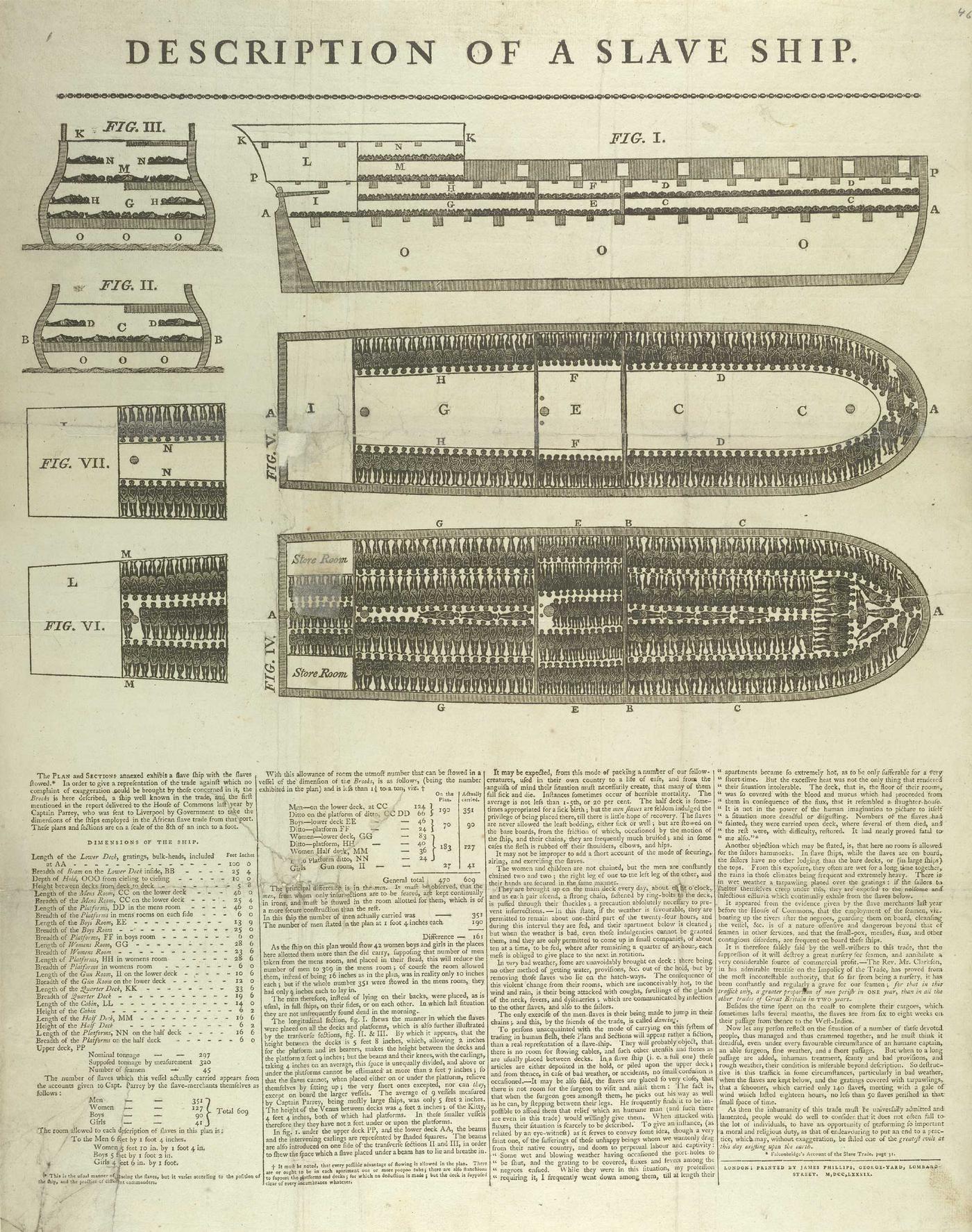
The Middle Passage refers to the second leg of the triangular trade route — the Atlantic crossing from West Africa to the Americas. The voyage took between six and eight weeks. Enslaved people were packed into the holds of ships in configurations that varied from "loose pack" to "tight pack" — terms that referred to how many bodies could fit in the available space. The Brookes diagram, published by British abolitionists in 1788, showed 454 people packed into a ship with only 16 inches of vertical clearance per person. The actual number carried was often higher.
Mortality on the Middle Passage averaged 12–15% per voyage. People died of dysentery ("the bloody flux"), smallpox, dehydration, and suicide. Jumping overboard was documented on so many voyages that ships began rigging nets along the sides. The Zong massacre of 1781 — in which the crew threw 132 enslaved people overboard alive to collect the insurance — was not prosecuted as murder. It was processed as an insurance claim dispute.
"The shrieks of the women, and the groans of the dying, rendered the whole a scene of horror almost inconceivable."
— Olaudah Equiano, The Interesting Narrative, 1789
4.9M
Transported to Brazil (largest share)
2.3M
To British Caribbean (Jamaica, Barbados)
389K
Directly to North America (3% of total)
The 12.5 million figure represents people who boarded ships. Of those, approximately 10.7 million survived to reach the Americas. Their destination was not primarily the United States: only about 3% were transported directly to North American colonies. The majority went to Brazil (the largest recipient of enslaved Africans in history) and to the Caribbean sugar islands, where mortality from brutal labor conditions was so high that planters relied on constant "resupply" from Africa rather than the natural growth of the enslaved population.
The United States was different in one significant way: the enslaved population grew through natural increase rather than constant importation. By 1860, there were approximately 4 million enslaved people in the United States — a population descended from that original 389,000. This was achieved through the domestic slave trade and the deliberate "breeding" of enslaved people, particularly after the U.S. formally banned the importation of enslaved Africans in 1808 — which did not end slavery; it merely shifted the market from Africa to the domestic South.
The 1808 ban did not end slavery
When the U.S. banned the international slave trade in 1808, the domestic slave trade expanded dramatically. Between 1820 and 1860, approximately 1 million enslaved people were sold from the Upper South (Virginia, Maryland) to the Deep South (Mississippi, Louisiana, Alabama) — separating families, building new fortunes, and extending slavery's reach. The ban on importation created a domestic slave-breeding industry.
250+
Documented slave revolts in the U.S.
1791
Haitian Revolution begins — the only successful slave revolt in history
1834
British abolition — after 200 years of pressure and profit
Resistance to slavery was not exceptional — it was constant. On the Middle Passage, revolts aboard ships occurred on approximately 10% of documented voyages. In the colonies and the American South, over 250 slave revolts are documented. Enslaved people also resisted through daily acts: slowing work, feigning illness, sabotaging equipment, learning to read in secret, maintaining African cultural practices, and running away. The infrastructure of slavery — the patrols, the passes, the overseers, the Fugitive Slave Acts — existed because resistance required constant suppression.
The Haitian Revolution of 1791–1804 was the only successful large-scale slave revolt in history. Enslaved people in Saint-Domingue (now Haiti) defeated the French army, the Spanish, and the British, and established the first Black republic in the Western hemisphere. The United States refused to recognize Haiti's independence for 58 years. France demanded — and Haiti paid — 150 million gold francs in "reparations" to French slaveholders, a debt that was not fully paid off until 1947 and which kept Haiti in poverty for generations.
250 yrs
Of unpaid labor before Emancipation
$0
Reparations paid to formerly enslaved people
$3.5M
Compensated — paid to slaveholders (D.C. Emancipation Act, 1862)
When slavery ended in 1865, the United States paid reparations — to slaveholders. The District of Columbia Emancipation Act of 1862 compensated owners up to $300 per enslaved person. Formerly enslaved people received nothing. General Sherman's Special Field Order No. 15 — the "40 acres and a mule" policy — was issued in January 1865 and rescinded by President Andrew Johnson in the fall of that year. The land was returned to former Confederate slaveholders.
This is not ancient history doing nothing. It is recent history doing specific things. 250 years of free labor built the agricultural, financial, and industrial foundation of the American economy. The wealth generated by that labor passed entirely to white Americans — in the form of land, capital, and institutions. Formerly enslaved people entered the "free" economy with nothing. Every wealth metric, every health metric, every educational metric that shows a racial gap in the United States today begins with this arithmetic.
"Emancipation without reparations is not freedom — it is eviction."
— Ta-Nehisi Coates, paraphrasing the historical argument