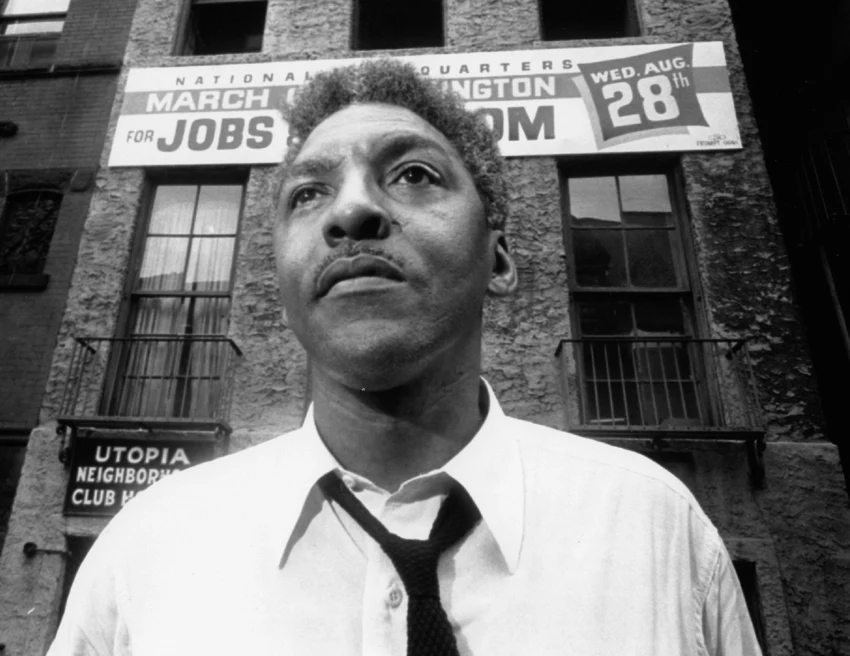
Who Rustin Was Before the Movement Found Him
Bayard Rustin was born in 1912 in West Chester, Pennsylvania, and raised by his Quaker grandparents. The Quaker tradition shaped everything: pacifism, direct action, the refusal of compromise with injustice. He was brilliant, musical (a trained tenor who performed professionally), and openly gay at a time when being so required extraordinary courage or extraordinary foolishness — often both at once.
In the 1930s he joined the Young Communist League, attracted to its anti-racism more than its politics. He left it by 1941. He joined the Fellowship of Reconciliation, a pacifist organization, and became a field secretary and organizer. He was arrested on a bus in 1942 — three years before Rosa Parks — for refusing to move to the back. He was beaten. He filed a report. It went nowhere. He had been practicing nonviolent civil disobedience for a decade before Montgomery.
In 1947, Rustin helped organize the Journey of Reconciliation — a bus trip through the South to test a Supreme Court ruling that segregation on interstate transportation was unconstitutional. The buses were attacked. Rustin was sentenced to 22 days on a North Carolina chain gang. He wrote a vivid account of the experience that helped bring national attention to conditions on Southern prison farms. It was a template for the 1961 Freedom Rides — which he had pioneered 14 years earlier.
He Taught King Nonviolence — Then Had to Work in the Shadows
When the Montgomery Bus Boycott began in 1955, Rustin went to Alabama. He found Martin Luther King Jr. — a young pastor whose house had just been bombed — in possession of several loaded guns, which King justified as necessary for self-defense. Rustin spent weeks with King, explaining Gandhi's philosophy: that nonviolence was not merely a tactic but a discipline, that it required absolute commitment in the face of violence, that its power came from moral witness and not just strategic effectiveness. King removed the guns.
Rustin helped draft early documents for the Southern Christian Leadership Conference. He introduced King to Stanley Levison, who became one of King's most trusted advisers. He connected the Montgomery movement to national and international networks of labor organizers, pacifists, and civil rights advocates. He was, functionally, King's strategic tutor — the person who translated the Gandhian nonviolence tradition for the American civil rights context.
"We need in every bay and community a group of angelic troublemakers. Our power is in our ability to make things unworkable. The only weapon we have is our bodies — and we need to tuck them in places so wheels don't turn."
— Bayard Rustin, speech, 1963But in 1960, Congressman Adam Clayton Powell — in a dispute with King's organization — threatened to publicly reveal Rustin's homosexuality unless he was removed from King's inner circle. King, under pressure from Powell and from other movement leaders who feared that Rustin's sexuality would be used to discredit the movement, distanced himself. Rustin was pushed out. Not by opponents of civil rights — by its leaders.
Six Weeks to Build the March on Washington
In June 1963, A. Philip Randolph — the elder statesman of the movement, head of the Brotherhood of Sleeping Car Porters — called on Rustin to organize a march on Washington. Rustin had six weeks. He had a staff of roughly 200 people, a borrowed office in Harlem, and 2,000 portable toilets to coordinate. He organized 250,000 people — the largest demonstration in American history at that point — into Washington, D.C. on August 28, 1963, without a single significant incident of disorder.
His logistics operation was extraordinary: 30 special trains chartered from New York alone, 2,000 buses coordinated from across the country, food distribution stations, a medical team, legal observers, crowd management protocols, a complete sound system, a program running to the minute. He produced a 23-page organizing manual. He distributed thousands of cheese sandwiches. The march ran without incident, on schedule, with the largest audience any civil rights event had ever seen.
On the day of the march, Rustin was kept off the main stage. He appeared briefly, at the end, to read a list of the march's demands. He was not in the official photographs that became iconic. When news cameras scanned the crowd and the stage, they landed on King, Lewis, Randolph, Wilkins — not Rustin, the man who had made it all possible. The FBI's COINTELPRO files on Rustin were thick; his sexuality was one of the tools it planned to use against him if he gained more prominence.
After the Movement: From Radical to Pragmatist
After the Civil Rights Act (1964) and Voting Rights Act (1965), Rustin argued for a shift in strategy: from protest to politics. In his landmark 1965 essay "From Protest to Politics," he argued that the legal victories of the movement were only the beginning — that structural economic inequality required a political coalition: labor, civil rights organizations, liberal Democrats, churches. He became head of the A. Philip Randolph Institute, a labor-civil rights organization, and spent the rest of his life building that coalition.
This shift brought him into conflict with Black Power advocates who saw his coalition-building as a sellout. His increasing conservatism on some issues — and his silence on Vietnam, under pressure from the AFL-CIO's pro-war leadership — cost him standing with younger activists. He was also, by the 1980s, a visible gay rights advocate — the man who had been erased for his sexuality eventually used whatever platform he had to speak openly about AIDS, about gay rights, about the link between all oppressions.
"The only weapon we have is our bodies, and we need to tuck them in places so wheels don't turn."
— Bayard RustinRustin died on August 24, 1987 — 60 years to the week after Sacco and Vanzetti, whose execution he had discussed in his Quaker household as a child. He had attended a humanitarian mission to Haiti in the final weeks of his life. He died of a perforated appendix at the age of 75. The New York Times gave him four paragraphs.
The Belated Recognition — and What the Erasure Means
On the 50th anniversary of the March on Washington, President Obama awarded Bayard Rustin the Presidential Medal of Freedom — posthumously. The same year, Obama publicly became the first sitting president to endorse same-sex marriage. The timing was not incidental. Rustin's rehabilitation has been gradual, fragmented, and incomplete. His name remains largely absent from K–12 curricula. Most Americans who know the March on Washington do not know his name.
The erasure of Rustin is not simply a personal injustice — it is a distortion of history. The standard narrative of the Civil Rights Movement centers charismatic male leadership: King, Lewis, Malcolm X. The infrastructure that made the movement's mass actions possible — the logistics, the coalition-building, the nonviolence training, the labor connections — came largely from people who could not be at the center: women like Ella Baker and Fannie Lou Hamer, and gay men like Bayard Rustin.
What Rustin's story exposes is the way the movement's respectability politics — necessary in some respects, corrosive in others — determined whose contributions could be acknowledged. The movement needed Rustin's genius. It could not afford, in its political judgment, to acknowledge it. That calculation cost Rustin his legacy. It cost the movement its full story. And it established a pattern: the radical, the queer, the female, the ideologically inconvenient — they do the work, and someone more acceptable gets the credit.