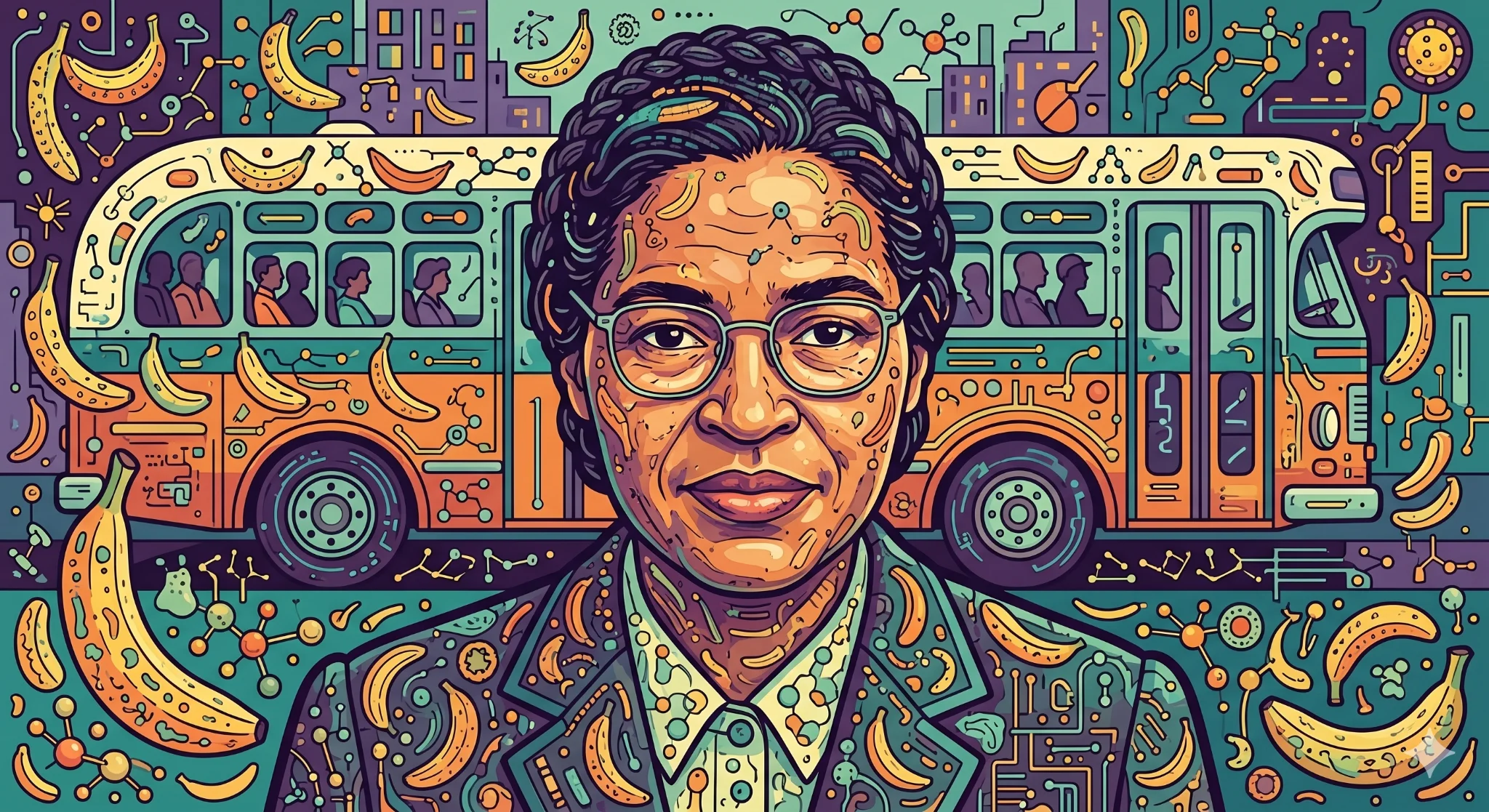
The Bus: What Claudette Colvin Actually Did
Claudette Colvin is 15 years old and a junior at Booker T. Washington High School when she boards a Montgomery city bus on March 2, 1955. She takes a seat in the middle section — the ambiguous zone where Black passengers were expected to yield to white passengers if the front section filled up. When the driver orders her to move, she refuses. She has been studying the Constitution in school. She knows her rights. "It's my constitutional right to sit here," she tells the driver. She does not move.
Two police officers drag her off the bus in handcuffs. She is charged with three offenses: violating the city's segregation ordinance, disturbing the peace, and assaulting a police officer. She is taken to an adult jail. Her pastor, the Reverend H.H. Johnson, bails her out. She is convicted on all three charges. She is fifteen years old.
This is not a spontaneous act. Colvin has been reading about civil rights in school and discussing bus segregation with her classmates. She is aware of how the system works. Her refusal is not impulsive — it is an act of deliberate principle by a young woman who understands exactly what she is doing.
Why the NAACP Chose Not to Build the Movement Around Her
The Montgomery NAACP and local civil rights leaders — including Rosa Parks herself, who was NAACP secretary and a trained organizer — are immediately aware of Colvin's arrest. They are actively looking for a test case to challenge bus segregation in court. Colvin's arrest is exactly what they need. But they decide she is not the right symbol.
The stated reasons, confirmed in later interviews and historical accounts: Colvin is a teenager, which makes her seem less credible to judges and juries. She is dark-skinned, in a movement that was painfully aware of colorism in public perception. Most critically: by the time NAACP leaders are evaluating her case, Claudette Colvin is pregnant — an unmarried, pregnant Black teenager in 1955 Alabama. NAACP leadership fears this will undermine the moral authority of any challenge they bring.
"They felt that I wasn't the right person — they said I was too young, too dark, and my pregnancy was an issue. I was not their 'perfect plaintiff.'"
— Claudette Colvin, in a 2005 interviewRosa Parks is arrested on December 1, 1955, nine months after Colvin. Parks is 42, married, light-skinned, employed as a seamstress at a department store, and a trained NAACP organizer. She is the movement's carefully chosen face. The Montgomery Bus Boycott launches four days after her arrest and runs for 381 days. It is one of the most successful civil rights actions in American history. Claudette Colvin's name is not in the press releases.
Browder v. Gayle: The Legal Case That Actually Won
Here is the irony: it is Claudette Colvin's case — not Rosa Parks' — that produces the legal victory ending bus segregation in Montgomery. In 1956, the NAACP files Browder v. Gayle, a federal challenge to Montgomery's bus segregation law. The plaintiffs are four Black women who were each arrested or mistreated on Montgomery buses. Claudette Colvin is one of the four.
The federal district court rules 2-1 that bus segregation is unconstitutional. The Supreme Court affirms the ruling in November 1956. The Montgomery Bus Boycott ends not because the city relents, but because the courts strike down the segregation law — in a case that rests substantially on Colvin's arrest. The textbooks attribute the legal victory to Rosa Parks. Browder v. Gayle is rarely taught.
Erasure, Obscurity, and a Very Late Reckoning
In 1958, Claudette Colvin moves to New York City, in part to escape the climate of threat and social stigma in Montgomery. She works as a nurse's aide for decades — a private life, far from the movement she helped launch. She is largely unknown to the general public until journalist Phillip Hoose publishes a young-adult biography of her in 2009: Claudette Colvin: Twice Toward Justice. It wins the National Book Award. Colvin is 70 years old when the book comes out.
In 2021, a French court expunges her 1955 juvenile criminal conviction — 66 years after the fact. Her arrest record, which had followed her for six decades, is cleared. She is 82 years old. She outlives the charge that was used to dismiss her.
Her story is not a story of bitterness. In interviews, Colvin has been clear-eyed rather than resentful — she understands why the movement made the choices it made, even as she names the calculus honestly. What her story illuminates is the machinery of which stories get told, and how those choices are made not by history but by strategists operating under pressure, making calculations about which Black body would be most acceptable to white judges, white juries, and white newspaper readers.
What Colvin's Story Teaches That Rosa Parks' Story Doesn't
Rosa Parks' story, as taught in schools, is a story of spontaneity and individual moral courage: a tired woman who refused to move. That story is false — Parks was a trained organizer, her arrest was strategic, the boycott was prepared — but even the corrected version focuses on the individual. Claudette Colvin's story forces a different set of questions: Who gets to be a hero? Who gets to be a symbol? Who is "respectable" enough to represent the cause?
The answers in 1955 were: not a dark-skinned teenager. Not an unmarried pregnant girl. Not someone whose body couldn't be made to represent the idealized victim of injustice that white moderates would accept. The civil rights movement, in choosing its public face, reproduced the very hierarchies — of color, class, gender, age, and respectability — that it was fighting to dismantle.
That tension — between strategic necessity and the erasure it requires — is not unique to 1955. It recurs in every movement for justice: questions of whose story gets amplified, whose gets managed, and whose gets quietly set aside. Claudette Colvin is the name that makes you ask those questions.