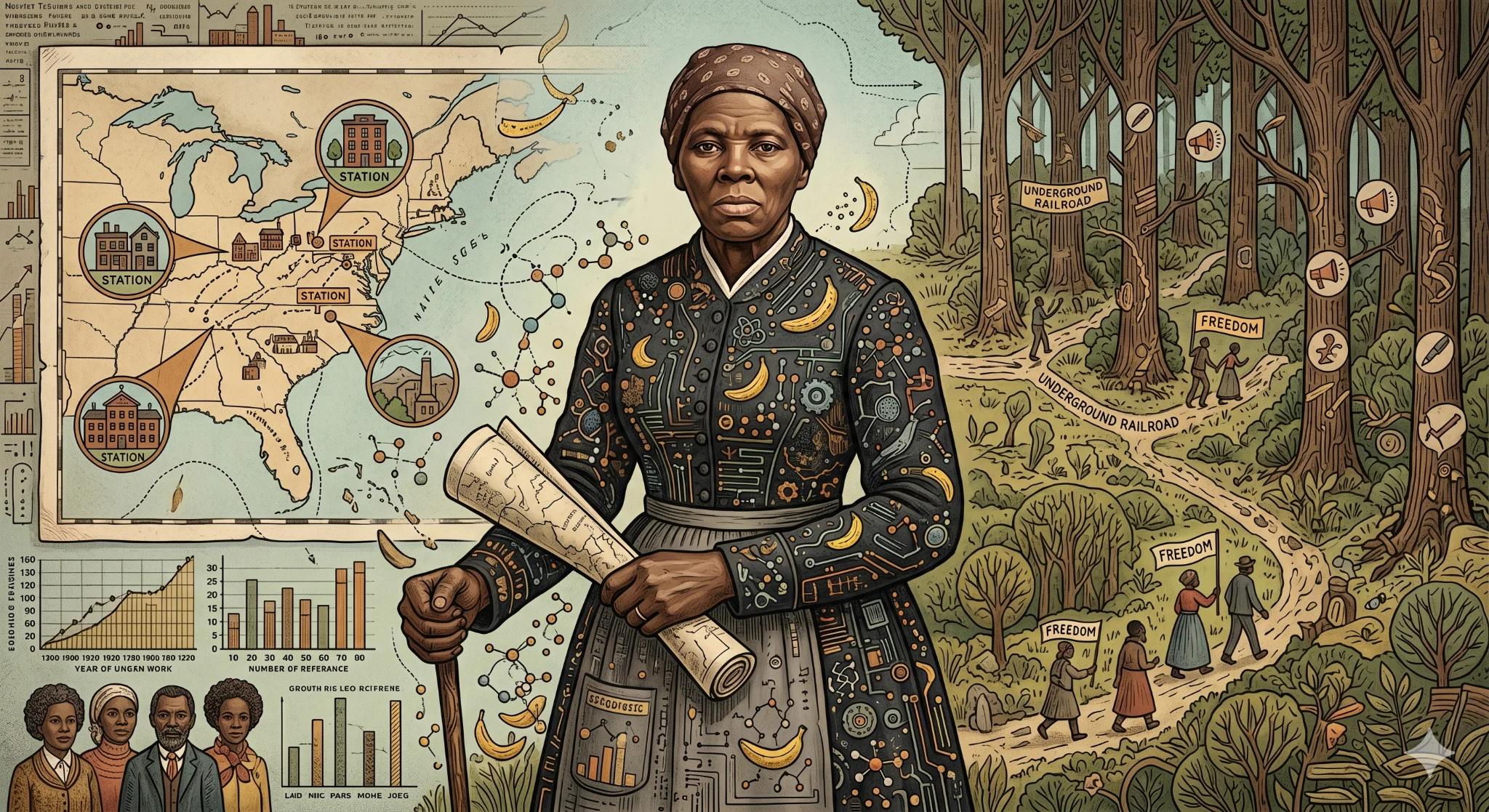
Before the Railroad: The Injury, the Visions, and the Decision to Run
Araminta Ross — later Harriet Tubman — is born into slavery around 1822 on a plantation on Maryland's Eastern Shore. As a child and teenager she does field work, then heavy labor. When she is approximately 12, an overseer throws a two-pound lead weight at another enslaved person; it hits Tubman in the head instead. The injury causes narcoleptic seizures and vivid visions for the rest of her life — episodes she cannot predict or control, during which she loses consciousness mid-activity. She later describes these visions as communications from God, giving her guidance. The injury that could have killed or incapacitated her becomes, in her interpretation, a source of spiritual direction.
In 1849, word spreads that the plantation's enslaved people will be sold south following their enslaver's death. Sale south — to the cotton and sugar plantations of the Deep South — meant a death sentence of brutal labor. Tubman makes the decision that will define her life: she runs. She walks approximately 90 miles north, at night, following the North Star and the network of safe houses that abolitionists call the Underground Railroad. She arrives in Philadelphia, free, alone, and immediately begins planning to go back.
The Railroad: Thirteen Missions, Zero Losses
Between 1850 and 1860, Tubman makes approximately 13 rescue missions into Maryland, freeing members of her family and others. She operates in winter, when long nights provide cover. She travels on Saturday nights, because newspapers did not publish runaway notices on Sundays. She uses a network of safe houses — Black and white abolitionists who hid fugitives in barns, cellars, and false-walled rooms. She carries a gun — not just for self-defense, but for a specific operational purpose: anyone who panicked and wanted to turn back was told, quietly, that dead people tell no tales. She never had to use the gun on her charges. She never lost anyone.
The Fugitive Slave Act of 1850 — which required Northern citizens to return escaped slaves and made Canada the only truly safe destination — escalated the danger of every mission. Tubman adapted: she began routing refugees to St. Catharines, Ontario, adding weeks to each journey. The reward for her capture, posted by Maryland slaveholders who knew someone was systematically liberating their human property, eventually reached $40,000 — equivalent to roughly $1.4 million today. She was never caught. She was never identified by name until after the Civil War.
"I never ran my train off the track and I never lost a passenger."
— Harriet TubmanThe Combahee River Raid: The First Woman to Lead an Armed U.S. Military Operation
During the Civil War, Tubman is recruited by the Union Army as a spy and scout in South Carolina. She builds a network of Black informants — enslaved people who provided intelligence on Confederate troop movements, supply routes, and the locations of torpedoes (mines) in the rivers. She is exceptional at this work for an obvious reason: she has been gathering intelligence and operating clandestine networks under hostile conditions for a decade.
On the night of June 2, 1863, Tubman guides three Union gunboats up the Combahee River through a Confederate mine field — using intelligence she had gathered — in a raid that destroys millions of dollars of Confederate supplies and liberates 700 enslaved people in a single night. She becomes the first woman in American history to lead an armed military raid. The U.S. Army would not formally commission a woman officer for another 85 years.
After the War: Poverty, Neglect, and 34 Years Without a Pension
After the war, Tubman returns to her home in Auburn, New York and lives in poverty for decades. She cares for her elderly parents. She takes in the sick and homeless. She is active in the women's suffrage movement — speaking at suffrage conventions alongside Susan B. Anthony and Elizabeth Cady Stanton. She donates land to establish a home for elderly Black people in Auburn. She does all of this without income from the government she served.
She applies for a military pension beginning in 1865. The government acknowledges her service. It declines to pay. She applies again. And again. Pension applications, affidavits from Union officers, letters from supporters — nothing moves the bureaucracy for 34 years. Congress finally approves a pension in 1899 — $20 per month, not for her own service but as the widow of her second husband, a Civil War veteran. She receives it for the last 14 years of her life. She dies in 1913 surrounded by friends and family. Her last words: "I go to prepare a place for you."
"I was the conductor of the Underground Railroad for eight years, and I can say what most conductors can't say — I never ran my train off the track, and I never lost a passenger."
— Harriet Tubman, 1896