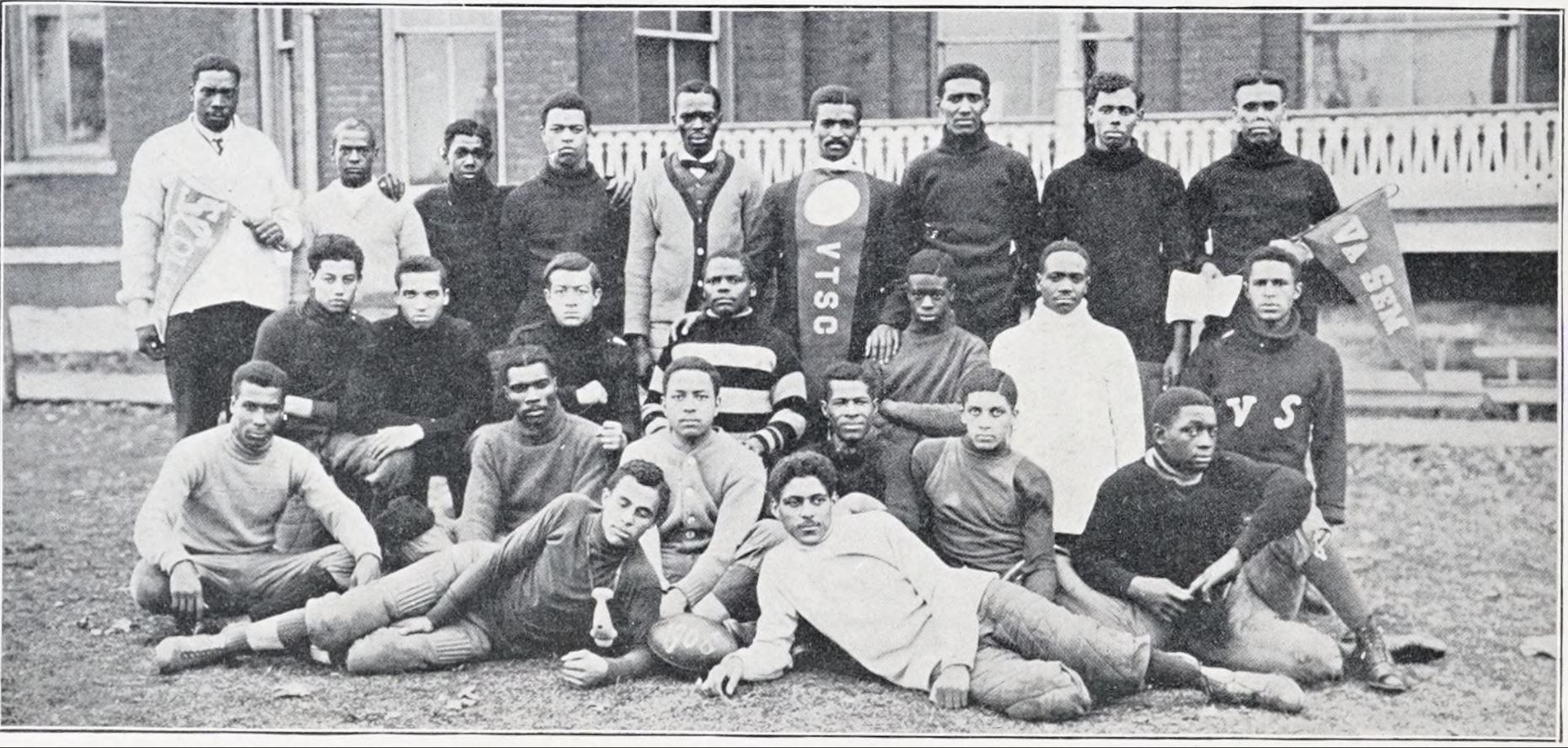
Closed Doors: Why HBCUs Exist
The first institution founded specifically for Black students was the Institute for Colored Youth, established in Philadelphia in 1837 by Quaker philanthropists. Lincoln University in Pennsylvania followed in 1854 — the first degree-granting HBCU. But the real wave came after the Civil War, when emancipation created an immediate crisis: four million newly free people with almost no access to formal education, and every white college in the South — and most in the North — refusing to admit them.
The federal government's Freedmen's Bureau (1865–1872) partnered with Northern missionary societies to establish dozens of schools across the South. The years 1865 to 1870 saw the founding of institutions that would define Black intellectual and professional life for the next century: Howard University (Washington D.C., 1867), Fisk University (Nashville, 1866), Morehouse College (Atlanta, 1867), and Hampton University (Virginia, 1868). These were not charity projects — they were emergency infrastructure built in the window of Reconstruction before white supremacist state governments reasserted control.
The premise was simple and brutal: Black Americans wanted education. White America denied it. Black Americans built their own institutions. What followed was a century-long project of institution-building under conditions of violence, legal suppression, and deliberate underfunding — one of the most consequential acts of collective self-determination in American history.
The Second Morrill Act: Separate and Deliberately Unequal
In 1862, the first Morrill Land-Grant Act created a system of public universities funded by federal land grants — institutions that became the flagship state universities across the country (Penn State, Michigan State, Ohio State, etc.). These universities were almost entirely white. Black students could not attend.
The Second Morrill Act of 1890 attempted to address this — but in a way that enshrined inequality rather than ended it. Southern states were required to either admit Black students to their land-grant institutions or create separate facilities for them. Every Southern state chose the second option. This created the network of public HBCUs — schools like Florida A&M, Alabama A&M, Southern University (Louisiana), and North Carolina A&T — that still exist today.
The catch: while the law required funding, it did not require equal funding. Southern states systematically channeled the vast majority of their education dollars to white institutions. A study of the era found that white land-grant colleges received on average 26 times more state funding per student than their Black counterparts. The buildings were inferior, the libraries sparse, the equipment minimal — but the institutions survived, and their faculties and students made extraordinary things happen anyway.
"The history of the American Negro is the history of this strife — this longing to attain self-conscious manhood, to merge his double self into a better and truer self."
— W.E.B. Du Bois, The Souls of Black Folk (1903); Du Bois was the first Black American to earn a PhD from Harvard and later taught at Atlanta University (HBCU)Jim Crow and the HBCU as the Only Path
After Reconstruction collapsed in 1877, Jim Crow laws systematically restricted Black life in every dimension — including education. Plessy v. Ferguson (1896) enshrined "separate but equal" as federal doctrine. In practice this meant Black students had exactly one option for higher education: an HBCU, and they had better pray the state had funded it.
In this context HBCUs became something more than colleges. They were the sole producers of Black doctors, lawyers, teachers, ministers, engineers, and leaders for an entire nation. Meharry Medical College (founded 1876, Nashville) and Howard University College of Medicine trained the overwhelming majority of Black physicians in America — because white medical schools would not admit Black students and white hospitals would not accept Black patients. Howard University School of Law was training the lawyers who would eventually dismantle Jim Crow itself: Charles Hamilton Houston — "the man who killed Jim Crow" — served as Howard Law's vice-dean and trained Thurgood Marshall, who argued Brown v. Board of Education.
HBCUs also became the incubator of the civil rights movement itself. Fisk University produced W.E.B. Du Bois and John Lewis. Spelman College in Atlanta — the first HBCU for Black women — produced Marian Wright Edelman and Alice Walker. Alabama State was ground zero for the Montgomery Bus Boycott. The sit-in movement that launched in 1960 was organized by students from North Carolina A&T. The institutional infrastructure for Black freedom was being built, quietly and relentlessly, inside the very walls that Jim Crow had tried to make inadequate.
The GI Bill, Desegregation, and the Surge That HBCUs Had to Absorb
When World War II ended, the GI Bill of 1944 promised college funding to every veteran. For white veterans, this meant the state flagship, the Ivy League, or any number of newly expanded public universities. For Black veterans — denied admission to white schools across the South and often in the North — it meant the HBCU or nothing.
Black veterans flooded HBCU campuses. Howard, Hampton, Morgan State, and others saw enrollment double and triple almost overnight, without corresponding increases in state funding. Classrooms were overcrowded. Dormitories overflowed. Faculty taught extraordinary course loads. The institutions were being asked to carry a demand that the entire American higher education system had produced — while receiving a tiny fraction of its resources.
Then Brown v. Board of Education arrived in 1954. The ruling that "separate but equal" was unconstitutional was a profound legal victory — but it had a complicated relationship with HBCUs. As desegregation slowly, imperfectly, resistingly opened white institutions to Black students, some predicted HBCUs would become obsolete. They were wrong. White resistance to integration — manifested in white flight, private academies, hostile campuses — meant that HBCUs remained the most welcoming, culturally affirming, and often most academically supportive option for many Black students. And the federal funding that was supposed to flow to HBCUs under desegregation plans often didn't.
Desegregation's Unintended Consequence: States Starve the Black Schools
The desegregation era produced a bitter irony for HBCUs. As white universities opened their doors (however reluctantly) to Black students, state governments began arguing that HBCUs were now redundant — and used that argument to justify cutting their funding, duplicating their programs at white schools, or attempting to merge and close them outright.
The most egregious cases were litigated under Adams v. Richardson (1973) and the long-running Ayers v. Fordice case in Mississippi, which reached the Supreme Court in 1992. In Mississippi, the state had maintained a dual system — massively funding white schools, minimally funding Black ones (Jackson State, Alcorn State, Mississippi Valley State) — for decades after Brown. The Supreme Court ruled the state must eliminate vestiges of segregation, but the remedy remained contested for another decade. Mississippi paid $503 million in HBCU enhancement funds under a 2002 settlement — partial compensation for a century of deliberate underfunding.
Even more damaging in the long run was program duplication: states would establish the same programs at nearby white institutions, drain enrollment from HBCUs, and then use the enrollment decline as justification for further cuts. It was a self-fulfilling cycle of disinvestment — one that paralleled what federal policy had done to Black neighborhoods through redlining, and to Black schools through property-tax funding formulas. The mechanism was always the same: create the conditions for failure, then blame the institution for failing.
The Achievement Paradox — and the Ongoing Attack
Today there are approximately 101 accredited HBCUs in the United States, enrolling roughly 10% of all Black college students. By almost every metric of professional output, they punch far above their weight:
The list of HBCU alumni reads like a who's who of Black American achievement: Thurgood Marshall, Martin Luther King Jr., Kamala Harris, Toni Morrison, Oprah Winfrey, John Lewis, Spike Lee, Samuel L. Jackson, Taraji P. Henson, Chadwick Boseman. These are not coincidences — they are the product of institutions that were designed, from the beginning, to develop Black talent that a racist society was determined to suppress.
Yet HBCUs continue to face structural disadvantages that trace directly to their history. Endowments are a fraction of comparable white institutions' — the result of a century of state underfunding during the wealth-building years of American higher education. Howard University's endowment is roughly $800 million; Harvard's is $53 billion. Facilities are older. Deferred maintenance is higher. Federal HBCU capital financing programs — such as the HBCU Capital Financing Program — have never been funded at a level adequate to close the gap.
"HBCUs weren't created because Black people wanted to be separate. They were created because America would not let us in."
— Michael Eric Dyson, Georgetown University professor and Morehouse alumnusMost recently, the broader political attack on diversity, equity, and inclusion programs has specifically targeted HBCUs. In 2025, the Trump administration's executive orders restricting DEI programs raised immediate questions about HBCU-specific federal grant programs, and several states moved to restrict or audit HBCU funding under anti-DEI legislation — an attempt to reframe institutions created by exclusion as themselves exclusionary. The chain from the 1837 founding to today's political battles is direct and unbroken.