First: The World Looked Nothing Like This
Before humans existed, before dinosaurs went extinct, all of Earth's landmasses were joined into a single supercontinent called Pangea. Understanding where the continents came from helps explain why humans had to migrate — and how remarkable it is that they did.
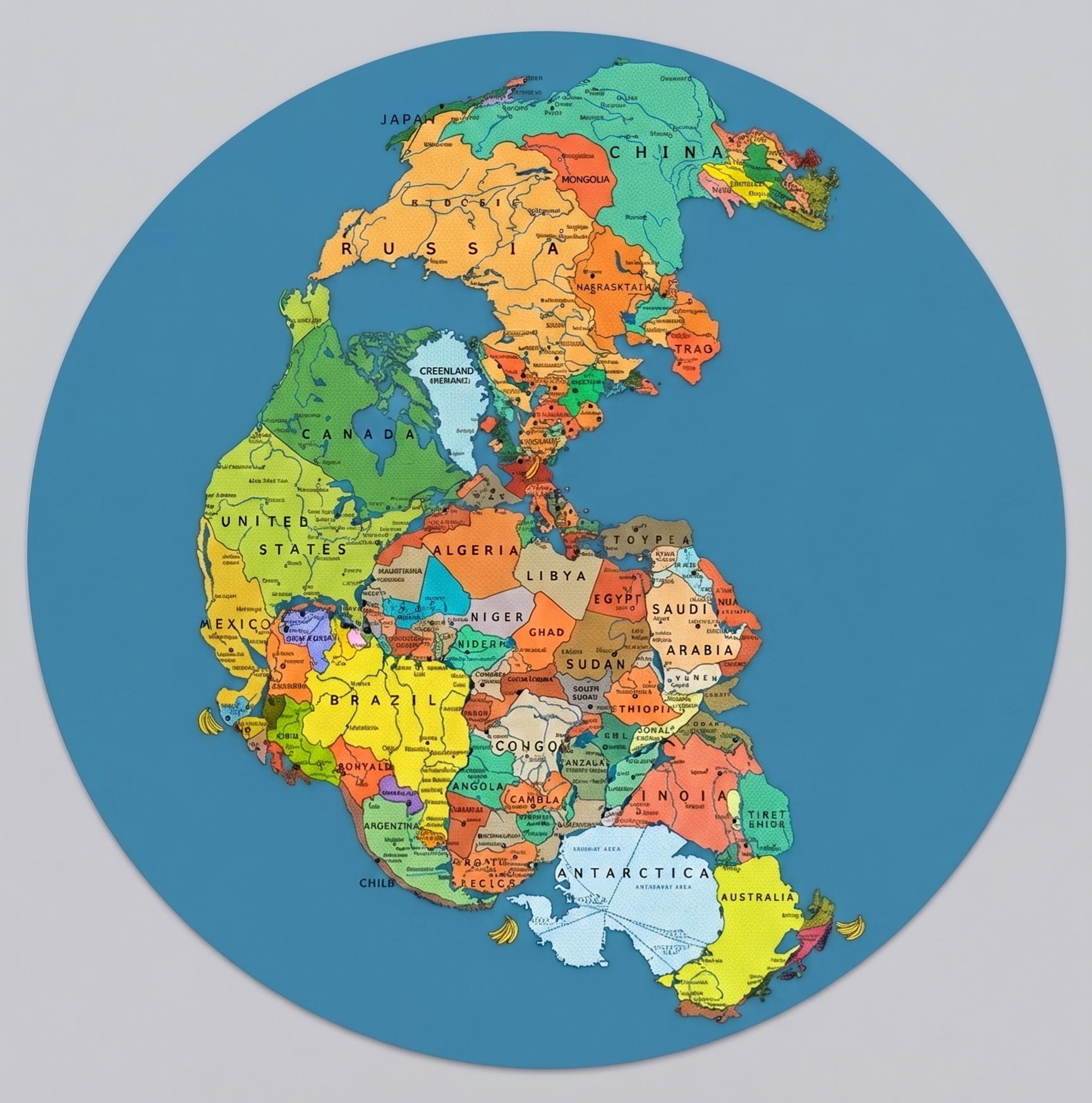
Simplified representation of Pangea (~335–175 million years ago). Dashed gold line shows where Africa and South America will eventually separate. Humans do not exist yet — Homo sapiens are still 295 million years in the future.
Pangea: The World Was One Continent
Long before the first human being drew breath, the Earth's continents were locked together in a single supercontinent called Pangea. If you could stand on it and walk in any direction, you could reach any landmass on Earth without crossing an ocean. There was no Atlantic Ocean. Africa and South America were pressed together. India was adjacent to Antarctica. Europe and North America were fused at the north.
Starting around 175 million years ago, Pangea began to fracture and drift apart — a process driven by the movement of enormous tectonic plates beneath the Earth's crust. Gondwana (the southern supercontinent) split into Africa, South America, Antarctica, Australia, and India. Laurasia (the northern supercontinent) split into North America, Europe, and Asia. The Atlantic Ocean opened. The Indian Ocean formed. Over millions of years, the continents drifted to approximately where they are today.
By the time the first human ancestors appeared in Africa roughly 7 million years ago, the continents were already in roughly their modern positions. The oceans between Africa and the rest of the world were real barriers. To reach Europe, Asia, Australia, or the Americas, humans would eventually have to cross water, traverse ice, or walk thousands of miles across land routes that no longer exist in the same form.
Homo Sapiens Evolve in Africa — And Stay There for a Quarter Million Years
The species that would eventually populate every continent on Earth first appeared in Africa approximately 300,000 years ago. The oldest known Homo sapiens fossils — found at Jebel Irhoud in Morocco (2017 discovery) — date to at least 315,000 years ago. Slightly later fossils from the Omo Kibish site in Ethiopia (~195,000 years ago) and the Herto skulls (~160,000 years ago) show fully modern anatomy.
For the first 250,000 years of human existence, Homo sapiens lived entirely within Africa. During this time, our ancestors were not idle or primitive. They developed complex tool technologies (the Middle Stone Age), symbolic behavior including personal ornaments and ochre pigment use, long-distance trade networks across hundreds of miles, and diverse cultural traditions across different African environments — from rainforests to savannas to coastlines.
"For the first 95% of human history, all human beings were African. The world began — and for an extraordinarily long time, remained — in Africa."
— Richard Leakey, paleoanthropologistThe Great Migration: A Small Group Leaves Africa and Becomes Every Non-African Person Alive Today
Around 60,000 to 70,000 years ago, a relatively small group of Homo sapiens — genetic estimates suggest somewhere between 1,000 and 10,000 people — crossed from the Horn of Africa into the Arabian Peninsula. Likely they walked across a land bridge exposed by lower sea levels during the last Ice Age, or crossed the narrow strait at the southern end of the Red Sea (the Bab-el-Mandeb, which may have been as little as 10 miles wide).
Every non-African person alive on Earth today descends from that single migration event. This is the scientific consensus, confirmed independently by mitochondrial DNA analysis, Y-chromosome studies, and whole-genome sequencing across thousands of populations worldwide. The genetic evidence is unambiguous: genetic diversity decreases the farther you move from Africa, exactly as you would expect if populations were founded by small groups breaking off from larger ones over successive generations.
Earlier migrations of Homo sapiens out of Africa (dated to around 120,000 years ago) appear to have died out or been absorbed without contributing significantly to modern populations. The 60,000–70,000 BCE migration is the one that counts: it is the genetic foundation of every non-African person who has ever lived.
Asia and Australia: The First Continents Reached
From the Arabian Peninsula, some groups moved east along the southern coast of Asia — what researchers call the southern coastal route. Tracing the shoreline (which provided reliable food from the sea), these populations reached South Asia within a few thousand years of leaving Africa. From there, groups continued east into what is now Southeast Asia.
The most remarkable early migration is to Australia. Around 50,000 years ago — possibly as early as 65,000 years ago based on some disputed evidence — humans crossed open ocean to reach Australia. At the time, sea levels were lower and some of the gaps were shorter, but a minimum of 90 km of open water still had to be crossed. This makes Aboriginal Australians among the first maritime navigators in human history — and their cultures among the oldest continuous cultures on Earth.
Other groups moved north from the Middle East and Central Asia into East Asia, eventually populating China, Japan, Korea, and the islands of the Pacific over the following tens of thousands of years.
Europe: Arriving to a Continent Already Occupied by Neanderthals
Groups moving northwest from the Middle East reached Europe approximately 45,000 years ago. Europe was not empty. It was home to Neanderthals — a distinct human species (Homo neanderthalensis) that had lived in Europe and western Asia for at least 400,000 years. Neanderthals were not primitive brutes; they buried their dead, cared for their sick and injured, and made tools and possibly art.
What happened next is written in our DNA. Modern humans and Neanderthals did not simply coexist — they interbred. Today, people of non-African descent carry approximately 1–4% Neanderthal DNA. By around 40,000 years ago, Neanderthals had disappeared as a distinct species — whether through competition, disease, absorption into modern human populations, or some combination of all three remains debated.
"When modern humans arrived in Europe, they didn't encounter a clean slate. They met people who had been there for hundreds of thousands of years. Some of those people are still in us."
— Svante Pääbo, Nobel Prize in Physiology or Medicine, 2022 (for Neanderthal genome research)The Americas: The Last Major Continents Reached, Via a Land Bridge That No Longer Exists
The Americas were the last major landmasses populated by Homo sapiens. During the last Ice Age, sea levels were significantly lower — enough to expose a wide land bridge, called Beringia, connecting what is now Siberia to what is now Alaska. This was not a narrow crossing; at its widest, Beringia may have been 1,000 miles from north to south — an entire continent-sized landmass that has since been swallowed by rising seas.
Groups who had migrated from Africa through Asia into Siberia crossed Beringia and entered the Americas, likely following herds of large game. By 15,000 years ago, humans were in North America. By 12,000 years ago, they had reached the southern tip of South America — Tierra del Fuego — completing the human occupation of every habitable landmass on Earth. The entire journey from Africa to the bottom of South America took roughly 50,000 years.
Some researchers argue for an even earlier arrival in the Americas — possibly via coastal routes using boats — with some sites suggesting human presence as early as 30,000 BCE. The debate continues. What is not debated is the origin: all Indigenous people of the Americas ultimately descend from African ancestors, via a migration through Asia and Siberia.
What This Means: Race Is Not Biology — It Is Geography and Time
The physical differences between human populations — skin color, eye shape, hair texture, nose shape — emerged over roughly the last 60,000 years, as small isolated populations adapted to different environments. Darker skin evolved in equatorial regions where UV radiation is intense; lighter skin evolved at higher latitudes where producing Vitamin D requires more UV absorption. These are adaptations — responses to climate — not fundamental differences between types of people.
Genetically, any two humans share 99.9% of their DNA. The genetic differences within any one so-called "racial" group are larger than the average differences between groups. There is more genetic diversity within Africa than there is between Africa and the rest of the world combined — because Africa is where humans have lived the longest.
The concept of biological race — the idea that humanity is divided into distinct subspecies with meaningfully different capabilities — has no support in genetics, paleoanthropology, or evolutionary biology. Race is a social and political category, not a biological one. What exists is geographic ancestry, shaped by migration patterns that all trace back, within the last 300,000 years, to a single species in a single place: Homo sapiens in Africa.
"We are all Africans. Some of us just left earlier."
— Attributed to various geneticists and paleoanthropologistsThis is not a metaphor or a political statement. It is the literal, genetic, fossil-record truth. Every person reading this — whatever their nationality, ethnicity, or the color of their skin — is a descendant of African migrants. The history of "other countries all over the world" begins in Africa. It has always begun in Africa.