The A-Group: Nubia Builds Cities Before Egypt Has a Pharaoh
The people archaeologists call the A-Group build complex settlements along the Nile south of modern Aswan around 3500 BCE. They trade copper, ivory, gold, and ebony northward into pre-dynastic Egypt. They develop their own pottery traditions and burial practices — evidence of organized social hierarchy — before Egypt's first pharaoh, Narmer, unifies the kingdom around 3100 BCE.
This sequencing matters: Nubia does not emerge from Egypt's shadow. The two civilizations develop in parallel, competing and exchanging along the Nile. Egyptian texts from the earliest dynasties record trade expeditions south into Nubia — called Ta-Seti (Land of the Bow) — for gold, cattle, and enslaved people. For 1,500 years before the 25th Dynasty, the relationship is that of complicated equals.
Egypt periodically conquers and administers Nubia. Nubia periodically reasserts independence. The town of Kerma, built around 2500 BCE, is one of the largest cities in Africa — a walled urban center with a royal palace, specialized craft production, and a formal cemetery of monumental burial mounds. Egypt does not build Kerma. Kerma builds itself.
Kerma: Africa's First Urban Kingdom
Around 2500 BCE, the city of Kerma emerges as the capital of the first kingdom indigenous to sub-Saharan Africa. It is a fully planned urban center — walled, with a ceremonial core, a royal palace complex, specialized craft workshops, and a cemetery of enormous burial mounds called tumuli, some over 90 meters in diameter. The largest tumuli contain hundreds of sacrificed retainers buried alongside the king — evidence of a powerful, centralized state willing to mobilize enormous human and material resources for its rulers.
Kerma's economy runs on the same commodities that will define Nubian wealth for millennia: gold, ivory, cattle, ebony, and enslaved people. Egyptian texts describe Kerma as a formidable rival — not a subject people. During the Second Intermediate Period (c. 1650–1550 BCE), when the Hyksos from Western Asia occupied northern Egypt, Kerma allied with the Hyksos against Egypt, nearly destroying the Egyptian state in a two-front war. Egypt survived — barely.
"Kerma was not a proto-civilization on its way to becoming something else. It was a mature, independent state — as sophisticated in its own terms as anything in the contemporary Near East."
— Charles Bonnet, archaeologist, University of GenevaEgypt eventually destroyed Kerma around 1500 BCE under Pharaoh Thutmose I, who advanced deep into Nubia, sacked the city, and hung the body of the Kerma king upside down from the prow of his ship as he sailed back to Thebes. The brutality of the response tells you how seriously Egypt took the threat.
The Egyptian Occupation: Colonized, Taxed, and Deliberately Erased
Following the destruction of Kerma, Egypt occupies Nubia for nearly 500 years. The New Kingdom pharaohs — including Thutmose III, Amenhotep III, and Ramesses II — extract enormous tribute from the territory: gold above all else. Nubian gold funds the New Kingdom's monuments, its armies, and its diplomacy. Roughly 40% of the gold used in New Kingdom Egypt comes from Nubian mines.
Egypt administers Nubia through a viceroy called the King's Son of Kush — a title deliberately chosen to assert that Nubia is not a foreign territory but a possession of the pharaoh. Egyptian temples are built throughout Nubia — at Soleb, Sesebi, Abu Simbel — designed to project pharaonic power and suppress local religious identity. Nubian elites are brought to Egypt, educated in Egyptian culture, and returned home as loyal administrators. The children of Nubian chiefs grow up in the Egyptian court.
And yet Nubian identity survived. When the New Kingdom collapsed after 1070 BCE — undone by economic strain, civil war, and Sea Peoples invasions — Nubia reasserted itself. The colonial administration dissolved. A new Nubian kingdom began consolidating around Napata. The 500-year occupation had given the Kushites deep knowledge of Egyptian religion, architecture, and statecraft. They would use all of it — on their own terms.
The Kingdom of Kush: Napata, the Sacred Mountain, and the Rise of a New Power
By 900 BCE, Egypt has fragmented. The New Kingdom — the era of Ramesses II — is over. Egypt is split between competing dynasties, and the Libyan-descended 22nd and 23rd dynasties rule incompetently. Meanwhile, south of the Third Cataract of the Nile, a new Nubian kingdom is consolidating around the city of Napata, in the shadow of the sacred mountain Jebel Barkal.
The Kushites adopt Egyptian religious practices — worshipping Amun, building temples in Egyptian style, using hieroglyphics — but they are not imitators. They are sophisticated cultural consumers, selectively integrating Egyptian religious legitimacy while maintaining distinctly Nubian social structures. Their royal women hold formal political power. Their succession passes through female lines. Their burial traditions are their own.
"The Kushites didn't see themselves as Egyptian vassals learning from a superior civilization. They saw themselves as the true heirs of Egyptian tradition — purer than the Egyptians who had allowed foreign dynasties to corrupt the old ways."
— Timothy Kendall, archaeologist, Nubian ExpeditionKing Kashta moves north, establishing Kushite influence over Upper Egypt. His successor, Piye, completes what Kashta began — a full military conquest of Egypt that installs a Nubian dynasty on the pharaonic throne.
The 25th Dynasty: Nubian Pharaohs Rule the Largest Empire on Earth
In 747 BCE, Piye invades Egypt from the south and conquers the entire country, north to the Mediterranean coast. He is crowned pharaoh at the temples of Karnak and Memphis, conducting elaborate Egyptian coronation rituals with a precision that shocks the Egyptian priests — the Nubian king knows the old rites better than the Egyptians who had abandoned them.
Piye's 25th Dynasty rules Egypt for a century. His successors — Shabaka, Shebitku, Taharqa, and Tantamani — govern an empire stretching from the modern Sudan border to the Levantine coast, the largest political entity on earth at the time. Taharqa is the greatest of them: he builds temples from Kawa to Karnak, restores monuments throughout Egypt, conducts military campaigns in the Levant, and is mentioned in the Hebrew Bible (2 Kings 19:9) as the king who came to aid Jerusalem against the Assyrian siege.
The dynasty ends when the Assyrian Empire — fielding iron weapons and a professional army — invades Egypt with overwhelming force. The Kushites withdraw south to Napata, and later to Meroë. They do not disappear. The Kingdom of Kush continues for another thousand years, building pyramids and developing a unique writing system called Meroitic that has never been fully deciphered.
Meroë: An Iron-Age Industrial City With Its Own Writing System
After withdrawing from Egypt, the Kingdom of Kush relocates its capital to Meroë, a city on the eastern bank of the Nile that becomes one of the great industrial centers of the ancient world. Meroë sits at the junction of iron ore deposits and forests for charcoal — the two raw materials for iron smelting. The city produces iron tools and weapons in industrial quantities, exporting them across sub-Saharan Africa and into the Indian Ocean trade network.
Meroë develops its own script — Meroitic — adapted from Egyptian hieroglyphics but phonetically distinct. It is the first writing system indigenous to sub-Saharan Africa. Despite surviving on hundreds of inscriptions, it was not deciphered until 1910, and even now scholars can read the sounds but not always understand the meaning — the language it encodes remains largely unknown.
"The slag heaps at Meroë are so large that they were initially mistaken for natural hills by early European explorers."
— Peter Shinnie, archaeologist, excavations at Meroë, 1960sThe kingdom is also famous for its powerful queens — the Kandakes (often Latinized as "Candace"). The Kandake led armies personally. One Kandake — unnamed in the historical record but described in the Acts of the Apostles — sent a court official to Jerusalem, where he was baptized by Philip the Evangelist. Another Kandake reportedly fought and negotiated with the Roman Emperor Augustus, losing an eye in battle but securing a favorable peace treaty. These women are among the most powerful rulers of the ancient world.
The Kandakes: Queens Who Fought Rome and Won
The Meroitic Kingdom is unique in the ancient world for the formal political and military power held by its queens — the Kandakes (singular: Kandake, often Latinized as "Candace"). This was not ceremonial queenship. Kandakes commanded armies, led campaigns, and governed as co-rulers or sole rulers of the state. Multiple Kandakes are depicted on temple walls in full pharaonic regalia — wearing the double crown, wielding weapons, trampling enemies underfoot.
The most documented military confrontation involves an unnamed Kandake who fought the Roman Emperor Augustus Caesar around 24 BCE. Roman forces under Petronius had advanced into Kushite territory, sacking the city of Napata. The Kandake — described in Roman sources as a fierce one-eyed warrior queen — launched a counter-offensive that recaptured Roman-held positions and drove negotiations that resulted in a peace treaty entirely favorable to Kush. Rome agreed to return conquered territory and waive tribute payments it had demanded. This is one of the only instances in ancient history of a small African state negotiating a favorable peace with Rome from a position of military strength.
"The Candace came against him with many thousands of men... she was lame in one eye, but of a fierce countenance and masculine courage."
— Strabo, Geographica, c. 20 BCE, describing the Kandake's confrontation with RomeAmanirenas is the Kandake most historians now associate with the Roman conflict. Amanitore, who ruled alongside King Natakamani in the 1st century CE, is among the most frequently depicted rulers in Meroitic temple art — shown at equal or greater scale than her male co-ruler, striking enemies, and making offerings to the gods. In 2021, a team of archaeologists excavating a Meroitic pyramid found an iron scepter and ceremonial objects in a queen's burial chamber, adding new physical evidence to the historical record of Kandake power.
The Fall: Aksum Destroys Meroë and a Civilization Ends
By the 3rd century CE, the Kingdom of Kush is weakening. The causes are multiple: shifting trade routes as the Red Sea economy bypasses Nile valley intermediaries; environmental degradation from centuries of industrial-scale iron smelting that deforested the region around Meroë; internal political fragmentation; and the rise of a powerful rival to the southeast — the Kingdom of Aksum in modern Ethiopia.
Around 330–350 CE, the Aksumite King Ezana launched a military campaign against Kush. His trilingual victory inscription — carved in Ge'ez, Sabaean, and Greek and still standing today — records the campaign in detail: the Aksumite army advanced up the Nile, burned Kushite cities, captured cattle and people, and destroyed Meroë. The inscription describes Ezana giving thanks to his god — the Christian god, newly adopted — for the victory. The fall of Meroë to a newly Christian Aksumite king marks a civilizational pivot point in the entire Nile Valley.
The Kushite successor states — the Noba, the Blemmyes, and eventually the medieval Christian kingdoms of Nobatia, Makuria, and Alodia — continue in the Nile Valley for another thousand years, maintaining literacy and Christianity until the 14th–15th centuries CE. The story does not end with Meroë. But the coherent, continuous civilization that began with the A-Group in 3500 BCE effectively closes with Ezana's campaign — 3,000 years of unbroken African civilization along the Nile, most of it invisible to Western curricula.
The Erasure: How Archaeologists Credited Egypt for Nubia's Achievements
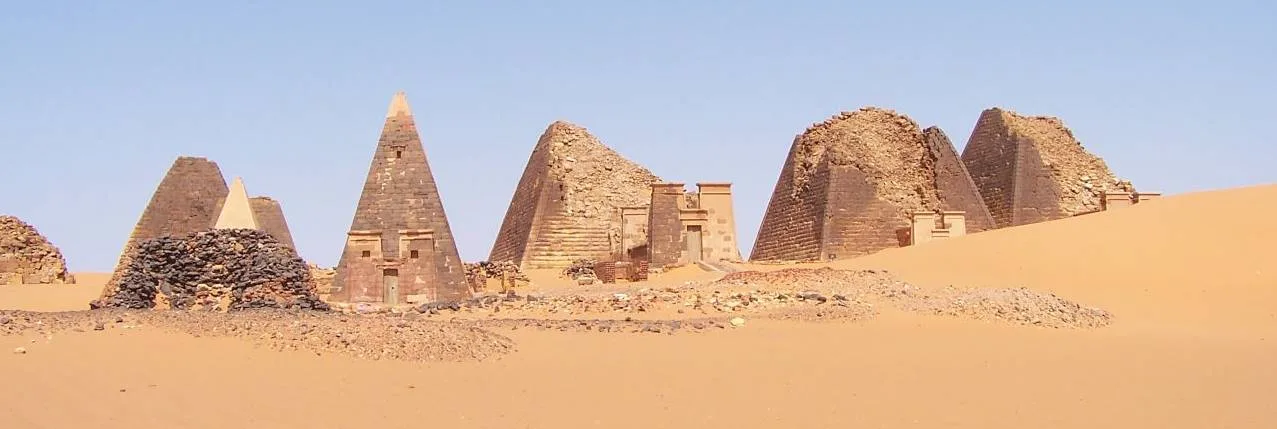
When European archaeologists first excavated Nubian sites in the 19th century, they operated under a predetermined conclusion: African people could not have built sophisticated civilizations independently. So they credited Egypt. Nubian temples built centuries after Egyptian influence had waned were described as "Egyptian-influenced." Nubian pyramids — steeper, more numerous, and structurally distinct from Egyptian ones — were described as "cruder imitations."
George Reisner, one of the most influential early 20th-century archaeologists of Nubia, explicitly argued that the 25th Dynasty pharaohs were not Nubians but Egyptians who had "gone native" — a conclusion driven entirely by his assumption that Black Africans could not have conquered Egypt. Later DNA and isotopic analysis confirmed what Nubian archaeologists had always argued: these were indigenous Nile Valley Africans.
The result is a curriculum paradox: students learn about Egypt extensively but learn almost nothing about Nubia, despite Nubia being older, despite Nubia having more pyramids, despite Nubia having its own writing system, and despite Nubians having literally ruled Egypt for a century. The omission is not random. It follows a consistent pattern: when African achievement is undeniable, it is attributed to non-Africans, minimized as derivative, or simply left out.