The Kouroukan Fouga: Mali's Constitutional Charter, 250 Years Before the Magna Carta
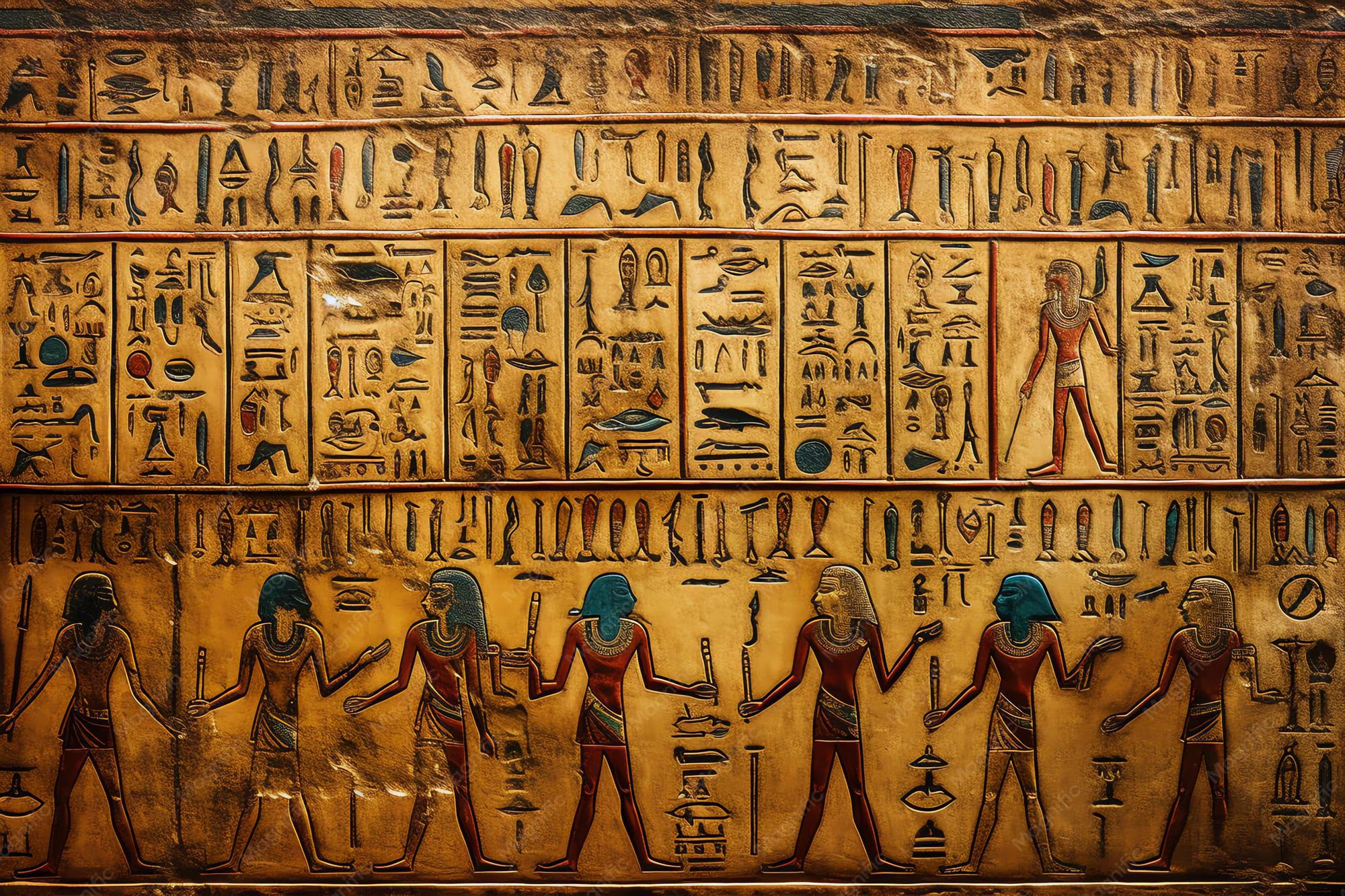
After defeating the Sosso king at the Battle of Kirina, Sundiata Keita convenes a great assembly of clan leaders at Kouroukan Fouga — the "Pact of Kouroukan Fouga" — around 1235 CE. The assembly produces a constitutional charter governing the Mali Empire: a formal, oral document establishing rules of governance, social relations, and rights.
The Kouroukan Fouga established: restrictions on slavery (only prisoners of war could be enslaved, not free persons), women's rights (women could not be insulted in public, certain property rights were protected), environmental protections (certain trees could not be cut, certain species not hunted), freedom of expression (griots — oral historians — were exempt from legal punishment for their speech), and clan governance rights (each of the empire's clans held defined roles in the state). The English Magna Carta was signed in 1215 CE — twenty years earlier. The Magna Carta protects the rights of barons from the king. The Kouroukan Fouga is more comprehensive.
The Kouroukan Fouga was transmitted orally for 800 years by Mande griots. It was formally transcribed in the 20th century. UNESCO recognized it as an Intangible Cultural Heritage of Humanity in 2009. When Western historians discuss the origins of human rights law, this document is rarely mentioned.
The Igbo Stateless Democracy: Governance Without a King
The Igbo people of modern southeastern Nigeria develop one of the most sophisticated examples of stateless democratic governance in human history. There is no king. There is no hereditary royal lineage. Instead, each village is governed by a council of elders — the Ohaneze — that makes decisions by consensus. Age grades (cohort-based civic groups organized by birth year) perform specific civic functions: building infrastructure, maintaining peace, running markets. The Ofo — a wooden staff representing ancestral authority — passes to whoever holds the community's moral confidence, not whoever has the most military power.
The Igbo also maintain the Aro Confederacy — a federated trading network organized around the Arochukwu oracle that mediates disputes between villages across a wide territory. The oracle's rulings function as binding arbitration between parties who would otherwise have no mechanism for resolving conflict across community lines. This is an African federal court system operating without a central state.
"The Igbo didn't need a king because they had something better: a system of distributed authority with multiple checks, consensus decision-making, and civic institutions that made coercive hierarchy unnecessary."
— Chinua Achebe, Things Fall Apart and historical essaysWhen British colonizers arrive, they cannot understand the Igbo political system because they are looking for a chief to co-opt. There is no chief. The British invent one — appointing "warrant chiefs" who have no traditional authority — producing confusion, resentment, and eventually the Women's War of 1929 (also called the Aba Women's Riots), one of the largest anti-colonial uprisings in Nigerian history, organized by Igbo women defending their market rights against British taxation.
The Oyo Empire: Checks and Balances, African Style
The Oyo Empire — a Yoruba state in modern Nigeria and Benin — develops a sophisticated constitutional system with explicit checks on royal power. The king (Alaafin) is not absolute. His power is constrained by the Oyo Mesi — a council of seven hereditary chiefs — and the Ogboni Society — a secret judicial society with the power to veto royal decisions and, in extreme cases, order the king's death.
When the Alaafin governs badly, the Oyo Mesi can present him with a symbolic calabash of parrot's eggs — a formal message that he has lost the council's confidence and must commit ritual suicide. This is not metaphorical. Several Oyo kings died this way. The system functions as a recall mechanism for an executive who has abused power — a constitutional check that predates Western parliamentary confidence votes by centuries.
The Ashanti Confederacy of modern Ghana operates on similar principles: the Asantehene (king) rules in consultation with chiefs of subordinate states, and his authority is symbolized by and contingent on possession of the Golden Stool — which is understood to contain the soul of the Ashanti people. The stool is not owned by the king. It belongs to the nation. A king who misused the stool lost legitimacy. When British Governor Sir Frederick Hodgson demanded to sit on the Golden Stool in 1900, the Ashanti people went to war. Not because the stool was a pretty chair. Because demanding to sit on it was declaring the right to own the nation's soul.
The Berlin Conference: 14 Countries Carve Africa. Zero Africans in the Room.
From November 1884 to February 1885, representatives of 14 European nations and the United States meet in Berlin to regulate European colonization of Africa. No African is present. No African is consulted. The continent is divided into spheres of influence on maps that its makers have never visited, drawing straight lines across mountains, rivers, and existing political boundaries without regard for the political systems those lines bisect.
The conference produces the General Act of the Berlin Conference, which establishes the principle of "effective occupation" — a colonial power must physically control a territory to claim it. This triggers a scramble: European powers race to establish military presence before rivals can. Within 30 years, 90% of Africa is under European colonial rule. The political systems that had governed the continent for centuries — the federations, the councils, the constitutional charters — are abolished, replaced by colonial administrations reporting to European capitals.
"The Berlin Conference didn't just divide Africa. It erased Africa — replacing centuries of political development with a system designed to extract resources for Europe."
— Chinua Achebe, The Education of a British-Protected ChildThe lines drawn at Berlin remain the borders of African nations today. The Organization of African Unity — at its 1963 founding — made the fateful decision to preserve colonial borders rather than redraw them along historical ethnic and political lines, fearing that border disputes would destabilize the newly independent states. The result: countries whose borders cut through ethnic groups, former enemies sharing national borders, and former political units divided across three or four countries. The dysfunction of post-colonial African governance is not African. It is the built-in dysfunction of borders drawn at Berlin for European administrative convenience.
The Legacy: Why "Africa Can't Govern Itself" Is a Colonial Artifact
The persistent Western narrative that Africa lacks the capacity for self-governance — that its post-independence instability proves some inherent deficiency — ignores everything in this thread. Africa had governance. Sophisticated governance. Constitutional governance. Governance with checks and balances, women's rights provisions, environmental protections, and federal arbitration systems. Colonization didn't bring governance to Africa. It destroyed the governance that was there and replaced it with extractive administrative systems designed to serve European capitals, then handed those systems to independence governments and called it decolonization.
The post-independence states that struggle most are often those where colonial powers left most abruptly, with least investment in transitional institutions — and where colonial-era borders created the most profound mismatches between political unit and social reality. The Democratic Republic of Congo, partitioned at Berlin and brutalized under Belgian rule, is not ungovernable because its people lack political capacity. It is ungovernable because it was designed to be ungoverned — designed as an extraction zone, not a state.
The recovery of pre-colonial African governance traditions is not nostalgia. It is historical evidence that governance capacity existed, was destroyed by a specific historical process, and can be rebuilt. The Kouroukan Fouga is still cited in Malian legal discourse. The Ubuntu philosophy is the foundation of South Africa's Truth and Reconciliation Commission. Igbo consensus decision-making models are studied in conflict resolution programs. The traditions didn't die. They are waiting to be remembered.