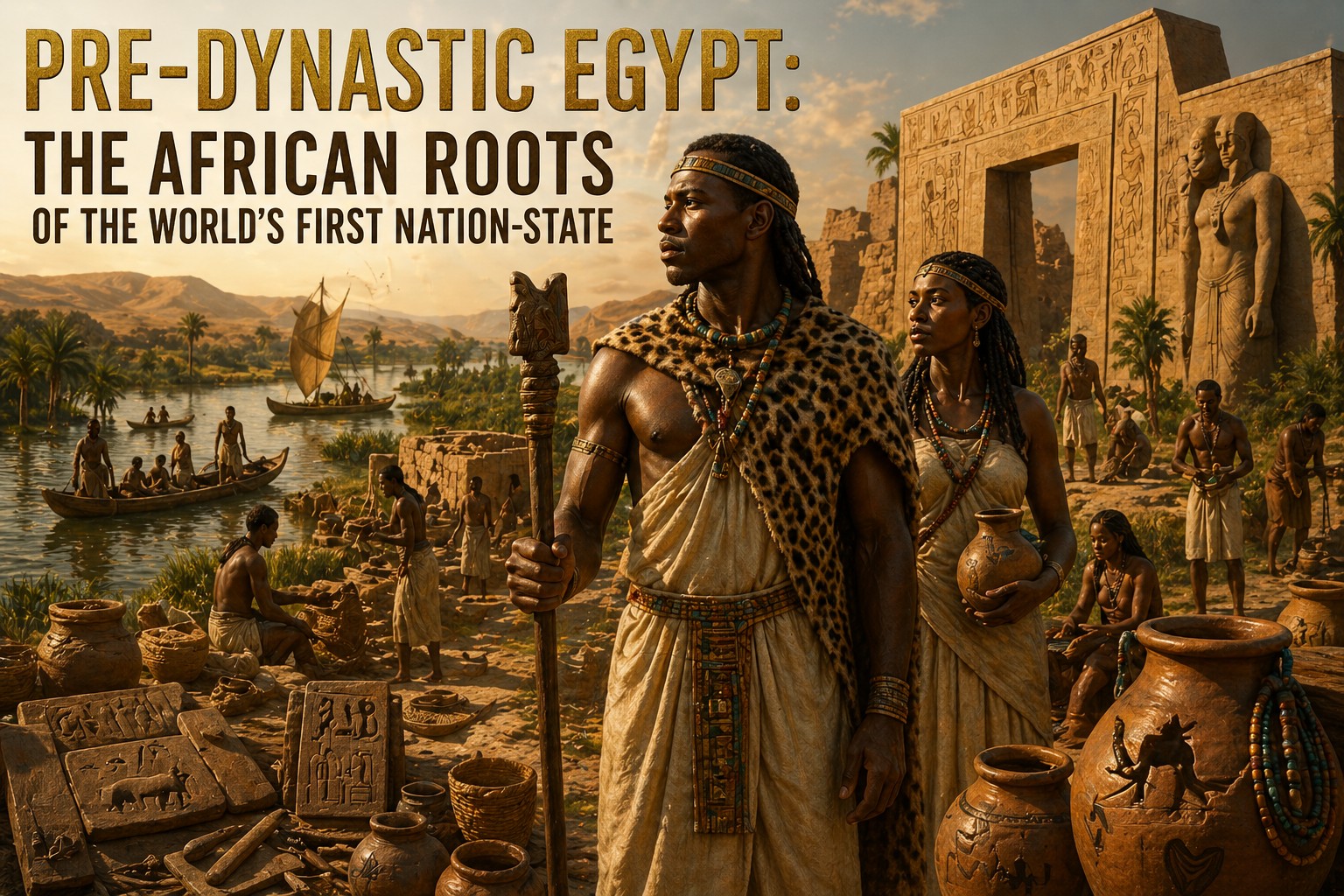
The Badarian Culture: The First Farmers of the Nile Valley
The Badarian culture (named for the site of Badari in Upper Egypt) represents the earliest known agricultural community in the Nile Valley, dating to approximately 5,000 BCE. Badarian people grow wheat and barley, herd cattle, and produce some of the finest pre-dynastic pottery found anywhere in Egypt — thin-walled, black-topped, burnished to a metallic sheen that later cultures never surpassed technically.
Badarian burial sites reveal a sophisticated society: the dead are buried with personal items — jewelry, cosmetic palettes, combs made from ivory and bone, small figurines. The grave goods indicate both social stratification (some burials are richer than others) and a belief in an afterlife — the cultural foundation on which Egypt's elaborate funerary tradition will later be built. The cosmetic palettes for grinding eye paint (kohl) found in Badarian graves are the direct ancestors of the ceremonial palettes — including the Narmer Palette — that mark the transition to dynastic Egypt 2,000 years later.
Skeletal analysis of Badarian individuals shows a population with sub-Saharan African physical characteristics — the same population type as modern Nile Valley Africans. The people building the foundation of Egyptian civilization are not "Mediterranean" or "Middle Eastern" people who later migrate into Egypt. They are indigenous Nile Valley Africans, with connections to Saharan and sub-Saharan populations, building something new in the particular ecological niche of the Nile flood plain.
Naqada I & II: Trade Networks, Craft Specialization, and the Proto-State
The Naqada culture (named for sites near modern Luxor) develops in Upper Egypt beginning around 4,000 BCE and represents a dramatic acceleration in social complexity. Naqada communities build larger settlements, develop specialized craft production (copper-working, lapis lazuli importation, fine pottery), and establish long-distance trade networks reaching into Nubia to the south, the Levant to the northeast, and across the Eastern Desert to the Red Sea coast.
The lapis lazuli in Naqada burials comes from Afghanistan — 3,000 miles away. This is not accidental contact. It is organized, sustained long-distance commerce operating 5,000 years ago, connecting East Africa to Central Asia through trade intermediaries. The cognitive and organizational capacity required to maintain such networks — across language barriers, ecological zones, and political territories — is substantial. It is present in pre-dynastic Egypt centuries before unification.
"Naqada II represents the clearest evidence that Egyptian civilization was not an import from Mesopotamia. The social complexity, the iconography, the trade networks — they develop indigenously in the Nile Valley from African roots."
— Fekri Hassan, archaeologist, UCLDuring the Naqada II phase (~3,500–3,200 BCE), the Nile Valley begins consolidating into larger political units. Regional chiefdoms absorb smaller communities. Certain sites — Hierakonpolis, Abydos, Naqada — develop into proto-urban centers with populations of several thousand people, monumental architecture, and evidence of early writing (symbols on pottery and ivory tags that will evolve into hieroglyphics). The state is forming. It will take another 400 years to fully arrive.
Hierakonpolis: The World's First City and the Invention of Egyptian Identity
Hierakonpolis — "City of the Falcon" — is the largest and most important pre-dynastic settlement in Egypt, with a population of perhaps 5,000–10,000 people by 3,400 BCE, making it one of the first true cities in human history. It has a planned brewery producing industrial quantities of beer (the oldest known large-scale brewery in history), a pottery district with purpose-built kilns, a temple precinct, and what appears to be a royal zoo — the oldest known zoo in the world, containing elephants, hippos, baboons, wildcats, and aurochs.
Most significantly, Hierakonpolis is where we find the first appearances of distinctly Egyptian iconography: the falcon god Horus (the patron deity of Hierakonpolis), the white crown of Upper Egypt, the imagery of the king smiting enemies that will define royal representation for 3,000 years. The visual language of Egyptian civilization does not appear at unification. It appears 400 years before unification, in this one city in Upper Egypt, among people working out what it means to be Egyptian.
The Painted Tomb at Hierakonpolis (Tomb 100, c. 3,200 BCE) contains the oldest known narrative wall painting in Egypt — predating the dynastic period by a century. It shows boats, battles, animals, and human figures in compositions that directly anticipate later Egyptian art. Egyptian visual culture is not invented at the moment of unification. It is the culmination of centuries of artistic development in Upper Egyptian cities.
The Unification: What Narmer Completes That Generations Built
When Narmer (also identified as Menes) unifies Upper and Lower Egypt around 3,100 BCE, he is not creating Egyptian civilization. He is completing a political process that has been building for centuries — consolidating under a single ruler the trade networks, agricultural systems, artistic traditions, religious institutions, and social hierarchies that pre-dynastic Egypt spent 2,000 years developing. The Narmer Palette — the ceremonial slate tablet that documents the unification — depicts Narmer wearing the crowns of both Upper and Lower Egypt, smiting enemies, and presiding over decapitated bodies. It is the first historical document of state power. But it is not the beginning of the story. It is the climax of a long one.
The Narmer Palette is also the earliest clear example of hieroglyphic writing used as a narrative tool — though the script had been developing for at least 200 years on pottery and administrative tags before this. Egypt invents writing independently of Mesopotamia, roughly simultaneously, using a completely different script tradition rooted in its own African pictorial heritage. The two earliest writing systems in the world appear in the same century — one in Mesopotamia, one in the Nile Valley — each developed independently from different cultural roots.
"Egypt did not receive civilization from Mesopotamia or Greece. Egypt gave civilization to Greece — and it built that civilization on African foundations that were already ancient when Athens was a village."
— Cheikh Anta Diop, The African Origin of Civilization, 1974The Debate: Was Egypt African? Why the Question Is Asked — and What the Answer Is
The question "Was ancient Egypt African?" should not be a question. Egypt is in Africa. The people who built pre-dynastic Egypt are genetically descended from African populations with deep roots in the Nile Valley and the Green Sahara. The cultural traditions of pre-dynastic Egypt connect southward to Nubia and westward to the Saharan cultures. The answer is obviously yes.
The question exists because the ideology of white supremacy requires a different answer. From the 18th century onward, a significant strand of Western scholarship argued that ancient Egypt was too sophisticated to have been built by Black Africans — and therefore must have been built by a "Mediterranean" or "Hamitic" (a pseudoscientific category invented for this purpose) population distinct from sub-Saharan Africans. This argument was explicitly racial: it was constructed to deny African achievement while preserving the prestige of Egyptian civilization for a non-African source.
The 1974 UNESCO Cairo Symposium brought together scholars from across the world specifically to address this question. The symposium's conclusions — after reviewing all available evidence — was unambiguous: ancient Egypt was a product of African civilization, its population was African, and its cultural roots were African. The debate did not end there in Western popular culture, but it ended in scholarship. Ancient Egypt is African. Pre-dynastic Egypt is African. The civilization that gave us writing, mathematics, architecture, medicine, and monotheistic religion was built by African people.