West Africa · Empire · Timbuktu · Erasure

The Songhai Empire: The Largest in African History — and How It Was Erased

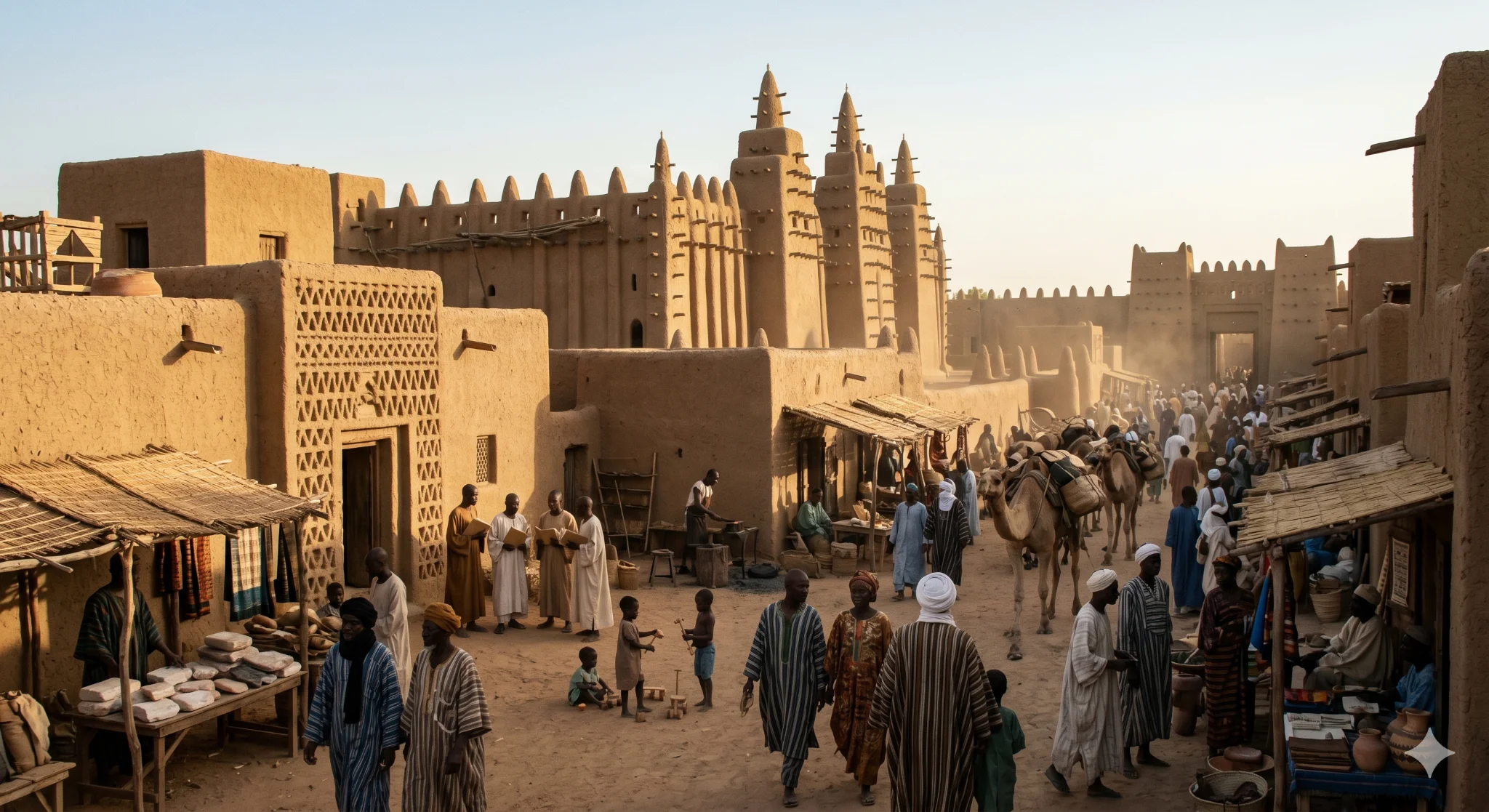
At its height, the Songhai Empire stretched across 1.4 million square kilometers of West Africa — larger than Western Europe. Its capital administered a professional bureaucracy, a standing army, a river navy, standardized currency, and a university at Timbuktu where 25,000 students studied medicine, law, mathematics, and astronomy. In 1591, a Moroccan army of 4,000 equipped with European arquebuses defeated a Songhai force of 40,000 in a single battle. Then European historians spent three centuries declaring that Africa had no history worth recording.

Periodc. 800 CE — 1591 CE
LocationWest Africa · Niger River basin
Entries7 documented events
DomainAfrican History · Empire · Erasure
The argument

The claim that Africa had no civilization before European contact was not a historical finding — it was a political requirement. The transatlantic slave trade needed an ideology to justify enslaving people, and "savage, stateless Africa" provided it. The Songhai Empire was one of the primary things that claim had to erase: a sophisticated, bureaucratic, literate state at continental scale that governed tens of millions of people, produced a world-class university, and maintained diplomatic relations with Egypt, Morocco, and the Ottoman Empire — all at the same time that European states were fighting the Wars of Religion. Songhai didn't disappear from Western consciousness by accident. It was removed.

Era 1
Origins · c. 800–1464 CE
1

The Songhai people had inhabited the Niger River bend — the area around the city of Gao in modern Mali — since at least the seventh century CE. Their position at the great bend of the Niger gave them a natural commercial advantage: the river was the highway of West Africa, and Gao sat at the point where trans-Saharan caravan routes from the north intersected with the river trade flowing east and west. Salt came south from the Saharan mines at Taghaza. Gold came north from the forest zones of the south. The Songhai, controlling the crossing point, collected taxes on everything that passed through.

By the ninth and tenth centuries, Gao was already a significant city documented by Arab geographers and travelers. The Dia dynasty ruled a Songhai state that was wealthy, urbanized, and commercially sophisticated — long before the empire that would later bear the name. When the Mali Empire rose to dominance in the thirteenth and fourteenth centuries, Gao came under Mali's authority. The Songhai absorbed Mali's administrative culture, its connections to the Islamic scholarly world, and its trade networks — and waited.

When the Mali Empire fragmented in the late fourteenth and early fifteenth centuries, the Songhai reasserted independence. By the time Sunni Ali Ber came to power in 1464, he inherited not a starting point but a sophisticated state with centuries of institutional memory. What he did with it was extraordinary.

Era 2
Sunni Ali and Conquest · 1464–1492
2

Sunni Ali Ber (r. 1464–1492) was one of the most formidable military commanders in African history, and one of the most consequential rulers of the fifteenth century anywhere on earth. In twenty-eight years of nearly unbroken campaigning, he transformed a regional power at Gao into the largest empire in African history.

His campaigns were systematic. In 1468, he captured Timbuktu from the Tuareg chiefs who had held it after Mali's decline — absorbing the city's scholars, its mosques, its trade connections, and its prestige as the intellectual capital of West Africa. In 1473, after a seven-year siege by river, he captured Djenné — the commercial city that controlled the trade routes connecting the forest south to the Saharan north. These two conquests gave him the twin engines of Songhai's power: Timbuktu's cultural authority and Djenné's commercial wealth.

Sunni Ali's military innovations
  • River navy on the Niger — Sunni Ali developed and deployed a war canoe fleet on the Niger River, giving him logistical reach and tactical mobility that no previous West African ruler had possessed at scale
  • Combined arms coordination — cavalry for the open steppe, river navy for riparian campaigns, infantry for siege; the integrated use of these forces across different terrain types was the operational signature of his conquests
  • Speed of movement — Arab chroniclers noted the remarkable pace of his campaigns; contemporary sources describe him as appearing at the front of battles personally, leading cavalry charges
  • Provincial consolidation — newly conquered territories were immediately integrated through garrisons, appointed governors, and tribute systems, preventing the fragmentation that had undone Mali

Sunni Ali's relationship with the Islamic scholarly establishment at Timbuktu was tense — the scholars, who had accommodated the Tuareg and remained suspicious of Sunni Ali's traditional religious practices alongside Islam, wrote critically of him in their chronicles. These chronicles, written by his enemies, form much of the primary source record for his reign, and historians have had to read against their bias to reconstruct his actual achievement. What is not in dispute is the result: by his death in 1492 (by drowning, crossing the Niger), he had built an empire that stretched from the Atlantic coast deep into the Sahara and east toward modern Nigeria.

"He never showed fear in battle... He was a scourge of those who wronged him, but he protected those who submitted to him."

— Paraphrase from the Tarikh al-Sudan, 17th-century Timbuktu chronicle (written by scholars hostile to Sunni Ali)

Era 3
Askia Muhammad and the Golden Age · 1493–1528
3

After Sunni Ali's death, his son was quickly overthrown by his general Muhammad Ture, who took the title Askia — beginning the Askia dynasty — and ruled as Askia Muhammad I from 1493 to 1528. Where Sunni Ali had been a conqueror, Askia Muhammad was an architect of governance. The distinction matters: empires won by military force frequently collapse when the conqueror dies; empires built on administrative systems persist. Askia Muhammad spent thirty-five years building systems.

1.4M
Square km at peak — larger than Western Europe
~10M
Estimated population governed
4
Vice-royalties with appointed governors
400+
Cities and towns within the empire

Askia Muhammad's governance innovations were substantial and documented:

The administrative infrastructure of Askia Muhammad's empire
  • Professional bureaucracy — centrally appointed provincial governors (replaced the local chiefs Sunni Ali had left in place), tax collectors, and judges; officials were accountable to Gao, not to local hereditary structures
  • Standardized weights and measures — a single system of measurement enforced across the empire's markets, enabling consistent trade over enormous distances
  • Standing professional army — a permanent military force, paid from the treasury, distinct from the feudal levies that most contemporary states relied on; including a cavalry corps, infantry, and the Niger river navy
  • Specialized court — separate ministers for agriculture, army, court protocol, treasury, and river navigation; functional differentiation of government roles
  • Islamic law courts — qadis (judges) appointed in major cities to administer sharia in commercial and civil disputes, giving merchants a reliable legal system across the empire
  • Diplomatic recognition — formal relations with Egypt (Mamluk and then Ottoman), Morocco, and the North African city-states; Askia Muhammad was received as a peer by foreign rulers

In 1496–1497, Askia Muhammad performed the hajj to Mecca — traveling with a reported entourage of 500 cavalry, 1,000 infantry, and 300,000 gold pieces for distribution as alms along the route. The pilgrimage was simultaneously a religious act and a diplomatic statement: he met with the Abbasid Caliph in Cairo, who formally recognized him as caliph of the Sudan (West Africa). He returned with scholars, books, and connections to the wider Islamic intellectual world, which he poured into Timbuktu.

4

Timbuktu is the name Western popular culture has used to mean "the most remote place imaginable" — the furthest point from civilization. The actual Timbuktu, at the height of the Songhai Empire, was one of the most sophisticated intellectual cities on earth.

At its height in the early sixteenth century, Timbuktu had a population of approximately 100,000 — larger than London at the same period, and comparable to the major cities of continental Europe. The city was organized around three great mosque-universities: the Djinguereber Mosque, the Sankore Mosque, and the Sidi Yahia Mosque. Together, the institutions of learning clustered around them — the complex known as the University of Sankore — enrolled an estimated 25,000 students from across West Africa, North Africa, and the broader Islamic world.

Djinguereber Mosque
Built 1327 during the Mali Empire. Expanded under Askia Muhammad. Capacity estimated at 2,000 worshippers. Still standing today — one of the oldest continuously functioning mosques in sub-Saharan Africa.
Sankore Mosque & University
The intellectual center of the empire. Faculty in Islamic law, medicine, mathematics, astronomy, history, and rhetoric. At peak enrollment, comparable in size to the University of Paris (est. 1150). Funded by private endowment from wealthy merchants.
180 Quranic schools
Leo Africanus documented 180 schools in Timbuktu in his Description of Africa (c. 1510–1513), providing mass literacy infrastructure below the university level.
Private libraries
Wealthy families in Timbuktu maintained private manuscript collections. The Ahmed Baba Institute currently holds over 100,000 manuscripts from these collections. The total number across family libraries is estimated at 700,000+.
The manuscripts
Subjects include astronomy, mathematics, medicine, law, history, theology, and philosophy. Scholars at Sankore were engaged with debates happening simultaneously in Cairo, Baghdad, and Persia — West Africa was not isolated from the global intellectual world of the period.
Leo Africanus's testimony
"Here are great stores of doctors, judges, priests and other learned men... and more profit is made from the book trade than from any other line of business." Written c. 1513, when Timbuktu was at the height of Songhai imperial power.
On the manuscripts — what was actually written in Timbuktu

The Timbuktu manuscripts are not religious texts alone. They include: a 13th-century treatise on eye surgery; mathematical texts calculating astronomical positions; legal commentaries on trade disputes and land tenure; histories of the Saharan kingdoms written by West African scholars; philosophical treatises on the relationship between Islamic law and local custom; and correspondence between Timbuktu's scholars and contemporaries in Cairo, Fez, and Mecca. The manuscripts establish, in primary-source documentary form, that West African intellectual life in the Songhai period was engaged with the global scholarly conversation of its era. The claim that "Africa had no written history" was not ignorance. It was a lie with a purpose.

Era 4
Destruction · 1591
5

In 1591, the Sa'adian Sultan of Morocco, Ahmad al-Mansur, sent an expeditionary force of approximately 4,000 men — mostly Spanish Moorish and Andalusian soldiers, armed with arquebuses and cannon — across the Sahara to seize Songhai's gold and salt revenues. The force was commanded by Judar Pasha, a Spanish-born eunuch who had risen to senior rank in the Moroccan court. The crossing of the Sahara with a gunpowder army — 1,500 miles across one of the world's most lethal environments — was itself a logistical achievement of the first order. Thousands of the soldiers and pack animals died on the crossing.

Battle of Tondibi — March 12–13, 1591
Songhai Empire
~40,000 troops
Cavalry, infantry, war canoes
Commander: Askia Ishaq II
Weapons: bows, spears, swords
Strategy: mass cavalry charge
vs
Moroccan Sa'adian Army
~4,000 troops
Infantry, artillery
Commander: Judar Pasha
Weapons: arquebuses, cannon
Strategy: disciplined gunpowder volley
Result: Decisive Moroccan victory. The Songhai cavalry charge — the empire's primary offensive tactic, which had won battles for a century — broke against sustained arquebus fire. The larger Songhai force could not close to melee range against disciplined volleys. Askia Ishaq II fled. Gao and then Timbuktu fell within weeks. The Songhai Empire never recovered.

The battle was not a demonstration of Moroccan civilization's superiority over Songhai civilization. It was a demonstration of what happens when one party in a military confrontation has gunpowder weapons and the other does not. The technology was European — developed in the wars of fifteenth and sixteenth century Europe and then diffused outward through trade. The Moroccan army was the vector through which European military technology entered West Africa before European armies arrived directly.

Ahmad al-Mansur did not get what he wanted. The gold and salt revenues he had invaded to capture were disrupted by the same conquest that was supposed to secure them. The Moroccan occupiers found they could not administer an empire of Songhai's scale and complexity; the provincial governors appointed from Marrakesh had no legitimacy and no institutional knowledge. Timbuktu and Gao declined rapidly under Moroccan occupation. The scholarly community dispersed — some scholars were deported to Morocco, including the great historian Ahmad Baba al-Timbukti, who spent years in Marrakesh before eventually returning home. The university did not recover its former scale.

Era 5
Erasure and Recovery · 1600s–Present
6

As the transatlantic slave trade scaled up through the seventeenth and eighteenth centuries, it required a justifying ideology. Enslaving people was a moral problem that European and American societies needed to resolve — or suppress — and the resolution arrived at was that the people being enslaved were not fully civilized, did not have history in the meaningful sense, and therefore were not entitled to the protections accorded to "civilized" peoples. The existence of the Songhai Empire — a bureaucratic, literate, cosmopolitan state of continental scale that had flourished for a century and a half, with a university that had trained generations of scholars in law, medicine, and mathematics — was directly incompatible with this ideology.

The erasure was accomplished through several mechanisms operating in parallel:

How the erasure worked
  • Framing the Arab and Timbuktu sources as unreliable — the primary written sources for Songhai history are the Tarikh al-Sudan and Tarikh al-Fattash, chronicles written in Timbuktu in the seventeenth century by West African scholars. European historians of the 18th and 19th centuries routinely dismissed these as exaggerated or inaccurate — a standard they did not apply to contemporary European or Arab sources of comparable date
  • Hegel's explicit exclusion of Africa — in his Philosophy of History (1837), G.W.F. Hegel wrote: "Africa is no historical part of the World; it has no movement or development to exhibit." This formulation was enormously influential in European academic culture and shaped how Africanist studies were framed for a century
  • The "Arab" attribution — where achievements in North and West Africa were acknowledged, they were frequently attributed to "Arab influence" rather than African authorship, effectively relocating the credit outside the continent
  • Colonial education systems — French colonial administration in West Africa (which controlled the Timbuktu region from the 1890s) did not integrate Songhai or Mali history into school curricula; what was taught was European history with Africa appearing only at the moment of European contact
  • Hugh Trevor-Roper, 1963 — the Oxford historian explicitly stated in a BBC lecture: "There is only the history of the Europeans in Africa. The rest is largely darkness... and darkness is not a subject of history." This was said publicly and without controversy at a major British university forty years after the Timbuktu manuscripts had been documented by French scholars

The recovery of Songhai's history in Western scholarship began in earnest only in the mid-twentieth century, with the decolonization era producing both new African scholars and new political pressure on European academic institutions to reckon with what they had ignored. The work of historians like J.F. Ade Ajayi, Jan Vansina, and the contributors to the UNESCO General History of Africa (8 volumes, 1964–1999) established the framework within which Songhai and other African empires are now understood.

7

The most tangible physical evidence of Songhai's intellectual civilization survived in the private manuscript collections of Timbuktu's old families — stored in wooden chests, buried in desert caches, and passed down across generations despite colonial disruption, drought, and poverty. By the late twentieth century, scholars and the Malian government estimated that somewhere between 300,000 and 700,000 manuscripts had survived in and around Timbuktu — one of the largest concentrations of pre-modern manuscript material in the world.

The Ahmed Baba Institute of Higher Learning and Islamic Research (IHERI-AB), established in Timbuktu in 1970, began the systematic work of collecting, cataloguing, and preserving these manuscripts. International partnerships with South African, European, and American institutions produced large-scale digitization programs beginning in the 1990s and accelerating after 2000. By 2012, tens of thousands of manuscripts had been digitized and catalogued.

In January 2013, Islamist militant groups associated with Al-Qaeda in the Islamic Maghreb (AQIM) — who had occupied Timbuktu for most of 2012 as part of the broader conflict in northern Mali — began destroying manuscripts as they retreated before the French military intervention. In the hours before French forces arrived, militants burned thousands of manuscripts stored at the Ahmed Baba Institute.

What the militants did not know — or could not stop — was that Timbuktu's librarians and archivists had been quietly moving manuscripts out of the city for months. Working through a network of trusted families and smugglers, they transported the bulk of the Institute's collection — an estimated 377,000 manuscripts — to Bamako, the Malian capital, in footlockers, suitcases, and wooden crates. The manuscripts were saved. The story of that rescue operation, organized by Abdel Kader Haidara and documented in journalist Joshua Hammer's book The Bad-Ass Librarians of Timbuktu (2016), is one of the most remarkable acts of cultural preservation in the twenty-first century.

"Books are more precious to us than our own lives. It is through books that we know our history, our science, our medicine, our poetry, our identity."

— Abdel Kader Haidara, director of the Mamma Haidara Library, Timbuktu

The manuscripts — now being digitized, translated, and published by scholars across multiple continents — are the primary rebuttal to everything that was claimed about Africa's absence from history. They were written in Timbuktu, by West African scholars, during the Songhai Empire. They document a civilization that governed itself, debated ideas, healed its sick, mapped the stars, and recorded its own story — for centuries, before European contact, and in spite of everything that came after.
The Chain of Causation

Gao c. 800 CE
Songhai state founded on Niger bend
Sunni Ali 1468
Timbuktu & Djenné conquered
Askia Muhammad 1493–1528
Bureaucracy, navy, law courts
Timbuktu peak
100,000 pop. · 25,000 students
Tondibi 1591
Arquebuses defeat 40,000 cavalry
"Africa has no history"
Political erasure, 3 centuries
700,000 manuscripts rescued 2013
The record survives