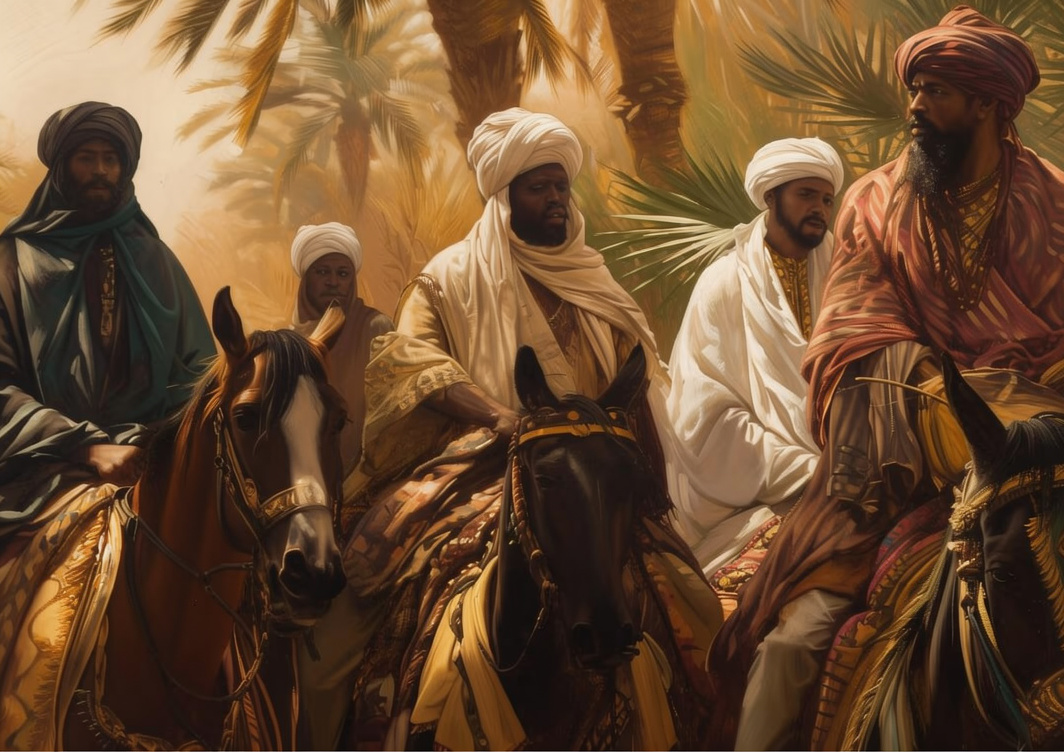
The Arrival: Tariq ibn Ziyad Crosses the Strait
Gibraltar · Iberian Peninsula
In April 711, a Berber general named Tariq ibn Ziyad crossed the narrow strait separating North Africa from Iberia with approximately 7,000 soldiers — mostly Amazigh (Berber) Africans from what is now Morocco. He landed at the great rock that still bears his name: Jebel al-Tariq. Gibraltar. Within seven years, Muslim forces had swept through nearly the entire peninsula, defeating the Visigothic kingdom that had ruled it since the fall of Rome.
The force that conquered Iberia was not Arab. It was African. The Berber people of North Africa — among them the ancestors of the Tuareg, the Amazigh, and the populations of modern Morocco, Algeria, and Tunisia — were the primary military force of the early Umayyad expansion into Europe. The word "Moor" derives from the Latin Mauri, used for the people of Mauretania (modern Morocco and western Algeria). It was a geographic term, not a racial category — but it consistently referred to North African Africans.
The Visigoths collapsed quickly, in part because the populations they ruled — Iberian Christians, Jews, and the rural poor — were not loyal to them. Many welcomed the new administration. The Umayyad forces brought a policy of relative tolerance: dhimmi status for Christians and Jews meant they paid additional taxes but kept their religion, property, and courts. This would prove central to what came next.
The term "Moor" was used by medieval Europeans to describe the Muslim inhabitants of Al-Andalus. The population was ethnically mixed: Berbers (Amazigh) from North Africa made up the majority military force; Arabs from the Umayyad Caliphate provided the political and administrative leadership; sub-Saharan Africans were present as soldiers, scholars, and merchants, particularly from the trans-Saharan trade networks. Later dynasties — the Almoravids (1086) and Almohads (1147) — brought reinforcements directly from West Africa and the Maghreb. Al-Andalus was not an Arab civilization with African soldiers. It was an African and Arab civilization, built by people whose descendants today are Moroccan, Algerian, Tunisian, and Malian.
Córdoba: The Ornament of the World
Córdoba, Al-Andalus
Abd al-Rahman I established the Emirate of Córdoba in 756. His descendants built a city that contemporary European visitors described with awe and disbelief. The Saxon nun Hroswitha of Gandersheim, writing in the 10th century, called Córdoba "the ornament of the world." That was not hyperbole — it was accurate reporting.
When Abd al-Rahman III declared the Caliphate of Córdoba in 929, the city had 500,000 inhabitants, 70 public libraries, 900 public baths, and street lighting. London at the same moment had a population of roughly 15,000 and no sewers. Paris was a muddy market town of perhaps 20,000. The rest of northern Europe was in what historians call the "Dark Ages" — a period of population decline, urban collapse, and lost literacy following the fall of Rome.
The comparison is not incidental. The "Dark Ages" were dark in northern Europe. They were not dark in Córdoba.
"Córdoba alone could furnish a library as large as that of any other city in Europe."
— Hroswitha of Gandersheim, Saxon nun and chronicler, c. 970 CE
The Córdoba of the Umayyads practiced a form of coexistence that historians call convivencia — living-together. It was not utopia; it was a hierarchy with Muslims at the top. But it was also a civilization in which Jewish scholars translated Arabic texts into Latin for Christian European courts, in which Christian scholars sought education in Córdoba because nowhere in Christian Europe offered it, and in which the three Abrahamic traditions produced a period of intellectual cross-pollination unlike anything before or since in European history.
The physician, diplomat, and poet Hasdai ibn Shaprut — a Jew — served as court physician and foreign minister under Abd al-Rahman III. Ibn Hazm — a Muslim theologian and poet born in Córdoba — wrote the first systematic comparative study of world religions. The scholar Gerbert of Aurillac, who would become Pope Sylvester II, traveled to Córdoba to study mathematics. He brought back Arabic numerals — the system you are using to read this page's numbers.
The Knowledge Transfer: What the Moors Gave Europe
Córdoba · Toledo · Seville · Palermo
The intellectual legacy of Al-Andalus is not a footnote in European history. It is the foundation of the European Renaissance. The scholars of the Moorish court preserved, translated, and extended the Greek philosophical and scientific tradition that had been lost in the Latin West — and then transmitted it back.
Aristotle's complete works — preserved in Arabic translation and commentary, retranslated into Latin by Gerard of Cremona in Toledo. Without this transmission, Scholastic philosophy — Aquinas, Albertus Magnus, Duns Scotus — has no foundation. Euclidean geometry and Ptolemaic astronomy — transmitted via Arabic translations that corrected and extended the originals. The decimal number system and algebra — Al-Khwarizmi's Kitab al-Mukhtasar gave Europe the word "algorithm" (from his name) and "algebra" (from al-jabr). Surgery, pharmacology, ophthalmology — Ibn al-Haytham (Alhazen) invented optics; Ibn Sina's Canon of Medicine was the primary medical textbook in European universities until the 17th century. Agricultural technology — Moorish engineers built irrigation systems, introduced cotton, sugar cane, rice, oranges, lemons, and apricots to Europe, and developed crop rotation systems that fed the continent.
The translation movement centered on Toledo after its conquest by Castile in 1085. Rather than destroy what the Moors had built, Christian scholars — including Englishmen, Italians, Germans, and Frenchmen who traveled specifically to Toledo — hired Arabic-speaking translators to render the Moorish libraries into Latin. This "Toledo School of Translators" is the direct mechanism by which classical and Islamic learning entered European universities. The Scholastic revolution of the 12th and 13th centuries, the precondition for the Renaissance, runs directly through it.
"Europe was a pupil of the Arab world. It could not have recovered the classical heritage of Greece and Rome without the bridge that Islamic civilization provided."
— Richard Fletcher, Moorish Spain (1992)
The Reconquista: Crusade, Expulsion, and the Invention of Race
Castile · Aragon · Granada
The Reconquista — the Christian reconquest of Iberia — was not a single event. It was a 770-year process of gradual territorial conquest, punctuated by periods of coexistence, alliance, and intermarriage between Christian, Muslim, and Jewish populations. The famous El Cid fought for Muslim rulers as well as Christian ones. The lines were not clean.
But the final phase, driven by Ferdinand of Aragon and Isabella of Castile, was something different. In 1478 they established the Spanish Inquisition — originally targeting conversos (Jewish and Muslim converts to Christianity) suspected of secretly practicing their original faith. In 1492, the same year Columbus sailed, they expelled all Jews from Spain. Between 1609 and 1614, they expelled the Moriscos — Muslims who had converted to Christianity — numbering perhaps 3 million people whose families had lived in Iberia for nine hundred years.
The theological justification for both expulsions was the doctrine of limpieza de sangre — blood purity. This was a new idea. Christian doctrine had always held that baptism cleansed sin and converted the soul. The limpieza doctrine held that Jewish and Moorish ancestry was itself a contamination, passed through blood, that baptism could not remove. People with "Moorish blood" or "Jewish blood" — even converts, even the children of converts — were barred from the priesthood, universities, military orders, and public office.
The Statute of Toledo (1449) was the first Spanish purity statute. It barred conversos from public office on the grounds that "Jewish blood" made conversion impossible to verify. Subsequent statutes spread to the military orders, the universities, the Inquisition itself, and eventually the entire colonial apparatus. This is the intellectual origin of modern racial categorization — the idea that ancestry, not faith, not culture, not language, determines belonging. The same logic that excluded Moriscos and conversos in 1500 would justify the enslavement of Africans in 1600 on the grounds that African ancestry was itself a mark of inferiority. The Transatlantic Slave Trade did not invent racial thinking. It inherited it from the Iberian Peninsula.
The fall of Granada on January 2, 1492, was framed by Ferdinand and Isabella as a crusade — a religious purification of the peninsula. The Alhambra palace, the greatest monument of Moorish architecture in Spain, was handed over. Muhammad XII (called Boabdil by the Spanish) handed over the keys and allegedly wept as he looked back at Granada for the last time. The Spanish have a word for that hill: El Último Suspiro del Moro — the Last Sigh of the Moor.
Within nine months of the fall of Granada, Columbus made landfall in the Caribbean. The same institutional apparatus — the Inquisition, the Reconquista's military orders, the limpieza doctrine — would be immediately deployed against the indigenous peoples of the Americas.
The Book Burning of Granada: Destroying the Archive
Granada, Castile
In 1499, Cardinal Francisco Jiménez de Cisneros — the Archbishop of Toledo and Inquisitor General — traveled to Granada and ordered the seizure of all Arabic manuscripts in the city. An estimated one million books were burned in the main square of Granada. Cisneros exempted approximately 5,000 medical texts, which he sent to the University of Alcalá. Everything else — theology, philosophy, poetry, history, science — was ash.
This was not vandalism. It was policy. Cisneros understood that a civilization's memory lives in its texts, and that the destruction of those texts was a precondition for rewriting the historical narrative. Without the Moorish archive, the story of Al-Andalus would have to be told by the people who burned it.
It largely has been.
"Wherever they burn books, they will also, in the end, burn human beings."
— Heinrich Heine, Almansor, 1823 — written about Cisneros's burning of the Quran in Granada
What survived did so by chance or by deliberate concealment. Moorish families buried manuscripts in walls and beneath floors. Some texts reached North Africa with the exiles. The Timbuktu manuscripts — hundreds of thousands of Arabic texts held in Mali — include material that passed through the trans-Saharan networks from Al-Andalus. The knowledge didn't die. It was displaced — from Europe to Africa — and then that displacement was used to argue that Africa had no intellectual tradition.
The Whitening of European History: How the Moors Were Written Out
European historiography
The construction of European identity in the modern period required a story: Europe as the heir of Greece and Rome, the origin of rational thought, democracy, science, and civilization. The Moors disrupted this story at every point. They had been more advanced than Christian Europe for five centuries. The European Renaissance was substantially a product of Moorish knowledge transmission. The architecture, mathematics, and medicine of medieval Europe bore Arabic names and Arabic methods.
The solution was not to deny the facts — the facts were too well documented. The solution was to reclassify the Moors. European historiography of the 18th and 19th centuries progressively described Al-Andalus as:
- "Arab" rather than African — erasing the Berber and sub-Saharan African composition of the Moorish population
- "Persian" or "Eastern" — positioning Moorish scholarship as a relay station for pre-existing knowledge rather than an originating civilization
- An "interruption" of European history — rather than a central chapter of it
- A civilization "despite" Islam — crediting the achievements to individual genius while attributing the decline to religious obscurantism
The most influential instrument of this rewriting was Hegel's Philosophy of History (1837), which placed Africa outside of history entirely — arguing that African peoples had no historical agency and that the continent's role was to receive civilization from outside. This required ignoring not only the Moors but the entire record of Mali, Songhai, Egypt, Kush, and Aksum — all of which Hegel acknowledged and then dismissed as not "properly" African, or not "properly" historical.
The direct scholarly counter to this historiography came most forcefully from Ivan Van Sertima, particularly in his edited volume The Golden Age of the Moor (1992). Van Sertima's argument is specific: the Almoravid dynasty — the Amazigh and Black African confederation that swept out of the Senegal River valley around 1040 CE, unified the Maghreb, crossed into Iberia in 1086 to push back the Reconquista, and ruled Al-Andalus for nearly a century — were Black West Africans, not simply "Arab" or even "Berber" in the way European historiography used those terms. The Almoravids came from the same West African Sahel that produced the Mali and Songhai empires. Their intervention saved Al-Andalus from Christian reconquest for another four hundred years. This means that the civilization whose knowledge transfers enabled the European Renaissance was, in its most critical military and political moment, led and defended by people from the same African region whose descendants would later be enslaved to build the Americas. The same Africa. The same people. Different centuries. Different uses.
What the Erasure Cost: The Direct Line to the Slave Trade
Iberia · West Africa · The Americas
The fall of Granada and the expulsion of the Moors did not merely end a civilization. It set the ideological and institutional machinery that drove the next five centuries of European expansion. The connection is direct:
The limpieza de sangre doctrine — developed to exclude Moorish and Jewish blood from Spanish civic life — was the conceptual template for racial classification in the Americas. The same Inquisitional apparatus that processed Moriscos was immediately redeployed against indigenous Americans and enslaved Africans. The same theological argument that justified expelling 3 million Moriscos from their ancestral homeland justified the enslavement of millions of Africans who had, in the Moorish case, been contributing to European civilization for 700 years.
The soldiers and administrators of the early Transatlantic Slave Trade were Reconquista veterans. Columbus sailed on behalf of the monarchs who signed the Alhambra Decree. The encomienda system imposed on indigenous Americans was a direct adaptation of the system used to govern conquered Muslim populations. The Spanish justification for enslavement — that Africans were naturally suited to servitude — was the same logic applied to Moriscos and conversos: that ancestry, not faith or culture or achievement, determined capacity.
January 2: The last Moorish king surrenders Granada. March 31: The Alhambra Decree expels all Jews from Spain. August 3: Columbus sails. October 12: Columbus makes landfall in the Caribbean. The Reconquista and the colonization of the Americas are not sequential events — they are the same event, with the same actors, the same ideology, and the same institutional machinery. The expulsion of peoples deemed racially impure from Europe and the seizure of peoples deemed racially servile from Africa and the Americas were two expressions of the same logic, in the same year, authorized by the same sovereigns.
The erasure of the Moors from European historical memory was therefore not incidental. A European civilization that remembered what the Moors had built — and what Europe had owed them — could not have sustained the ideological claim that African peoples were without history, without civilization, without the capacity for self-governance that justified their enslavement. The burning of the Córdoba libraries was preparation for the Middle Passage. The propaganda required the archive to be gone first.
"The story of how Greek learning was preserved and transmitted to medieval Europe is, in large measure, the story of Islamic civilization — and in particular, the story of Al-Andalus."
— Maria Rosa Menocal, The Ornament of the World (2002)
What Remains: The Alhambra, the Words, the Debt Unpaid
Spain · Morocco · Mali · Global
The Moors left traces that could not be burned. The Alhambra palace in Granada is one of the most visited buildings in the world — a UNESCO World Heritage Site, the greatest surviving example of Moorish architecture, a monument that every year draws millions of tourists to Spain. The Spanish government earns hundreds of millions of euros from it annually. The civilization that built it was expelled.
The English language contains hundreds of words from Arabic that entered through Al-Andalus: algebra, algorithm, alcohol, alkaline, almanac, admiral, arsenal, cotton, sugar, coffee, lemon, orange, apricot, tariff, hazard, mattress, magazine. Every time a student studies algebra, they are using a word that means "the reunion of broken parts" — from the Arabic title of a book written in Moorish-connected Baghdad that was translated into Latin in Toledo because Spanish scholars wanted to learn what Moorish civilization knew.
The debate about the Moors is not historical. It is ongoing. In Spain, the question of whether to acknowledge the Arab-African heritage of Iberian culture is contested politically. In Morocco and Algeria, the Andalusi diaspora maintains cultural memory — architectural styles, musical forms (the gharnata, Andalusian classical music), and oral traditions that survived the expulsion. In West Africa, the trans-Saharan networks that connected Al-Andalus to Mali, Songhai, and the Sudan mean that the Moorish intellectual tradition is also part of the African heritage of Timbuktu.
The manuscript libraries of Timbuktu — which held an estimated 700,000 to 1 million manuscripts at their height — received texts and scholars from Al-Andalus through the trans-Saharan trade routes. After the fall of Granada, Moorish and Andalusi scholars emigrated not only to North Africa but deeper into West Africa. The Sankore University of Timbuktu under the Songhai Empire drew on the same intellectual tradition as the Córdoba academies. When Cardinal Cisneros burned Moorish books in Granada, the same knowledge lived in Mali. The erasure of Moorish civilization from European history is also the separation of African intellectual history from its own continuity — the pretense that Timbuktu and Córdoba were unconnected, when they were nodes in the same network.
The question of what we owe — historically, intellectually, morally — to the civilization of Al-Andalus is not resolved. The Alhambra stands. The debt is not paid. The words remain in the language. The history is still being rewritten.
The causal chain: from Al-Andalus to the Slave Trade
The question is not whether the Moors influenced European civilization. They were its most advanced component for five hundred years. The question is why that fact required suppression — and whose interests the suppression served. The answer to that question runs directly through the Transatlantic Slave Trade and the construction of racial hierarchy that justified it.
The same logic that expelled the Moors enslaved the Africans. Read the African empires thread →