Origins · Erasure · National Symbol

The Black Statue of Liberty

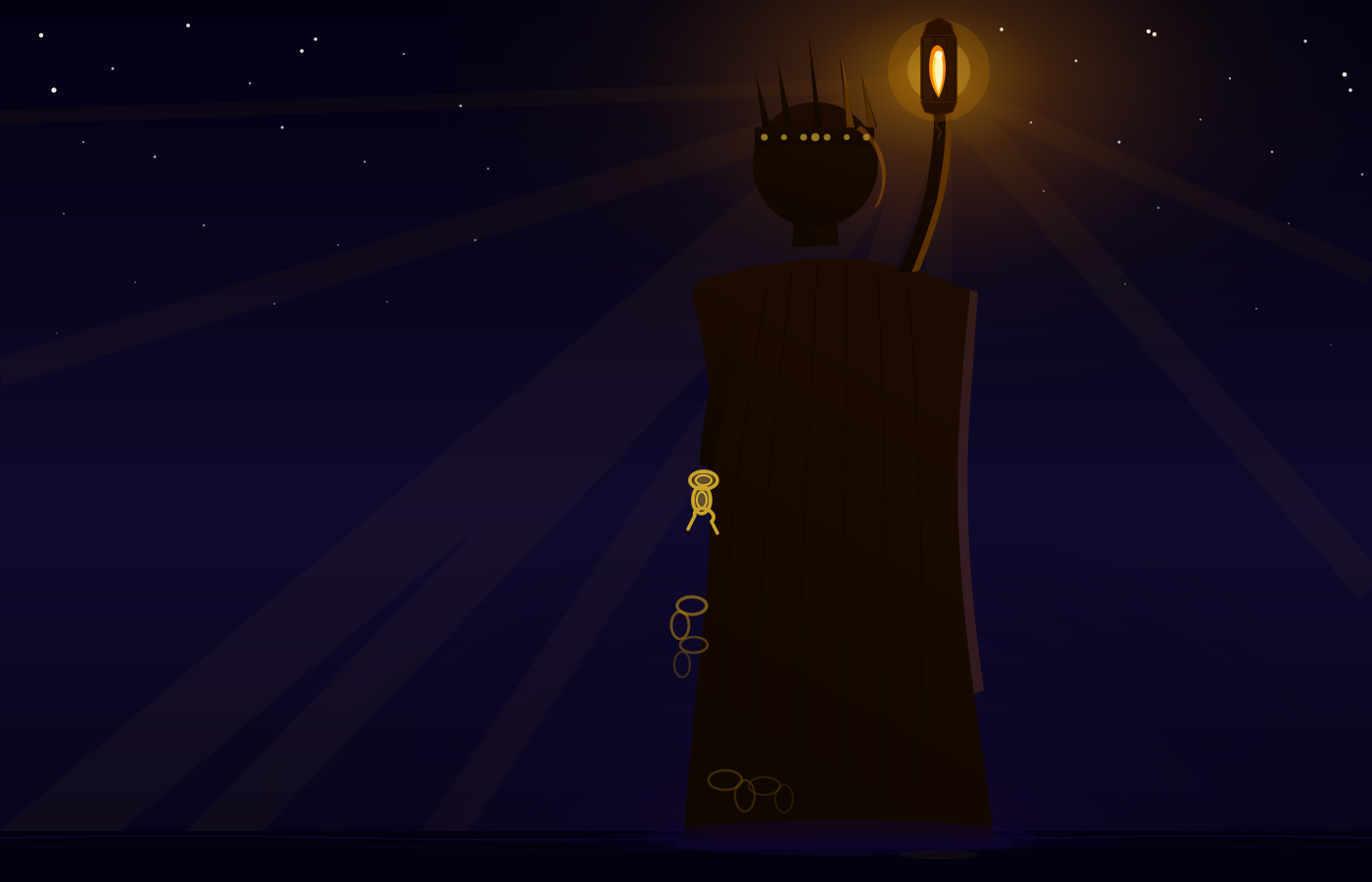
The Statue of Liberty was conceived by a French abolitionist to celebrate the end of American slavery. The sculptor's early sketches show a woman with broken chains raised overhead — a freed Black woman. The chains are still at her feet, visible but almost never shown in official photographs. The immigration story came forty years later. This is the documented history of what the statue was before it became America's symbol of welcome — and why that original meaning was buried.

Period1865 — Present
Entries8 documented events
DomainHistory · Symbolism · Erasure
StatusLive
The argument

The Statue of Liberty as most Americans understand it — the beacon for immigrants, the welcome at the harbor — is the second story told about the monument. The first story, documented in the correspondence of its creator Édouard de Laboulaye, in Frédéric Bartholdi's early sketches, and in the original fundraising literature, is an abolitionist story: a monument to the end of American slavery, specifically linking French and American republican ideals to emancipation. That story was displaced because the Southern states that had fought to preserve slavery were not willing to fund or celebrate a monument to its destruction. The immigration narrative that replaced it was politically acceptable in a way the emancipation narrative was not. The chains at the statue's feet are not decorative. They are the original message, preserved in copper while the meaning that explained them was buried.

Era 1
The Abolitionist Origin, 1865–1871
1

The Statue of Liberty was not primarily conceived as an immigration symbol. It was conceived as an emancipation monument. The person who first proposed it — Édouard de Laboulaye, a French legal scholar, politician, and committed abolitionist — proposed it at a dinner party at his estate in Glatigny in the summer of 1865, weeks after the end of the American Civil War and the ratification of the 13th Amendment. His guest was the sculptor Frédéric Auguste Bartholdi.

Laboulaye's motivation was explicit in his correspondence and writings: he was a lifelong admirer of American democracy, a fierce opponent of slavery, and deeply moved by the Union's victory. He had written extensively about American abolitionism — his 1855 book The United States and France praised the American experiment while condemning the contradiction of slavery within it. The end of slavery, to Laboulaye, was the fulfillment of the American promise. He wanted a monument that would celebrate that fulfillment and link it to French republicanism.

His exact words at the 1865 dinner, as later recalled by Bartholdi: "If a monument should rise in the United States, as a memorial to their independence, I should think it only natural if it were built by united effort — a common work of both our nations." The monument he envisioned was tied to the moment: the end of slavery, the survival of the republic, the victory of the democratic ideal over the slave-holding one. The immigration story — "give me your tired, your poor" — did not exist yet. It would not be written for another eighteen years.

2

Frédéric Auguste Bartholdi began sketching his concept for the monument in the late 1860s. The earliest documented sketches — some held at the Musée Bartholdi in Colmar, France — show a robed female figure with distinctly African features: broad facial structure, thick hair, dark complexion. The figure holds broken chains aloft, the posture of liberation rather than greeting. Art historians, most prominently Yasmin Sabina Khan, author of Enlightening the World: The Creation of the Statue of Liberty (2010), have documented this design lineage.

Documented Evidence of the Original Black Woman Design
Bartholdi's 1870 Egyptian Concept
Before proposing the American project, Bartholdi pitched a colossal figure of a robed Arab/Egyptian peasant woman to the Egyptian Khedive Ismail for placement at the entrance to the Suez Canal. When Egypt declined (cost), Bartholdi adapted the concept for America. The two designs share the robed feminine form, colossal scale, and arm-raised gesture — but the American concept incorporated the emancipation context Laboulaye specified.
Source: Khan, Enlightening the World (2010); Statue of Liberty NPS archives
Bartholdi's 1871 Fundraising Tour
When Bartholdi toured the United States in 1871 to build support for the project, he met with President Grant, Congressmen, and the Black abolitionist leader Frederick Douglass. His pitch explicitly linked the monument to emancipation and to "the common cause of liberty." His promotional materials described the statue as honoring "the alliance of the two nations in the triumph of liberty and the abolition of slavery."
Source: Statue of Liberty NPS history archives; Berenson, The Statue of Liberty (2012)
The Broken Chains
The statue as built holds broken chains at her feet — deliberately placed, always present, and almost never shown in standard photographs which crop at the torch or waist level. In early design proposals, the chains were raised overhead in the figure's left hand, an even more explicit emancipation symbol. They were moved to the feet during design revisions — still present, but less prominent.
Source: National Park Service monument documentation; confirmed visible in low-angle aerial photographs
Laboulaye's Own Description
In an 1875 fundraising speech, Laboulaye described the proposed statue as representing "the liberty which enlightens the Old and New World, putting to flight despotism and slavery." The phrase "putting to flight... slavery" was central to his pitch. He was not describing immigration. He was describing emancipation.
Source: Laboulaye, 1875 fundraising address; translated in Trachtenberg, The Statue of Liberty (1976)
Era 2
The Political Problem, 1875–1886
3

The Statue of Liberty project was funded through a transatlantic partnership: France would build and donate the statue; America would build the pedestal. The American Committee for the Statue of Liberty, chaired by Senator William Evarts, raised money from 1876 through 1884. Fundraising was dramatically more successful in Northern states than in Southern ones. The American South — whose states had fought to preserve slavery and were, by the late 1870s, dismantling Reconstruction and reimposing racial subjugation through Black Codes and convict leasing — was not enthusiastic about funding a monument to slavery's abolition.

The correspondence of the American Committee documents the political difficulty explicitly. In 1877, the Compromise of 1877 ended Reconstruction and withdrew federal troops from the South. The political environment for an emancipation monument immediately worsened. Committee members from Southern states reported that the monument's connection to the abolition of slavery was the primary objection among potential Southern donors. In response, the public description of the monument shifted: less emphasis on emancipation, more emphasis on "the liberty of the free world," a formulation generic enough to be acceptable to those who had just ended Black freedom in the South.

This shift was not incidental. It was a deliberate political accommodation. The emancipation framing was accurate to the monument's origin. The generic-liberty framing was necessary to raise the money. The former yielded to the latter — and the reframing that began with the 1877 fundraising crisis became the dominant narrative of the statue's meaning.

4

The Statue of Liberty was dedicated on October 28, 1886 in a ceremony attended by President Grover Cleveland, French dignitaries, the American Committee, and thousands of spectators. Women were barred from the official ceremony — the French suffragist organizations that had helped fundraise were particularly bitter about this exclusion. Black Americans, whose emancipation was the stated original purpose of the monument, were almost entirely absent from the official events.

Frederick Douglass — the nation's most prominent Black leader, the man Bartholdi had met on his 1871 fundraising tour — was not invited to attend the dedication. The omission was not accidental. By 1886, the political rehabilitation of the Confederacy was well underway. The Compromise of 1877 had ended Reconstruction. The Supreme Court had struck down the Civil Rights Act of 1875. Racial terror was driving Black Americans from political participation across the South. A monument dedication that honored Frederick Douglass as a symbol of what the monument meant would have been politically explosive.

The Black newspaper The Cleveland Gazette editorialized: "Liberty enlightening the world, indeed! The expression of this idea is a lie as long as the shackles of the colored man in the South are still on." The New York Freeman wrote: "It is an irony that a monument to liberty should be built at a time when colored people are being lynched, their rights destroyed, and the nation silent." A group of Black protesters and women's suffragists circled the harbor in rented boats during the dedication ceremony, shouting protests. Their voices did not carry to the speakers' platform.

"Liberty enlightening the world, indeed! The expression makes us laugh — or weep. There is not a Black man in this nation who does not feel the mockery of it."

The Cleveland Gazette, October 1886, the week of the Statue of Liberty dedication
Era 3
The Rebranding, 1883–1920s
5

Emma Lazarus wrote "The New Colossus" in 1883 — not for the Statue of Liberty as a permanent dedication, but as a donation for a fundraising auction at the Academy of Design in New York to help raise money for the pedestal construction. Lazarus, a Sephardic Jewish American poet, was moved by the plight of Jewish refugees fleeing pogroms in Russia and Eastern Europe who were arriving in New York harbor at that moment. The poem's "huddled masses yearning to breathe free" referred specifically to those refugees. It was her poem, for her community, for a fundraiser. It was not a statement of American immigration policy.

The poem received relatively little attention when it was written. It was not read at the 1886 dedication ceremony. It was not attached to the statue at all until 1903, when a friend of Lazarus's had a bronze plaque made and donated it to the monument. It was placed inside a stairwell, not at the entrance. The poem's now-iconic status — its current prominence as the primary text associated with the statue — developed gradually over the 20th century, particularly after the immigration restriction debates of the 1920s, when its vision of America as a refuge became politically useful to immigration advocates fighting restrictionist legislation.

The poem is beautiful and its sentiment genuine. But it is not the Statue of Liberty's founding document. It was written eighteen years after the statue was conceived, for a different purpose, by someone with no connection to the monument's design. Its elevation to primary status in the statue's meaning reflects a choice made by subsequent generations — a choice that displaced the emancipation narrative with an immigration one.

6

The full displacement of the emancipation narrative by the immigration narrative happened gradually between the 1900s and 1940s. The timing is not coincidental: this is the period of the nadir of American race relations — the peak of lynching (1890–1920), the disenfranchisement of Black voters across the South through grandfather clauses, literacy tests, and poll taxes, and the rise of a resurgent Ku Klux Klan that by 1924 claimed 3–6 million members including governors, senators, and a Supreme Court justice.

In this context, the emancipation meaning of the Statue of Liberty — a monument to the end of slavery, linked to Black freedom — was incompatible with the political reality. The immigration meaning — a welcome to European immigrants arriving at Ellis Island, which opened in 1892 and processed 12 million people between 1892 and 1954 — was visible, geographically obvious (the statue stood at the entrance to the harbor), and politically neutral in a way the emancipation meaning was not. The immigration narrative expanded to fill the space that the political suppression of the emancipation narrative created.

The Chains That Were Never Hidden — Just Never Shown

The broken chains at the Statue of Liberty's feet are not hidden. They are physically present on the monument, clearly visible from aerial and close-up ground-level angles. The left foot is raised mid-step, with a broken shackle and chain visible beneath it. A second chain section lies at her right foot. They are there for anyone who looks — from a boat at low angle, from a helicopter, in close-up photographs of the base.

What is notable is how rarely they appear in official imagery. The standard photographs of the statue — the ones in textbooks, on stamps, in government documents — are taken from distance and angle that shows the torch, the tablet, and the crown but crops the feet. The National Park Service's own promotional materials largely show the statue from distance. The chains exist in the monument's physical record. They have been systematically excluded from the monument's visual record for over a century.

This is not a conspiracy of active suppression — no one ordered the chains removed or hidden. It is the quieter operation of a society that found one meaning of the statue politically useful and another politically inconvenient, and made visual choices accordingly, over generations, until the inconvenient meaning became invisible through accumulated omission.

Era 4
Scholarship and Reclamation, 1980s–Present
7

Serious scholarly recovery of the Statue of Liberty's Black emancipation origins began in the 1980s with the monument's centennial and has grown substantially since. The key works include: Alan Trachtenberg's The Statue of Liberty (1976); Marvin Trachtenberg's architectural history; Yasmin Sabina Khan's Enlightening the World (2010), which is the most comprehensive account of the monument's creation and explicitly documents the emancipation context; Clarence Lusane's The Black History of the White House (2011), which includes a chapter on the monument's origins; and Barry Moreno's NPS-published histories.

The National Park Service, which administers the monument, acknowledges the emancipation origins in interpretive materials and on its website. The monument's main museum includes exhibits on Laboulaye's abolitionism and the statue's original anti-slavery context. These materials exist and are accessible to anyone who visits or reads the NPS site. The question is not whether the evidence is available. The question is what makes it into standard American educational curricula, and what doesn't.

The answer, consistently, is that the immigration story is taught and the emancipation story is not. The Statue of Liberty appears in American history textbooks primarily in the context of immigration — Ellis Island, the tired and poor, the huddled masses. The broken chains are rarely photographed. Laboulaye is rarely named. Bartholdi's early sketches of a Black woman are almost never reproduced in educational contexts. The recovery work of scholars has not yet reached the classroom at scale.

8

The Statue of Liberty today is one of the most contested symbols in American political life. It appears in debates about immigration policy as the symbol of American welcome; in debates about civil liberties as the symbol of American freedom; and occasionally — in the work of scholars, artists, and the Black press — as the symbol of broken promises. The statue's contemporary meaning is deeply shaped by which of its histories is in view at any given moment.

New York Harbor — where the statue stands — is the harbor into which an estimated 400,000 enslaved Africans were brought during the trans-Atlantic slave trade, entering through what is now the city that built the American financial infrastructure of slavery. The statue that stands at the entrance to that harbor was conceived to celebrate the end of that traffic in human beings. It was built holding broken chains as proof. Its original Black freedom meaning was displaced by a politically safer immigration meaning because the emancipation it celebrated was simultaneously being dismantled by the country that was supposed to receive it.

The full history of the Statue of Liberty is not a competing narrative to the immigration story. Both are true. Laboulaye's abolitionism is documented. The broken chains are real. Emma Lazarus's poem is beautiful and its immigration meaning is also real. What the full history reveals is that America chose, over generations, which meaning to amplify and which to allow to recede into scholarly footnotes. The choice — like the choices this archive traces throughout — was not random. It reflected whose history was deemed worth telling and whose was deemed safely forgettable.

What the full record shows
  • Conceived 1865 by abolitionist Édouard de Laboulaye specifically to celebrate the end of American slavery
  • Early Bartholdi sketches documented by art historians showing a Black woman figure with broken chains
  • Broken chains physically present at the statue's feet — visible in aerial photographs, almost never shown in standard textbook imagery
  • Frederick Douglass met Bartholdi in 1871 during the original fundraising tour; not invited to the 1886 dedication
  • "The New Colossus" written 18 years after the statue's conception, for a fundraising auction, for Jewish refugees — not as the monument's mission statement
  • Black press in 1886 called the dedication "a sham" while lynching rates were at their peak and Reconstruction was being dismantled
  • NPS acknowledges emancipation origins in interpretive materials; the standard American educational curriculum does not teach them

Built for Black Freedom — Rebranded Away From It

Laboulaye conceives emancipation monument 1865
The origin
Bartholdi sketches freed Black woman with chains
The design
South refuses to fund — story shifts
The compromise
Douglass excluded from 1886 dedication
The signal
Immigration narrative becomes dominant
The erasure
Chains still at her feet — unseen
The evidence remains

The statue was built the year after emancipation. Reconstruction's destruction came next.

The same political forces that blocked the South from funding an emancipation monument were dismantling Reconstruction at the same time. The Reconstruction thread documents what was destroyed — and how the monument's rebranding and Reconstruction's destruction were part of the same political moment.

Read: Reconstruction and Its Destruction →