
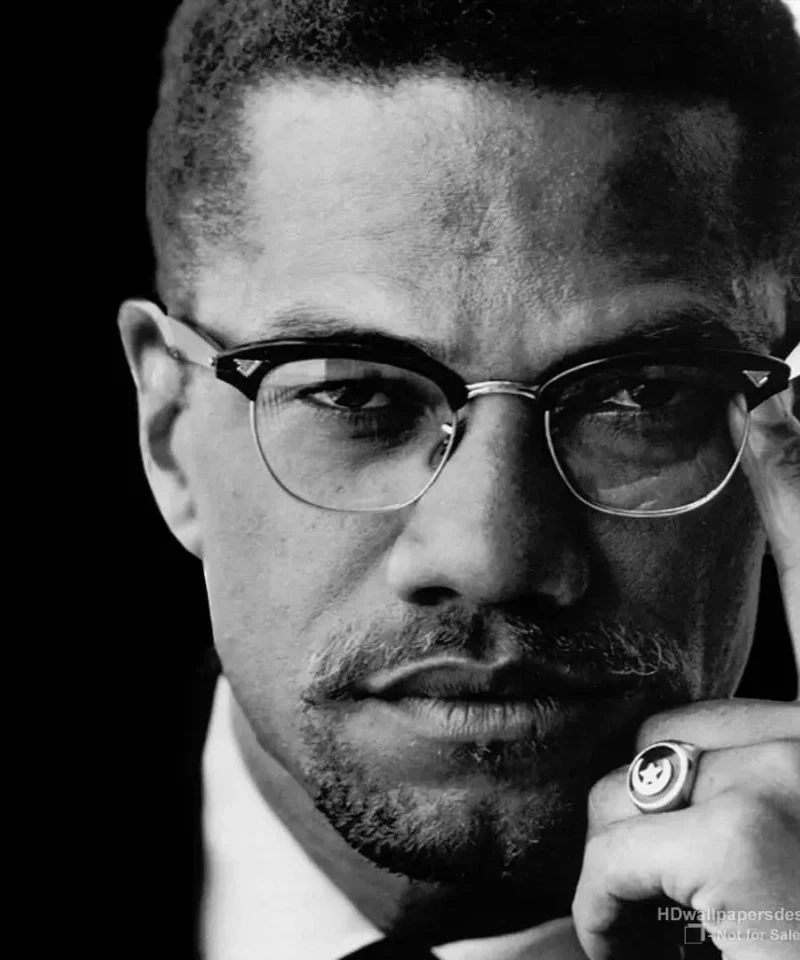
Omaha to Lansing: A Childhood Shaped by State Violence
Malcolm Little was born May 19, 1925, in Omaha, Nebraska, to Earl Little — a Baptist preacher and organizer for Marcus Garvey's Universal Negro Improvement Association — and Louise Norton Little, a homemaker from Grenada. He was the fourth of seven children. His father traveled the Midwest preaching Garvey's message of Black self-reliance and repatriation to Africa. For this, the family was targeted before Malcolm was born: Ku Klux Klan riders surrounded their Omaha home while Louise was pregnant, warning Earl to leave town.
They moved to Lansing, Michigan. In 1929, when Malcolm was four, their home was burned down — set ablaze, the family always maintained, by the Black Legion, a white supremacist organization. In 1931, Earl Little was found dead on the streetcar tracks, his body nearly cut in half. The official ruling was accident. The family was certain it was murder. Either way, a Black UNIA organizer was dead and his family was destitute.
The state then completed what the violence had started. Louise Little, struggling to hold the family together through the Depression, was declared legally insane by Michigan welfare authorities in 1939 — a judgment her children contested for the rest of their lives — and committed to Kalamazoo State Hospital, where she remained for 26 years. The children were split up and placed in foster care and state institutions. Malcolm, 13, was eventually placed with a white foster family in Mason, Michigan.
In Mason, Malcolm was an exceptional student — the only Black child in his class, voted class president. His English teacher, when Malcolm said he wanted to be a lawyer, told him that was "no realistic goal for a nigger" and suggested carpentry instead. Malcolm later said this was the moment something broke in him. He soon left Michigan for Boston, where his half-sister Ella Collins lived. He was 15.
Boston, Harlem, and Norfolk: The Education of Detroit Red
In Boston and then Harlem, Malcolm Little became "Detroit Red" — a street hustler, numbers runner, drug dealer, and small-time thief operating in the world of jazz clubs and underground economy that the war years had made briefly permissive. He was quick, stylish, and reckless. By 1946, at 20, he was arrested for burglary in Boston along with his associate Malcolm "Shorty" Jarvis. He was sentenced to eight to ten years — a sentence his defenders noted was dramatically heavier than the white women who had been involved in the same burglary ring received.
Charlestown State Prison, then Concord Prison, then Norfolk Prison Colony. What happened at Norfolk was the transformation that defined everything after. Malcolm's brother Reginald, who had converted to the Nation of Islam, wrote to him: "Don't eat any more pork, and don't smoke any more cigarettes. I'll show you how to get out of prison." Malcolm followed the instruction, began corresponding with NOI leader Elijah Muhammad, and over several years underwent the most complete intellectual and spiritual renovation in American autobiographical literature.
"I have often reflected upon the new vistas that reading opened to me. I knew right there in prison that reading had changed forever the course of my life. As I see it today, the ability to read awoke inside me some long dormant craving to be mentally alive."
— Malcolm X, The Autobiography of Malcolm X (1965)
At Norfolk, Malcolm had access to a substantial library — the prison was an experimental rehabilitative facility. He copied the entire dictionary by hand. He read voraciously: history, philosophy, linguistics, Gregor Mendel, H.G. Wells, Will Durant, W.E.B. Du Bois, Carter G. Woodson. He debated the Norfolk debate team — and won. He wrote constantly, in the careful, copperplate hand he had trained himself into. When he walked out of prison in 1952, he was not the same person who had walked in. He was Malcolm X — the X standing for the African family name stolen by slavery.
The Nation of Islam: Minister Malcolm X
From 1952 to 1964, Malcolm X was the Nation of Islam's most powerful public voice. He was assigned to Temple No. 7 in Harlem — which he rebuilt from a few dozen members to the largest NOI temple in the country. He was appointed National Representative of the Honorable Elijah Muhammad. He founded the NOI newspaper Muhammad Speaks. He became, by the early 1960s, arguably the second most recognized Black voice in America after Martin Luther King Jr. — and the FBI considered him far more dangerous.
The NOI's theology held that white people were a race of devils created by an evil scientist named Yacub, that Black people were the original humans, and that integration was a trap. Malcolm taught this — but the theology was, for many who listened, secondary to the practice: NOI members were clean, disciplined, off drugs and alcohol, building Black-owned businesses, protecting their communities, and demanding dignity without asking white permission for it. In the zones of Black urban poverty that the Great Migration had created and that white flight and redlining had abandoned, this was a program that worked.
"We don't want integration. We want separation. Not segregation — separation. There's a difference."
— Malcolm X, 1963
The media caricature of Malcolm X in this period — angry, violent, reverse-racist — missed the actual argument he was making, which was both more specific and more threatening: that integration into a burning building was not progress, that nonviolent compliance with people who were violently oppressing you was not a strategy, and that Black people had both the right and the responsibility to defend themselves "by any means necessary." The phrase was deliberately chosen — it was not an incitement to aggression, it was a statement of equivalence. White Americans had always reserved the right to armed self-defense. Malcolm was insisting Black Americans had it too.
The Break, the Hajj, and el-Hajj Malik el-Shabazz
In late 1963, Malcolm learned that Elijah Muhammad had fathered illegitimate children with multiple young NOI secretaries — a catastrophic violation of the moral code Muhammad preached and that Malcolm had upheld rigidly. He had, for years, refused to credit mounting evidence of this. When John F. Kennedy was assassinated in November 1963, Malcolm publicly commented that it was "chickens coming home to roost" — meaning that the violence America exported had returned to its source. Muhammad publicly silenced him for 90 days.
By March 1964, Malcolm had left the Nation of Islam. He was now, for the first time in twelve years, without an institutional home, with death threats from NOI members, under 24-hour FBI surveillance, and trying to build something new. He founded the Muslim Mosque, Inc. and then — crucially — the Organization of Afro-American Unity, modeled on the Organization of African Unity, explicitly Pan-African and non-religious.
In April 1964, he made the Hajj — the pilgrimage to Mecca required of all Muslims who are able. What he found there shattered the NOI's racial theology and rebuilt his worldview on a different foundation. He prayed alongside white Muslims from Eastern Europe, ate from the same bowl as Africans, Arabs, and Asians. He saw that Islam was not a racial religion, that white people were not categorically devils, and that the struggle he had been fighting needed to be understood as a human rights struggle — not a civil rights struggle, not a matter for American courts, but a matter for the United Nations and the international community.
"I have eaten from the same plate, drunk from the same glass, and slept in the same bed — while praying to the same God — with fellow Muslims whose eyes were the bluest of blue, whose hair was the blondest of blond, and whose skin was the whitest of white. And in the words and in the actions and in the deeds of the 'white' Muslims, I felt the same sincerity that I felt among the black African Muslims of Nigeria, Sudan, and Ghana. We were truly all the same — brothers."
— Malcolm X, letter from Mecca, April 1964
He returned as el-Hajj Malik el-Shabazz. The fire was still there — but the theology had expanded. He traveled to Africa, meeting with heads of state, addressing the Organization of African Unity, proposing that African nations bring the United States before the United Nations for human rights violations. He was building an international framework for Black liberation that the State Department found alarming enough to track his meetings abroad.
Assassination, Contested Memory, and the Long Afterlife
On February 21, 1965, Malcolm X was shot fifteen times while taking the stage at the Audubon Ballroom in Washington Heights, New York. He was 39. His wife Betty Shabazz and their four daughters were in the front row. Three men were convicted of the murder — all NOI members. Two of the three men convicted have since been exonerated (Khalil Islam and Muhammad Aziz, exonerated in 2021 after 55 years), with a Manhattan District Attorney's review concluding the FBI and NYPD had withheld material evidence that would likely have changed the verdicts. The full architecture of the assassination — who ordered it, what role state agencies played, what the FBI and NYPD knew and when — remains contested.
The contested nature of Malcolm X's legacy begins with the question of which Malcolm to inherit. The Malcolm of the NOI period — Black separatist, anti-integration, "the white man is the devil" — is the one the mainstream media crystallized in amber and uses to this day as a contrast with the "respectable" Martin Luther King Jr. The Malcolm of the last year — internationalist, post-racial in his theology while still Black nationalist in his politics, building coalitions, addressing the UN — is the one the Black Power movement, the Black Arts Movement, and subsequent generations found most generative.
The Autobiography of Malcolm X, written with Alex Haley and published posthumously in 1965, is one of the most widely read books in American educational history. It is also a document that was still being revised when Malcolm died — the last chapters, dealing with his post-Mecca transformation and the founding of the OAAU, were written in the weeks before the assassination. Some scholars argue the book, as published, understates how much his politics had changed and how far he was moving away from racial essentialism at the end.
Malcolm X's life is a direct product of the chain this site traces: his father targeted and killed for organizing in the Garveyite tradition; his mother institutionalized by welfare authorities; his own criminalization and imprisonment as a young Black man in mid-century America; his FBI surveillance under COINTELPRO; his assassination in circumstances that implicate state agencies. His analysis of that chain — that Black suffering in America was not the result of individual failure but of systematic institutional design — is the analytical framework this site is built on.
Read: Mass Incarceration thread →Read: The War on Drugs — Nixon's Confession →
"By any means necessary" was not a call to violence. It was a statement about equivalence.
White Americans had always claimed the right to defend themselves, their property, and their political interests by any means available. Malcolm X said Black Americans had the same right. The statement was radical only because the equivalence was radical.