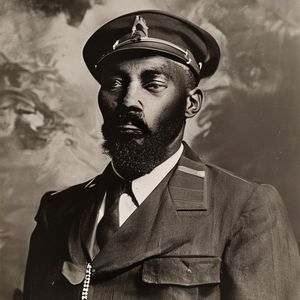
From Jamaica to Harlem: 1887–1916
Marcus Mosiah Garvey Jr. was born in St. Ann's Bay, Jamaica, in 1887. He trained as a printer, became involved in labor organizing, traveled through Central America documenting the conditions of Black migrant workers, and studied in London, where he encountered Pan-African thought and the writings of Booker T. Washington. In 1914 he founded the Universal Negro Improvement Association (UNIA) in Jamaica. Getting little traction there, he moved to Harlem, New York in 1916 — arriving in the city that was becoming the center of Black intellectual and cultural life in America.
The UNIA and Black Economic Nationalism
In Harlem, Garvey's oratory and vision drew massive crowds. The UNIA grew explosively during and after World War I, when Black soldiers who had fought for American democracy returned to Jim Crow America — and found that fighting for the United States had purchased them nothing. Garvey offered an alternative framework: not integration into a white-dominated society, but Black self-determination, economic independence, and Pan-African solidarity.
"Up, you mighty race! You can accomplish what you will."
The UNIA established the Black Star Line, a shipping company intended to facilitate trade and immigration between Africa, the Caribbean, and North America. It founded Negro World, a weekly newspaper that reached 200,000 readers in multiple languages. By 1920, the UNIA's first International Convention filled Madison Square Garden and drew delegations from 25 countries. Estimates of membership range from 1 to 6 million.
J. Edgar Hoover and the Dismantling of the UNIA
J. Edgar Hoover, then a young official at the Bureau of Investigation, identified Garvey as a threat as early as 1919 and assigned agents to infiltrate the UNIA. In 1922, Garvey was indicted for mail fraud related to the Black Star Line's stock sales — a prosecution widely seen as politically motivated. He was convicted in 1923, sentenced to five years, and imprisoned in Atlanta Federal Penitentiary in 1925.
President Coolidge commuted his sentence in 1927 but immediately deported him as an alien. Garvey returned to Jamaica, then London, where he died in 1940. He never returned to the United States. The FBI's targeting of Garvey was a direct precursor to COINTELPRO — the same playbook of surveillance, infiltration, and legal harassment used against the Civil Rights Movement and Black Panthers decades later.