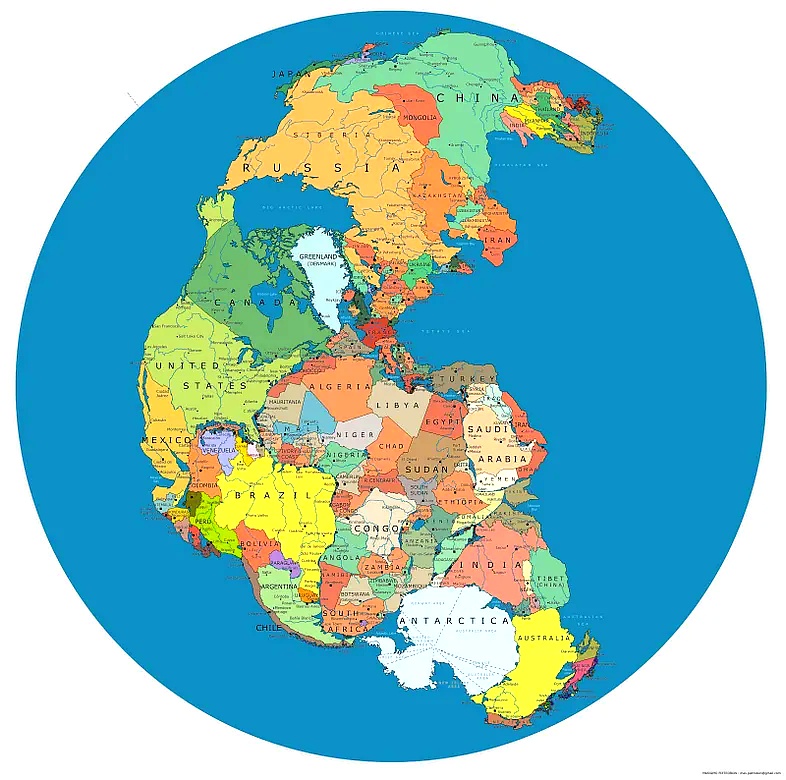
Out of Africa: The Original Diaspora and the Human Family Tree
The oldest fossils of Homo sapiens come from Africa — the Jebel Irhoud site in Morocco (dated to ~300,000 years ago) and Omo Kibish in Ethiopia (~195,000 years ago). Every genetic study of human diversity reaches the same conclusion: all living humans descend from African ancestors. Africa contains more genetic diversity within its population than the rest of the world combined — because modern humans have lived there longest. Every other population is a subset of African genetic variation.
The first major migration out of Africa occurred roughly 60,000–70,000 years ago, when a small group of Homo sapiens crossed into what is now the Arabian Peninsula and began the peopling of Asia, Europe, Australia, and the Americas. All non-African humans today descend from that founding population. The population that stayed in Africa diversified further. The population that left carried a genetic snapshot of one moment in African history.
This means there is no such thing as a human being who is not, in origin, African. The question of the African diaspora is not “how did African people end up elsewhere?” The question is “how did everyone end up elsewhere, and what were the conditions of each departure?” The first diaspora was free. The second was not.
The Transatlantic Slave Trade: 12.5 Million People, 400 Years, the Forced Diaspora
Between approximately 1500 and 1900, an estimated 12.5 million African people were forcibly transported across the Atlantic Ocean to the Americas. This is the documented figure from the Trans-Atlantic Slave Trade Database (slavevoyages.org) — the most comprehensive scholarly accounting of the trade. The actual number is likely higher; the database documents approximately 36,000 individual voyages, and records for many voyages do not survive.
Of the 12.5 million who embarked, approximately 10.7 million survived the Middle Passage. Roughly 1.8 million people — nearly 15% — died at sea. The survivors were distributed across the plantation economies of Brazil (the largest single recipient: ~4.9 million people), the Caribbean (~4 million), Spanish South America (~1.3 million), and British North America (~390,000 — the ancestors of the majority of African Americans today).
The trade was not only transatlantic. The Indian Ocean slave trade, the trans-Saharan slave trade, and the East African slave trade dispersed additional millions of Africans into the Middle East, South Asia, and the Indian Ocean world over the same centuries. The total forced displacement of Africans across all slave trades from the 15th through the 19th centuries is estimated at 15–20 million people.
The African American Great Migration: The Diaspora Within the Diaspora
After emancipation in 1865, the 4 million formerly enslaved people in the American South were technically free but materially trapped — by sharecropping debt, by Black Codes and then Jim Crow law, by the convict leasing system, and by the systematic terror of the Ku Klux Klan and vigilante lynching. The freedom granted by the 13th Amendment did not include the freedom to leave the land, to accumulate wealth, to vote, or to move without risk of death.
Between approximately 1910 and 1970, six million Black Americans left the South in what historians call the Great Migration — one of the largest internal relocations in American history. They moved to Northern cities (Chicago, Detroit, Philadelphia, New York), to Midwestern industrial centers, and to West Coast cities (Los Angeles, Oakland, Seattle). They moved to escape racial terror, to find industrial employment, and to build lives outside the caste system of the Jim Crow South.
The Great Migration remade American culture. Jazz and blues traveled north with the migrants and became the foundation of American popular music. Chicago’s South Side, Harlem in New York, and Detroit’s Black Bottom became centers of Black cultural and political life. The Black voter base that shifted to the Democratic Party in the 1930s was the Great Migration’s political legacy. The neighborhood segregation, school segregation, and wealth gaps that persist in Northern cities today are the Great Migration’s unresolved inheritance — because the cities migrants moved to practiced their own forms of exclusion through redlining, restrictive covenants, and urban renewal.
The African Diaspora Today: 200–300 Million People Across Every Inhabited Continent
The African diaspora today encompasses an estimated 200 to 300 million people living outside the African continent — descendants of the slave trade, of colonial-era labor displacement, of post-independence voluntary migration, and of every other mechanism by which African people and their descendants have been distributed across the globe. Brazil has the largest population of African descent outside Africa, with approximately 56% of its population — roughly 120 million people — identifying as Black or mixed-race. The United States has approximately 40 million Black Americans. The Caribbean nations are majority African-descended. Significant African-descended populations exist in Colombia, Venezuela, Peru, the Dominican Republic, Cuba, and throughout Central America.
Beyond the Atlantic world: African-descended communities exist in India (the Siddis, descendants of East African migrants and enslaved people who arrived via the Indian Ocean trade), in the Arabian Peninsula (the Afro-Arab communities of Oman, Yemen, and Kuwait), in Southeast Asia, and — through very recent migration — in China, Australia, and every other inhabited part of the world. No inhabited continent is without African-descended people.
The pan-African philosophical tradition — from Marcus Garvey’s Universal Negro Improvement Association to the African Union’s recognition of the “Sixth Region” of the diaspora as a full member constituency — has long argued that this geographic dispersal does not represent fragmentation. It represents the reach of a civilization that was always central to human history, and whose descendants carry that centrality with them wherever they are.
“Africa is not just where we came from. Africa is what we carry. The diaspora does not end at the shoreline — it extends as far as any of us have traveled.”
— Paraphrasing the core argument of pan-African thought, from W.E.B. Du Bois through the African Union’s Sixth Region designation (2005)What Pangaea Tells Us: The Geography of Belonging
The Pangaea map is not a curiosity. It is an argument. When you look at today’s national borders overlaid on a single continent, you see something that political geography normally obscures: the artificial nature of every border that claims to divide “us” from “them.” Every line drawn on today’s maps was drawn by human beings, usually by men with weapons, in the last few hundred years. The land was there for hundreds of millions of years before any of those lines existed.
Africa drifted to where it is now. So did Europe. So did the Americas. The Atlantic Ocean — which became the central artery of the slave trade — is a wound in the earth, the scar of a continental separation that took 130 million years to fully open. The slave ships crossed a gap that was once solid rock. The people they carried were returning, in a grotesque parody of migration, to lands their ancestors had once walked to without crossing any water at all.
The diaspora did not scatter African people into foreign lands. It scattered them into the geological neighborhood. Brazil and Nigeria were once the same land. The people enslaved in one place and taken to the other were traveling across the inside of a world that their deep ancestors had never left. The Pangaea map does not make the history of the slave trade any less monstrous. It makes the monstrousness more precise: people were taken from the center of the human world and forced to build the edges of it, for free.
Understanding the diaspora through this lens does not diminish the specific cultures, languages, religions, and identities that African-descended people have built in every corner of the globe. It deepens them. The Afro-Brazilian traditions, the Caribbean religions, the African American vernacular culture, the Afro-Colombian musical traditions, the Afro-Mexican communities — these are not pale copies of something left behind in Africa. They are new forms of a civilization that has always been capable of reinventing itself wherever it lands, because it invented itself the first time on the continent that became the center of the Pangaea map.