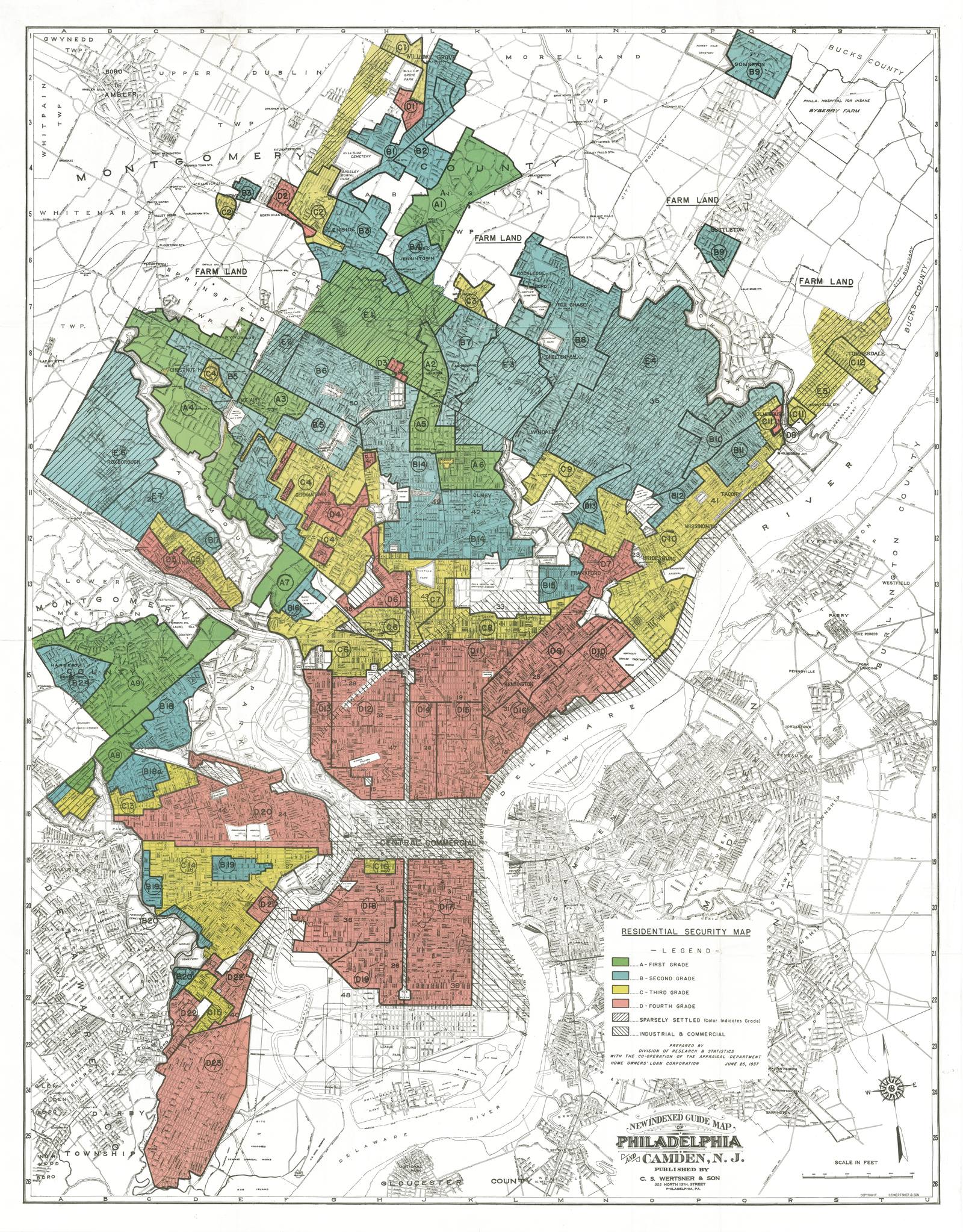
The Setup: Redlining, Disinvestment, and the Creation of "Blighted" Neighborhoods
Gentrification does not begin with the arrival of coffee shops. It begins with the deliberate devaluation of Black neighborhoods through federal policy. Redlining (1934–1968) denied mortgages and insurance to residents of "hazardous" — predominantly Black — neighborhoods, preventing homeownership, disinvestment in maintenance, and equity accumulation. Urban renewal (1949–1973) destroyed viable Black neighborhoods to build highways and public housing projects that concentrated poverty. White flight and the movement of retail and jobs to suburbs depleted the tax base of cities with large Black populations.
By the 1970s and 1980s, many Black urban neighborhoods are caught in a feedback loop: disinvestment reduces property values, reduced property values reduce tax revenue, reduced tax revenue reduces city services, reduced services make the neighborhood less attractive, which reduces property values further. The neighborhood is not blighted because Black people live there. It is blighted because federal policy made it so. And once it is blighted, the same political economy that created the blight begins to see it as an opportunity.
How Gentrification Works: Capital, Speculation, and the Displacement Cascade
Gentrification typically follows a sequence. First, artists and low-income white residents move into a Black neighborhood because rents are cheap — often specifically because of the disinvestment that has kept rents low. Their presence signals to real estate speculators that the neighborhood is on the verge of "turning." Developers begin buying properties. The city, seeing an opportunity for rising tax revenue, increases code enforcement and permits for renovations. Rents rise. Long-term Black residents — renters, mostly, because redlining prevented their parents from buying — cannot afford the increases and are displaced.
In Harlem — the cultural capital of Black America for a century — the percentage of Black residents fell from 99% in 1990 to 54% by 2015. In Washington D.C.'s Shaw neighborhood, formerly the heart of Black D.C., Black residents went from 80% to 28% between 2000 and 2020. In Atlanta's Old Fourth Ward — the birthplace of Martin Luther King Jr. — the Black population declined by 30% between 2000 and 2015. The same communities that produced the Harlem Renaissance, the civil rights movement, and Black cultural production for a century are being systematically replaced by people who can afford the rents that historic disinvestment had previously made impossible.
"Gentrification is not about coffee shops. It's about who can stay and who gets pushed out — and the answer follows a racial map drawn decades ago by federal policy."
— Richard Rothstein, The Color of Law, 2017The Debate: Who Owns a Neighborhood's Future?
The standard defense of gentrification — that it improves neighborhoods, reduces crime, and increases the tax base — contains partial truths that obscure the central question: who benefits? Property values rise, but the people who held on through decades of disinvestment are renters, not owners, so they don't capture the equity gains. Crime often does fall, but displaced residents move to other neighborhoods where crime follows. Schools improve in gentrifying neighborhoods, but the children of displaced families are now in different schools.
The counter-organizing has produced real tools: community land trusts (where land is held in trust for the community, removing it from the speculative market), tenant protection laws, anti-displacement funds, and right of return policies (giving displaced residents priority access to new affordable units built in their former neighborhood). Cities like Portland, Oakland, and Washington D.C. have experimented with these policies with mixed results. The structural constraint is that gentrification is profitable for landowners, developers, and city governments — and they have more political power than the people being displaced.
The deepest irony of gentrification: the cultural production that makes neighborhoods desirable — the music, the food, the community identity, the creative energy — is almost always produced by the Black and brown residents who are then displaced by the people who come to consume it. The neighborhood is commodified. The creators are removed. The commodity remains, marketed to new residents who may not know the history of what they are buying into.