3
Enslaved women repeatedly operated on without anesthesia
30+
Operations on one woman, Anarcha, in four years
1845
Experiments began — Sims's statue stood in Central Park until 2018
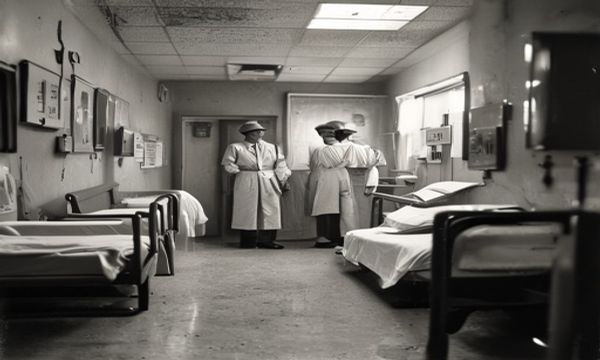
J. Marion Sims is credited in medical textbooks as the "father of modern gynecology." He developed the surgical technique for repairing vesico-vaginal fistulas — a debilitating complication of childbirth. He developed this technique by performing repeated surgeries, without anesthesia, on enslaved Black women in Montgomery, Alabama, between 1845 and 1849.
The three women whose bodies he used most extensively — Anarcha, Betsey, and Lucy — are named in his memoirs. Anarcha underwent more than 30 operations over four years. Sims justified operating without anesthesia on the widely held medical belief of the era that Black people did not feel pain the same way white people did — a pseudoscientific claim with no biological basis that originated in the slave economy as a justification for brutal labor conditions. This belief was not eradicated with the end of slavery. Studies as recent as 2016 found that half of medical students and residents endorsed false beliefs about Black pain tolerance, leading to under-treatment of pain in Black patients today.
The myth that persists in medicine
A 2016 study in the Proceedings of the National Academy of Sciences found that 50% of medical students and residents believed at least one false biological difference between Black and white people — including that Black people's skin is thicker, that they have fewer nerve endings, and that their blood coagulates more quickly. These beliefs led those students to rate Black patients' pain as lower and prescribe less pain medication. The pseudoscience of 1845 is still shaping treatment decisions in 2024.
399
Black men enrolled with syphilis — untreated for 40 years
1947
Year penicillin became the standard cure — study continued anyway
28
Men who died of syphilis directly; 100+ deaths total
Beginning in 1932, the U.S. Public Health Service enrolled 399 Black men with syphilis in Macon County, Alabama, in a study that told them they were receiving treatment for "bad blood." They were not. The study's purpose was to observe the natural progression of untreated syphilis in Black men — based on the racist premise that the disease manifested differently in Black bodies. The men received no treatment. They received placebos, aspirin, and vitamins. They were told this was medicine.
In 1947, penicillin became the standard cure for syphilis. The Public Health Service did not inform the study participants or offer them treatment. The study continued for 25 more years. When the study was finally exposed by journalist Jean Heller in 1972, 28 men had died of syphilis, 100 had died of related complications, 40 wives had been infected, and 19 children had been born with congenital syphilis. President Clinton issued a formal apology in 1997 — 65 years after the study began and 25 years after it ended. The legacy of Tuskegee — documented in research — continues to reduce Black Americans' willingness to participate in medical trials and to trust healthcare providers.
"The legacy of the Tuskegee study is a deadly one — it is the reason so many Black Americans today hesitate to trust the healthcare system with their bodies."
— Harriet Washington, Medical Apartheid, 2006
1951
Cells taken from Henrietta Lacks without consent
$Billions
Generated by HeLa cells — her family received nothing
70+ yrs
HeLa cells have been used in research — the family learned in 1973
In 1951, Henrietta Lacks — a 31-year-old Black woman from Baltimore — was treated for cervical cancer at Johns Hopkins Hospital. During her treatment, a doctor removed samples of her cells without her knowledge or consent. Those cells — labeled HeLa — turned out to be remarkable: unlike any other human cells scientists had worked with, they survived and reproduced indefinitely in laboratory conditions. They became the most important biological material in the history of medicine.
HeLa cells were used in developing the polio vaccine, cancer research, gene mapping, HIV research, COVID-19 vaccine development, and thousands of other medical breakthroughs. They have been bought, sold, and commercialized for decades by a global industry worth billions of dollars. Henrietta Lacks died in 1951. Her family did not learn that her cells existed until 1973. They received no compensation. Multiple companies continued to profit from her cells for decades without her family's knowledge or consent. In 2023, a federal judge dismissed a lawsuit by her family against Thermo Fisher Scientific, ruling that too much time had passed. The statute of limitations had run out. The commercial exploitation had not.
75%
Of hazardous waste facilities in the U.S. are in majority non-white communities
2016
Flint water crisis — 100,000 residents exposed to lead; majority Black city
50x
Higher cancer risk in Louisiana's "Cancer Alley" — majority Black corridor
Environmental racism refers to the systematic pattern by which hazardous facilities — chemical plants, waste dumps, refineries, highways — are sited in Black and low-income communities. The pattern is documented across the United States. The original EPA environmental justice report (1992) found that race was the most significant predictor of proximity to hazardous waste sites — more significant than income. Communities with political power successfully fought these facilities. Communities without it did not.
In Flint, Michigan, cost-cutting state officials switched the city's water supply to the Flint River in 2014 without adequate treatment. The corrosive water leached lead from aging pipes. 100,000 residents — in a majority-Black city — were exposed to elevated lead levels for 18 months before state officials acknowledged the problem. Lead causes irreversible neurological damage in children. Louisiana's "Cancer Alley" — an 85-mile stretch of the Mississippi River between Baton Rouge and New Orleans lined with 150+ petrochemical plants — has cancer rates 50 times the national average. It is majority Black. These are not coincidences of geography. They are decisions made by regulators who responded to political power, and Black communities had less of it.
💧
Flint, Michigan
2014–2016 — Lead contamination in 100K residents; state officials knowingly delayed response
🏭
Cancer Alley, Louisiana
150+ petrochemical plants in majority-Black corridor; cancer rates 50x national average
🛣️
Urban Highways
1950s–1970s — Interstate highways routed through Black neighborhoods, destroying communities and increasing pollution exposure
3.5x
Higher maternal mortality rate for Black women vs. white women
69.9
Black maternal deaths per 100,000 live births (2021)
80%
Of maternal deaths are preventable, per the CDC
Black women in the United States die from pregnancy-related complications at 3.5 times the rate of white women. The disparity persists across all income levels and education levels — a Black woman with a college degree faces higher maternal mortality risk than a white woman who did not finish high school. This is not explained by poverty or access alone. Research consistently points to two drivers: the physical toll of chronic stress from racism (the "weathering hypothesis") and systemic failures by healthcare providers to take Black women's symptoms seriously.
Serena Williams nearly died after giving birth in 2018 — she had to insist that nurses take her report of shortness of breath seriously before a pulmonary embolism was detected. Her case is not exceptional; it is representative. Studies show that Black patients' self-reported pain and symptoms are more frequently dismissed by providers. The maternal mortality crisis is documented, the causes are known, and the CDC says 80% of these deaths are preventable. They continue. In 2021, 69.9 Black women died per 100,000 live births — a rate comparable to some low-income countries and far higher than any other wealthy nation.
"I almost died after giving birth. I'm one of the lucky ones. I know that. A lot of women aren't as lucky."
— Serena Williams, Vogue, 2022
2x
Black COVID death rate vs. white in early pandemic
Last
Black communities received vaccines last despite dying first
3
Conditions driving disparity: comorbidities, essential work, housing density — all policy outcomes
In the spring of 2020, as COVID-19 spread across the United States, the racial data became impossible to ignore. Black Americans were dying at twice the rate of white Americans. The explanation offered by media and officials was "comorbidities" — higher rates of diabetes, hypertension, and obesity in Black communities. This was true. It was also the wrong conclusion. Those comorbidities are themselves the product of everything in this thread — environmental racism increasing pollution exposure, chronic stress from discrimination raising blood pressure, food deserts in redlined neighborhoods limiting diet quality, and economic exclusion limiting healthcare access.
Black and Hispanic Americans were also more likely to hold "essential worker" jobs — unable to work from home, exposed daily in warehouses, meatpacking plants, transit systems, and care facilities. They were more likely to live in multigenerational housing where isolation was impossible. When vaccines became available, distribution was handled through systems — pharmacies in suburbs, employer-based programs, technology-dependent registration — that favored white communities. The communities that died first in the pandemic were vaccinated last.
The comorbidities are the history
Higher rates of hypertension in Black Americans are explained in part by the "weathering hypothesis" — chronic stress from experiencing racism accelerates biological aging. Higher rates of diabetes are explained in part by food deserts in redlined neighborhoods. The "comorbidities" cited as individual risk factors are themselves the consequences of structural racism. The pandemic didn't create the disparity. It measured it.