Chain · Era 5 · Jim Crow Era
Jim Crow Era · 1862–1931

Ida B. Wells:
The Woman Who Documented American Terror

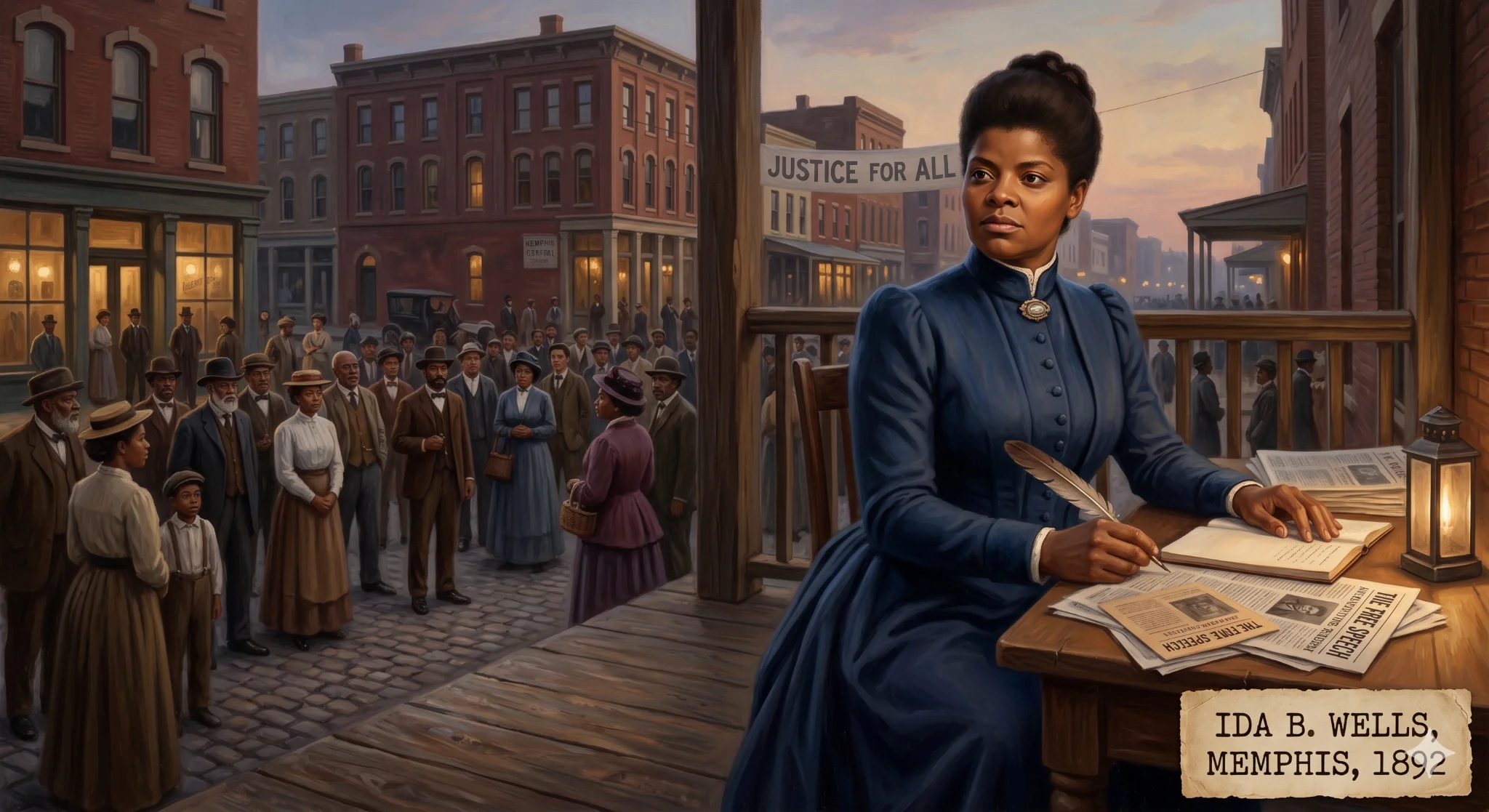
Ida B. Wells was a journalist, suffragist, civil rights activist, and the person who proved — with data — that lynching was not about rape or crime. It was about economics and political control. When three of her friends were lynched in Memphis in 1892 for running a grocery store that competed with a white-owned store, Wells launched an investigation that produced the first systematic documentation of American lynching. White Memphis destroyed her newspaper and threatened her life. She never returned to the South. She took her data to Britain, to Congress, and to the world.

Born
July 16, 1862 — Holly Springs, Mississippi
Free Speech destroyed
1892, Memphis — Wells forced into exile
Documented
3,000+ lynchings in Southern Horrors, A Red Record
Ida B Wells
The Central Argument

Ida B. Wells did not just report on lynching — she proved that the 'rape' justification was a lie invented to justify economic and political terror. Her investigation of hundreds of documented cases showed that the majority of lynching victims were not accused of rape at all; that most were accused of economic competition, political activity, or social transgression; and that white-on-Black rape went systematically unpunished while the accusation of Black-on-white rape became a death warrant. She published this in 1892. She was called a liar by Southern newspapers and a troublemaker by Northern ones. She was right about all of it.

The Journalist · 1892–1909
01
March 9, 1892

The Lynching That Made Her a Crusader

Memphis, Tennessee

Tom Moss, Calvin McDowell, and Henry Stewart owned the People's Grocery in Memphis — a cooperative store in a Black neighborhood that had taken business away from a white-owned grocery across the street. On March 9, 1892, all three were taken from jail by a white mob and lynched. The city of Memphis used the incident to crush Black economic competition: the People's Grocery was looted and destroyed, and the city seized the opportunity to run the Memphis street railway, which Black residents had been successfully boycotting over segregation.

Tom Moss was Wells's close friend and the godfather of her daughter. His last words, according to witnesses, were: "Tell my people to go west — there is no justice for them here." Wells wrote a furious editorial. Within weeks, white citizens had destroyed her newspaper, the Free Speech, and threatened her life. She was in Philadelphia at the time. She never returned to Memphis.

02
1892–1900

Southern Horrors: The Data That Disproved the Lie

New York · London · Edinburgh
728
Lynchings documented in A Red Record (1895), 1892–94 alone
Of victims accused of rape — the majority were killed for other reasons

In exile in New York, Wells published Southern Horrors: Lynch Law in All Its Phases (1892) and A Red Record (1895). Using white Southern newspapers as her sources — documents that could not be dismissed as Black propaganda — she documented that the rape justification for lynching was fabricated: most victims were accused of murder, theft, economic competition, or simply "being uppity." Many accusers were white women in consensual relationships with Black men that became dangerous when discovered. The documentation was meticulous and devastating.

Wells took her findings to Britain in 1893 and 1894, generating international condemnation of American lynching that embarrassed the Cleveland administration. Southern newspapers responded by calling her a "Negro adventuress." Frederick Douglass, who had initially been skeptical, wrote her a letter calling her work "a revelation" and admitting he had not fully understood the economics of lynching before reading it.

"The way to right wrongs is to turn the light of truth upon them."

— Ida B. Wells
03
1909–1931

Co-Founder of the NAACP — Then Erased From Its History

Chicago, Illinois

In 1909, Wells was one of the co-founders of the NAACP, alongside W.E.B. Du Bois, Mary Church Terrell, Oswald Garrison Villard, and others. She was one of two Black women at the founding meeting. Within a decade, she had been largely pushed to the margins of the organization — too radical, too confrontational, and insufficiently deferential to the white liberal donors who funded it. She continued organizing in Chicago: fighting residential segregation, documenting the 1919 race riot, campaigning for women's suffrage while arguing that white suffragists were wrong to sacrifice Black women's votes to secure Southern white women's support.

Wells died in 1931. She was largely forgotten by mainstream history for decades. In 2020, she was awarded a posthumous Pulitzer Prize for "outstanding and courageous reporting on the horrific practice of lynching." The Pulitzer citation did not mention that she had done the work 128 years earlier, that white newspapers had called her a liar, or that the country had not passed federal anti-lynching legislation until 2022 — 91 years after her death.

The Tradition She Built

Wells invented investigative journalism in service of civil rights. That tradition runs directly to today.

The practice of documenting racial violence with evidence — to force accountability on a system designed to avoid it — runs from Wells's Red Record to the NAACP's anti-lynching campaigns to the Mapping Police Violence database.

Next in the chain
W.E.B. Du Bois: The Architect of Black Consciousness
Continue →