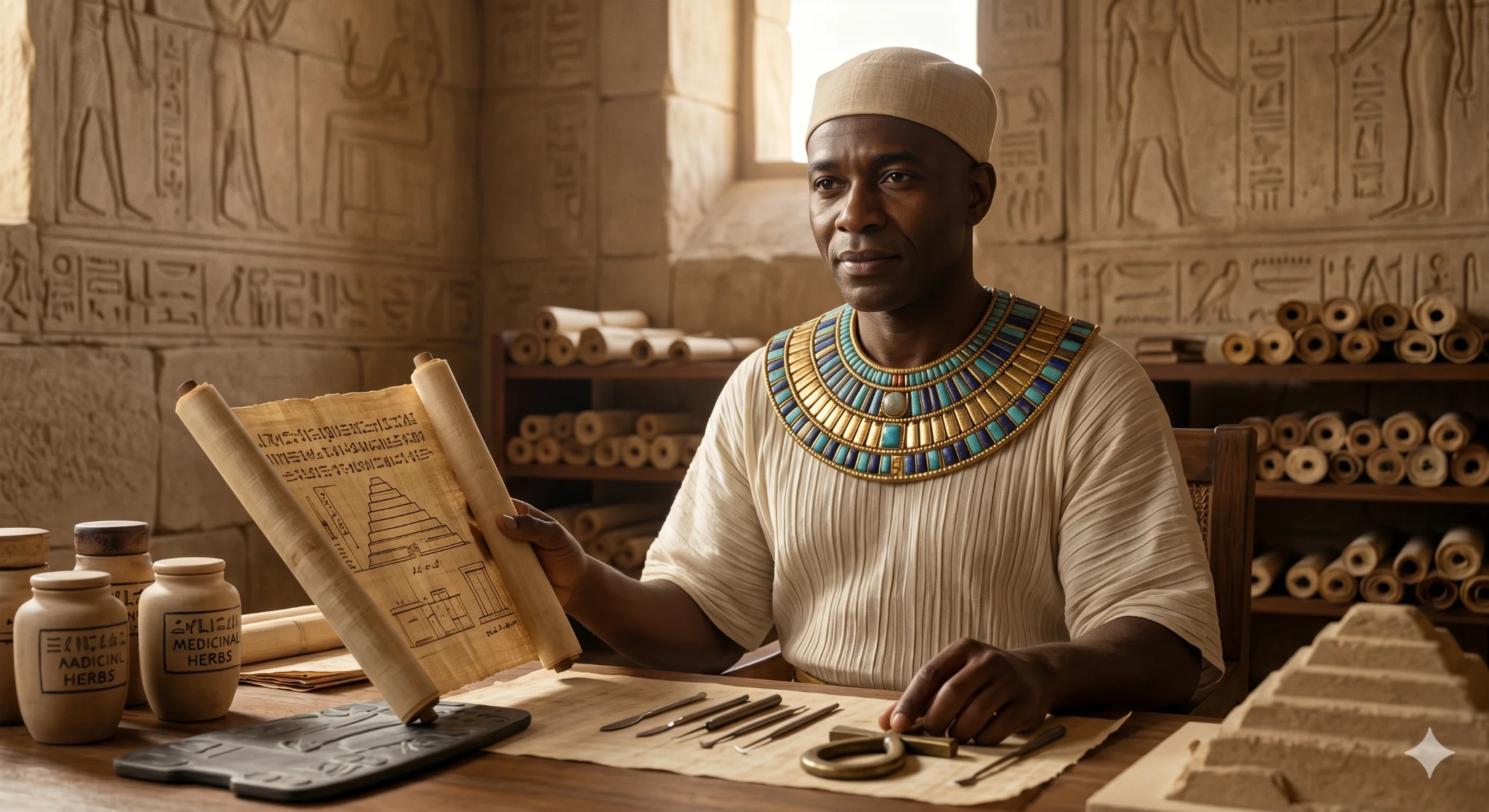
Who Imhotep Was: The Most Accomplished Person in the Ancient World
Imhotep was born a commoner — not a king, not a prince. He rose to become the Grand Vizier (prime minister) of Pharaoh Djoser of the Third Dynasty, serving as the highest-ranking official in Egypt around 2650 BCE. His recorded titles are staggering in their breadth: Chancellor of the King of Lower Egypt, First After the King of Upper Egypt, Administrator of the Great Palace, Hereditary Nobleman, High Priest of Heliopolis, Builder, Chief Carpenter, Chief Sculptor, Maker of Vases in Chief.
These titles are not honorary. They reflect actual accomplishments. Imhotep designed and supervised the construction of the Step Pyramid of Saqqara — the first large stone structure ever built in human history. Before this, Egyptian monumental architecture used mud brick. Imhotep was the person who figured out how to build in stone. He invented architectural techniques that would define Egyptian civilization for 2,700 years.
He was not a legend invented later. His name appears in inscriptions from his own lifetime, carved into the base of statues of Pharaoh Djoser at Saqqara — a uniquely high honor for a non-royal official. No other commoner in Egyptian history before him was given this distinction. He was recognized as extraordinary while he was alive.
The Edwin Smith Papyrus: Rational Medicine Before Hippocrates
What made Imhotep revolutionary in medicine was not magic or prayer — it was rational, empirical observation. The Edwin Smith Papyrus, an ancient Egyptian medical text dating to approximately 1600 BCE but widely believed by scholars to derive from writings attributed to Imhotep more than a thousand years earlier, is the oldest known surgical text in the world. It documents 48 cases of injury — wounds, fractures, dislocations, tumors — described with clinical precision.
For each case, the text records the presenting symptoms, a diagnosis, a prognosis (using one of three verdicts: an ailment I will treat, an ailment I will contend with, an ailment not to be treated), and the treatment. The language is systematic and observational — not supernatural. There are no incantations in the surgical sections. This is medicine as a rational discipline, developed in Africa, 1,000 years before Hippocrates was born.
"The Edwin Smith Papyrus is, in the history of science, one of the most remarkable documents ever written. It is the earliest known scientific document. It is African. It predates Greek medicine by a thousand years."
— James Henry Breasted, The Edwin Smith Surgical Papyrus, 1930The papyrus describes the anatomy of the brain, the meninges, the cerebrospinal fluid, and recognizes that brain injuries could cause paralysis on the opposite side of the body — a concept (contralateral control) that would not be rediscovered in Western medicine until the 19th century. Egyptian physicians understood how the brain controlled the body 3,600 years before European medicine caught up.
Deification: The Greeks and Romans Worshipped Imhotep as a God
After his death, Imhotep was elevated in stages over centuries. By the Middle Kingdom (c. 2000 BCE), he was venerated as a sage. By the Late Period (c. 525 BCE), he had been fully deified — worshipped as a god of medicine and healing. Temples were built in his name. Pilgrims sought cures at his shrines. Physicians in Egypt left votive offerings at his sanctuaries.
When the Greeks came to Egypt — and they came often, including Pythagoras, Plato, and Solon, who all traveled to study in Egypt — they encountered Imhotep. They equated him with their own god of medicine, Asclepius. Roman physicians worshipped him. The Emperor Augustus made offerings at his temple. Imhotep was, for centuries of Mediterranean antiquity, the recognized founding figure of the healing arts.
Greek historian Manetho wrote of Imhotep: "Imuthes, because of his medical skill, holds a place among the gods." The Egyptologist Sir William Osler — one of the founders of modern Western medicine — called Imhotep "the first figure of a physician to stand out clearly from the mists of antiquity." The record is there. The choice to center Hippocrates instead is a choice, not a discovery.
The Erasure: How Hippocrates Became "The Father of Medicine"
Hippocrates (c. 460–370 BCE) was a real physician and an important one. He contributed to the systematization of Greek medical practice and is associated with the Hippocratic Corpus — a collection of texts that may or may not have been written by him personally. He is credited with separating medicine from supernatural superstition in the Greek context — a genuine contribution.
But he did not invent rational medicine. He inherited it — from Egyptian physicians whose tradition he explicitly acknowledged. Ancient Greek writers were relatively candid about Egypt's influence on Greek learning. What changed was 19th-century European scholarship, which needed to construct a narrative of Western civilization as an autonomous achievement, independent of African or Eastern origins. "The Father of Medicine" designation was formalized in this era — an era when European anthropology was simultaneously arguing that Black Africans were incapable of civilization.
"The Greeks themselves acknowledged that their medicine, their philosophy, and their mathematics came from Egypt. It is modern European scholarship that erased the African source and called the European branch the origin."
— Cheikh Anta Diop, Civilization or Barbarism, 1981The pattern is consistent across disciplines: African and Egyptian roots of Greek mathematics, philosophy, astronomy, and medicine were acknowledged in antiquity and erased in modernity. Imhotep is not a marginal figure waiting to be "discovered." He was known. He was worshipped. He was then quietly deprioritized when the construction of "Western civilization" required the ancient world to begin in Greece.
What Imhotep's Story Means for How We Teach History
Imhotep is not a niche correction to a minor footnote. He represents the operating principle behind the erasure of African intellectual history: the contributions exist, the evidence exists, and the choice to omit is deliberate. His case is useful precisely because it is so clean. The evidence for his primacy in medicine is not contested — it is simply not taught.
The Step Pyramid of Saqqara still stands at Saqqara, 4,600 years later. The Edwin Smith Papyrus is in the New York Academy of Medicine. Imhotep's name is in hieroglyphic inscriptions from his own lifetime. The Greeks called him a god. None of this is disputed. What is missing is its inclusion in how we teach the origins of science, architecture, and medicine.
When students are taught that science began in Greece, that rational medicine began with Hippocrates, that architecture began with Rome, they are being taught a mythology — not history. The correction is not about replacing one hero with another. It is about understanding that human knowledge is African in its oldest layers, and that every other civilization built on a foundation that was already there.