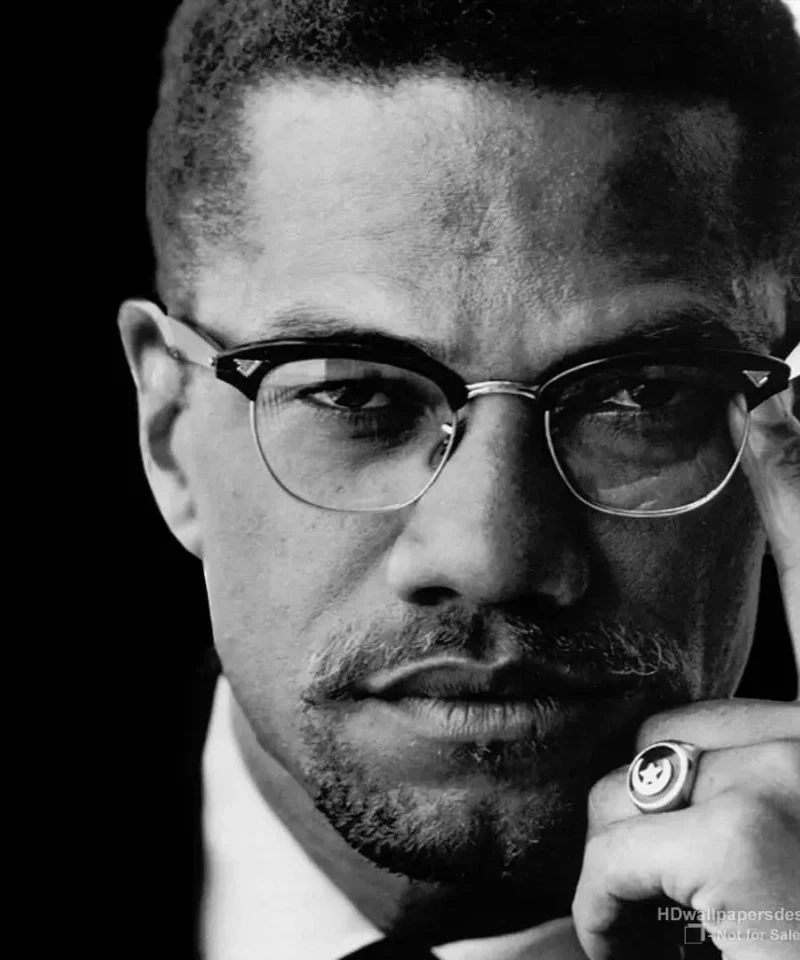
Chain · Era 7 · Civil Rights
Civil Rights · 1925–1965

Malcolm X:
By Any Means Necessary

Malcolm X was the most honest voice of Black American rage in the 20th century. Born Malcolm Little in 1925, his father was killed by white supremacists, his mother institutionalized, his family scattered by the state. He spent his twenties in prison, where he became a Muslim and a reader. He emerged as the Nation of Islam's most brilliant spokesperson — and was surveilled, infiltrated, and ultimately helped toward his assassination by the FBI's COINTELPRO program. He was murdered at 39, the same age as Martin Luther King Jr., 3 years before King. His evolution — from the Nation of Islam's racial separatism to universal human rights in the year before his death — makes him one of the most significant political thinkers of the 20th century.

Born
May 19, 1925 — Omaha, Nebraska
NOI minister
1952–1964 — Nation of Islam national spokesman
Murdered
February 21, 1965 — Audubon Ballroom, New York, age 39
The Central Argument

Malcolm X gave voice to the part of Black America's experience that the respectability politics of the Civil Rights mainstream was not allowed to express: the accumulated rage of a people who had tried every peaceful method and been met with violence, betrayal, and terror. His critique was not that America was failing to live up to its ideals — it was that the ideals were a cover for a system of oppression that had never intended to include Black Americans. He was murdered before he could fully develop the universal human rights framework he was building in 1964–65. The FBI's role in that murder is documented, contested, and consequential.

Formation · 1925–1952
01
1925–1952

What the State Did to His Family

Omaha · Lansing · Boston · Norfolk Prison

Malcolm's father, Earl Little, was a Baptist preacher and Garveyite organizer. When Malcolm was six, Earl Little was found dead on streetcar tracks in Lansing, Michigan — his skull crushed, his body nearly severed. The death was ruled a suicide by white insurance companies who denied his widow's claims. Malcolm's mother, Louise, spent the next years fighting poverty and the state. When she was committed to a mental institution in 1939, the state separated her children. Malcolm spent years in a detention home, then Massachusetts, then New York, where he became a hustler and small-time criminal. He was arrested at 20 for burglary and sentenced to 8–10 years in prison.

In Norfolk Prison Colony, he encountered the Nation of Islam. He read voraciously — teaching himself to copy the dictionary word by word to improve his vocabulary. He wrote to NOI leader Elijah Muhammad and converted. By the time he was released in 1952, he was the most intellectually prepared person the Nation of Islam had ever received.

02
1952–1964

The Nation of Islam: Building the Nation

Harlem · Detroit · Los Angeles
500 → 30,000
NOI membership during Malcolm's tenure as national spokesman

Malcolm X became the NOI's national representative and built it from a small sect into a national organization. His weekly column in Black newspapers reached hundreds of thousands. His debates with civil rights leaders, white liberals, and hostile television interviewers were forensically devastating — he prepared thoroughly, spoke precisely, and refused to accept the premises of questions designed to put Black anger on trial. He articulated what the Civil Rights mainstream could not say on white television: that Black America had not been failed by the absence of good intentions, but by the presence of systematic oppression; that nonviolence was a tactic, not a moral obligation; that Black people had the right to defend themselves.

"I'm not going to sit at your table and watch you eat, with nothing on my plate, and call myself a diner. Sitting at the table doesn't make you a diner... Being here in America doesn't make you an American."

— Malcolm X
03
1964–1965

Mecca, Pan-Africanism, and the Assassination

Mecca · Ghana · New York

In 1964, Malcolm left the Nation of Islam after discovering Elijah Muhammad's affairs with young NOI secretaries and receiving the "chickens coming home to roost" suspension. He made his Hajj to Mecca, where he prayed alongside white Muslims and emerged having revised his position on white people as irredeemably evil. He founded the Organization of Afro-American Unity, began building connections with African independence leaders (meeting Nkrumah, Nasser, Nyerere), and shifted his framework from racial nationalism to universal human rights — framing Black American oppression as a human rights violation to be brought before the United Nations rather than a civil rights issue to be resolved within American courts.

The FBI had been surveilling him since 1953. COINTELPRO agents infiltrated the NOI and his new organization, exacerbated tensions between him and the NOI, and the FBI's own files document awareness of NOI threats to his life without intervention. On February 21, 1965, he was shot 21 times at the Audubon Ballroom in New York. He was 39 years old. In 2021, Manhattan District Attorney Cyrus Vance vacated the murder convictions of two men who had maintained their innocence for 55 years, citing withheld FBI and NYPD evidence. The full extent of government involvement remains disputed.

The Longer Chain

He was building a global human rights framework when he was killed. That framework lives.

Malcolm X's shift from Black nationalism to universal human rights in 1964–65 was the most intellectually significant evolution of the Civil Rights era. The Black Power movement, pan-Africanism, and contemporary human rights frameworks all trace to work he was doing when he was murdered.