55–65
White people killed — largest in U.S. history
200+
Black people killed in retaliation (most uninvolved)
1831
Virginia nearly abolished slavery — then didn't
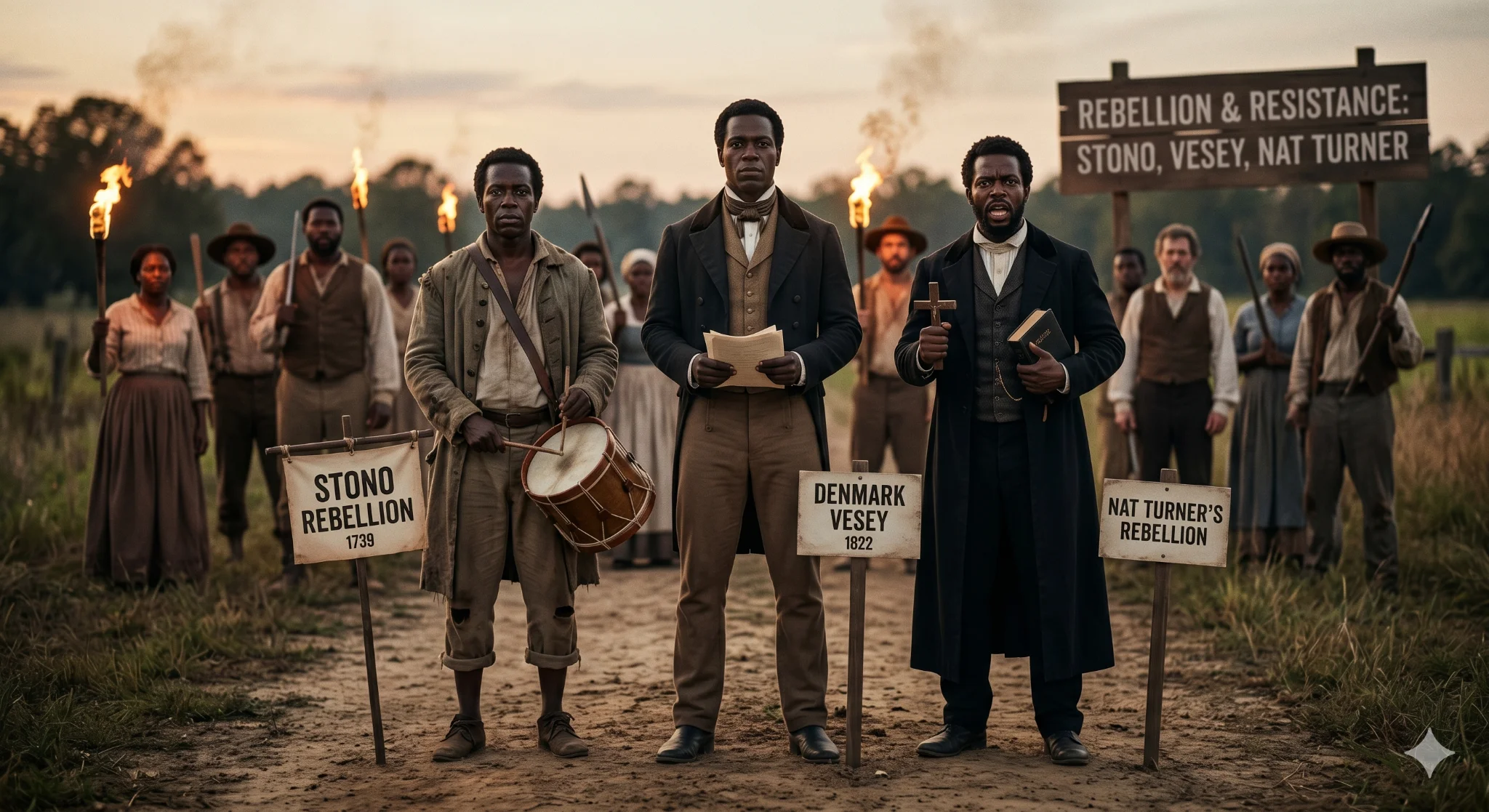
Nat Turner was an enslaved preacher in Southampton County, Virginia — literate, deeply religious, and described by contemporaries as highly intelligent. He believed he had received divine visions commanding him to lead his people to freedom. On August 21, 1831, he and six trusted men began the bloodiest slave revolt in American history, moving from farm to farm and growing their number to roughly 70 before state militia forces crushed the rebellion.
The aftermath was catastrophic for Black people throughout the South. In Virginia alone, more than 200 Black people — most of whom had nothing to do with the revolt — were killed in the days following. Turner hid for six weeks before being captured. He was tried, convicted, and hanged on November 11, 1831. His body was then flayed; his fat was rendered into grease; portions of his flesh and skin were kept as trophies and distributed among white Virginians. Scholars including Vincent Woodard have analyzed this act not as aberrant mob behavior but as an extension of the same logic that governed slavery itself — the total claim of ownership over a Black body, exercised past the point of death.
Virginia's legislature, shaken by the uprising, held a serious debate in early 1832 about abolishing slavery. The proposal failed — but only narrowly, and primarily because of economic arguments about the cost of compensating slaveholders. It was the last time any Southern state legislature would seriously debate abolition before the Civil War.
The response across the South was a new wave of slave codes that banned Black literacy (it was illegal to teach enslaved people to read in most Southern states after 1831), banned Black religious gatherings without white supervision, banned the circulation of abolitionist literature, and expanded slave patrols. Every form of Black assembly — church, school, market, gathering — was targeted as a potential organizing site for the next revolt.
"I had a vision — and I saw white spirits and black spirits engaged in battle, and the sun was darkened — the thunder rolled in the heavens, and blood flowed in streams — and I heard a voice saying, 'Such is your luck, such you are called to see, and let it come rough or smooth, you must surely bear it.'"
— Nat Turner, from The Confessions of Nat Turner, as recorded by Thomas R. Gray, 1831