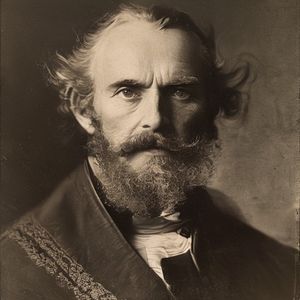
Connecticut, Calvinism, and the Conviction That Slavery Was War
John Brown was born on May 9, 1800, in Torrington, Connecticut, into a deeply Calvinist family. His father Owen was an ardent opponent of slavery who moved the family to Ohio — a free state — when John was five. As a child, Brown witnessed the brutal beating of a Black boy, an event he later described as the moment he "swore eternal war" against slavery. The experience was not abstract. He grew up in communities where the Underground Railroad was an active presence, where the question of slavery was not a distant political argument but an immediate moral emergency.
Brown failed at nearly every business venture he attempted across five decades — tanning, farming, wool trading, surveying. He married twice, fathered 20 children (11 of whom survived to adulthood), and was repeatedly in debt. None of this diminished his central conviction, which hardened through the 1840s and 1850s as the political compromises of the abolitionist movement — gradual emancipation, moral suasion, colonization schemes — seemed increasingly inadequate to him in the face of the Fugitive Slave Act, Bleeding Kansas, and the Supreme Court's Dred Scott decision. Brown's conclusion was theological and strategic: slavery was a state of war imposed on Black people by white America, and it could only be ended by war.
Pottawatomie and the Argument for Violence
The Kansas-Nebraska Act of 1854 opened the question of whether new territories would be slave or free to popular vote, producing a proxy civil war in Kansas between pro-slavery "Border Ruffians" from Missouri and Free State settlers. Brown arrived in Kansas in 1855 with five of his sons. When pro-slavery forces sacked the Free State town of Lawrence in May 1856 and the Senate chamber was used to nearly beat abolitionist Senator Charles Sumner to death with a metal-tipped cane — and no legal consequence followed — Brown decided the moment required a different response.
On the night of May 24–25, 1856, Brown led a party of seven men — including four of his sons — in the Pottawatomie Massacre: the killing of five pro-slavery settlers along Pottawatomie Creek. The men were dragged from their cabins and hacked to death with broadswords. The killings were premeditated and deliberate. Brown never denied his role. He believed they were an act of war in a war that was already being fought — just not yet acknowledged as such by the people with the power to name it.
The Pottawatomie Massacre cannot be separated from any honest account of Brown. It was not self-defense. It was an offensive strike against civilian pro-slavery settlers. The question it poses — whether political violence against the active infrastructure of slavery was morally justified — was debated by abolitionists at the time and has been debated by historians ever since. Frederick Douglass, who knew Brown well and disagreed with his tactics, never condemned him for it.
"I, John Brown, am now quite certain that the crimes of this guilty land will never be purged away but with blood."
The Provisional Constitution and the Appalachian Guerrilla Strategy
Brown's plan for ending slavery was not limited to a single raid. He had developed, over years, a strategic vision for a sustained guerrilla campaign in the Appalachian Mountains — a spine of free territory running through the South where escaped enslaved people and free Black fighters could organize, raid plantations, liberate more people, and gradually make slavery untenable and unenforceable across the region. He drafted a provisional constitution for this liberated territory in 1858.
To fund and organize the plan, Brown met secretly with Frederick Douglass in Chambersburg, Pennsylvania, in 1859, trying to persuade Douglass to join him. Douglass declined. He told Brown directly that seizing Harpers Ferry — a federal armory — would bring the full force of the United States government down on them before a broader movement could take hold. He was right about the tactical problem. He was also writing, years later, that Brown's willingness to die for Black freedom was something no white man before him had demonstrated in the same way. Both things were true.
Brown also met with Harriet Tubman, who had conducted 13 missions on the Underground Railroad. She supported the broader plan but was ill when the raid was mounted and could not participate. Brown called her "General Tubman" and said she was "one of the best and bravest persons on this continent."
Harpers Ferry
On the night of October 16, 1859, Brown led a force of 21 men — 16 white, 5 Black — across the Potomac River into Harpers Ferry, Virginia (now West Virginia). They seized the federal armory, the arsenal, and a rifle works without significant resistance. Brown sent out raiding parties to take hostages from local plantations, including the great-grandnephew of George Washington. He expected enslaved people from the surrounding countryside to rise and come to him. They did not, or could not — the surrounding area was immediately placed under alarm and militia forces sealed the roads within hours.
By morning, Brown and his men were surrounded in the armory's engine house — later known as "John Brown's Fort" — by local militia, Virginia state forces, and eventually a detachment of U.S. Marines under the command of Colonel Robert E. Lee, with Lieutenant J.E.B. Stuart leading the assault party. On the morning of October 18, the Marines broke down the engine house door. Ten of Brown's men were killed in the fighting, including two of his sons. Brown was wounded, captured, and taken prisoner.
The entire raid had lasted 36 hours. Brown had failed to ignite the rebellion he planned. What he had done was force the country to reckon with the question of whether slavery could continue without producing exactly this kind of response — and make vivid, for both sides, that the political settlement they had been maintaining since the Missouri Compromise was finished.
The Courtroom as Pulpit
Brown was tried in Charles Town, Virginia, on charges of treason against Virginia, conspiracy with slaves to rebel, and murder. The trial lasted one week. Brown, still recovering from his wounds, conducted his own defense with extraordinary composure and used every opportunity to speak directly to the moral question of slavery rather than the legal question of his guilt. He was convicted on all counts on November 2, 1859, and sentenced to death.
In the five weeks between his conviction and his execution, Brown wrote letters from his cell that were published across the North and in Europe. He became the most discussed figure in the Atlantic world. In the South, his raid confirmed every fear about abolitionist intentions and accelerated the push toward secession. In the North, his letters — calm, principled, without self-pity — made him a martyr before he died. Ralph Waldo Emerson said he would "make the gallows as glorious as the cross." Henry David Thoreau gave a speech defending him. Victor Hugo wrote from France appealing for clemency.
"Now, if it is deemed necessary that I should forfeit my life for the furtherance of the ends of justice, and mingle my blood further with the blood of my children and with the blood of millions in this slave country whose rights are disregarded by wicked, cruel, and unjust enactments — I submit; so let it be done."
Brown was hanged on December 2, 1859, at Charles Town, Virginia. Among the witnesses at the execution were Stonewall Jackson and John Wilkes Booth. On the morning of his execution, Brown handed a guard a note that read: "I, John Brown, am now quite certain that the crimes of this guilty land will never be purged away but with blood." He was 59 years old.
Eighteen Months Later, the War
The Civil War began on April 12, 1861 — 16 months after Brown's execution. Union soldiers marched to war singing "John Brown's Body," a song that became the melody for "The Battle Hymn of the Republic." Brown had not been wrong about whether blood would be required. He had been wrong about the scale — the blood was not 21 men at Harpers Ferry but 620,000 dead in a four-year war.
Frederick Douglass delivered the most precise assessment of Brown at the dedication of a memorial to him in 1881:
"I knew him well. He was a white gentleman. In his attachment to the Negro he was in sympathy with all that was best and most enduring in human nature... I could live for the slave, but he could die for him."
Brown's historical standing has always split along the question of whether political violence against slavery was morally legitimate — a question that implicates the entire history of American abolitionism, the founding mythology of a nation that declared independence through armed rebellion while maintaining chattel slavery, and the persistent American distinction between violence that preserves the existing order and violence that threatens it. The nation that executed Brown for treason for attempting to end slavery erected statues to the men who made war to preserve it.
The Weather Underground named their collective "the John Brown Anti-Klan Committee" in one of its successor organizations. The tradition of invoking Brown by white Americans who take up the cause of Black liberation — and the question of whether that invocation is solidarity or appropriation, effective or counterproductive — runs unbroken from 1859 to the present.