The Wealthiest Person in Recorded History
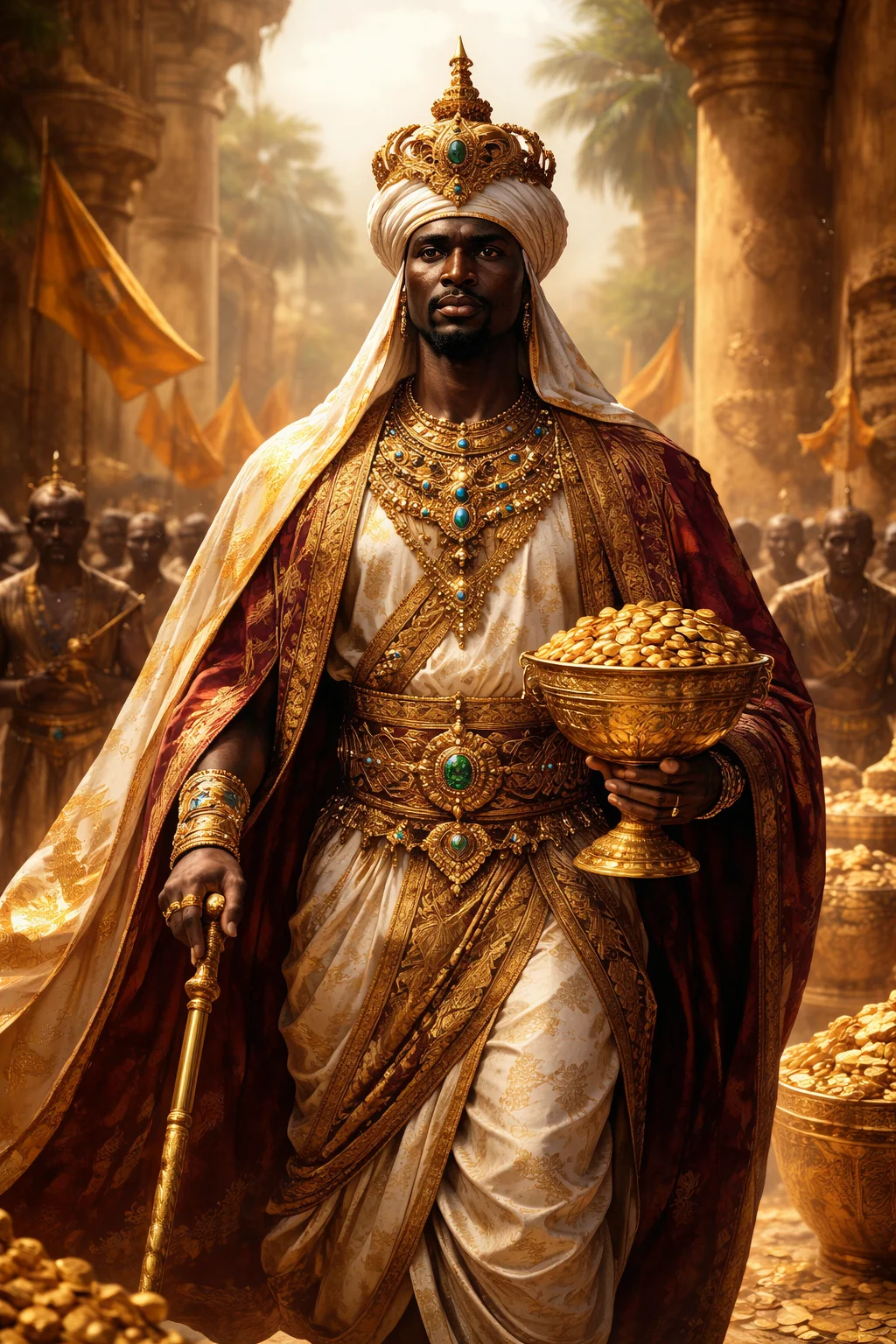
Mansa Musa I — born circa 1280 and ruling the Mali Empire from 1312 to 1337 — is consistently identified by economists and historians as the wealthiest individual in human history. His estimated fortune of $400 billion in modern terms dwarfs every comparable figure: John D. Rockefeller at his peak held approximately $340 billion in comparable terms; Elon Musk and Jeff Bezos have not approached $400 billion simultaneously.
The source of this wealth was structural, not personal accumulation. The Mali Empire at its height controlled more than half of the entire world's gold supply and nearly all of its salt trade — the two most economically essential commodities in the medieval world. Gold was the monetary foundation of Mediterranean, trans-Saharan, and Asian trade networks. Salt was essential for food preservation across the entire pre-refrigeration world. The emperor who controlled both was not wealthy in the way we think of individuals being wealthy — he was the governor of an economic system that had no competitor.
The West — and most of the world — has been taught almost nothing about Mansa Musa. His absence from standard historical education is not an accident of the historical record. The record is extensive: Arab geographers, Egyptian court officials, and North African scholars documented his reign and his pilgrimage in detail. The absence is a choice about whose history counts.
The Mali Empire at Its Height
The Mali Empire that Mansa Musa inherited and expanded covered modern-day Mali, Senegal, Gambia, Guinea, Guinea-Bissau, Mauritania, and parts of Niger and Burkina Faso — a territory larger than Western Europe. It was built on the foundation Sundiata Keita established in 1235 CE and grew through a combination of military conquest, strategic alliance, and the monopoly control of the Saharan gold-salt trade routes.
Timbuktu, the empire's intellectual capital, was one of the great cities of the medieval world. Its population of approximately 100,000 made it larger than London (which had fewer than 50,000 residents at the same time) and comparable to Paris and Florence. The city housed three major universities — the Sankore, Djinguereber, and Sidi Yahia mosques — all functioning as centers of scholarship, not merely worship.
The Sankore mosque functioned as a university whose faculty included scholars of law, mathematics, astronomy, and Quranic studies from across the Islamic world. Students traveled from North Africa, the Middle East, and Europe to study there. Its curriculum predated the formalization of most European universities — and its library holdings dwarfed them.
The Pilgrimage That Broke the Mediterranean Economy
In 1324, Mansa Musa undertook the hajj — the Islamic pilgrimage to Mecca — in a manner the world had never witnessed and has never witnessed since. He traveled with an entourage of approximately 60,000 people, including 12,000 enslaved attendants each carrying four pounds of gold, 500 heralds each carrying a gold staff and dressed in fine silk, and a personal retinue of nobles, soldiers, merchants, and scholars. He brought approximately 12 tons of gold to distribute along the route as alms and gifts.
Empire
Egypt
Mecca
journey
"This man Musa flooded Cairo with his kindness, leaving no emir or holder of a royal office without the gift of a load of gold. The people of Cairo earned incalculable sums from him, whether by buying and selling or by gifts."
— Al-Umari, Mamluk scholar, writing approximately 12 years after the pilgrimage, in Masalik al-Absar
What Mansa Musa Built — and What Erased Him
During and after his pilgrimage, Mansa Musa commissioned a building program that transformed the architectural landscape of West Africa. He brought back the Andalusian architect Abu Ishaq al-Sahili, who designed the Djinguereber Mosque in Timbuktu — still standing today and a UNESCO World Heritage Site. He built mosques, palaces, and madrasas across the empire. The Sankore Mosque was reconstructed and expanded under his patronage into the institution that would host 25,000 students.
The Mali Empire did not survive long after Mansa Musa's death in approximately 1337. Succession disputes weakened the central government; the Songhai Empire absorbed Mali's territory by the late 15th century; and the Portuguese exploration of the West African coast — beginning in the 1440s — established the slave trade infrastructure that would systematically target exactly the populations Mali had governed.
The erasure of Mansa Musa from Western historical consciousness was not a passive forgetting. Medieval European cartographers knew about him — the Catalan Atlas of 1375 depicts him by name. The systematic exclusion of African historical figures from the Western curriculum happened alongside the intellectual construction of racism that was used to justify the transatlantic slave trade: if Africans had no history, no civilization, no kings of note, then their enslavement was easier to rationalize. Mansa Musa's existence — the wealthiest man who ever lived, governor of a civilization more learned than contemporary Europe — directly contradicted that construction. So he was omitted.
The Mali Empire — one of the wealthiest and most sophisticated civilizations in human history — was destabilized by the same Atlantic slave trade whose infrastructure was built by European powers who dismissed African civilization as primitive. The descendants of the people Mansa Musa governed were among those taken in the transatlantic trade. Their labor built American wealth. Their descendants were then systematically excluded from that wealth. The chain runs directly from Timbuktu's libraries to the racial wealth gap today.
Read the full thread: African Empires and the Origins of the DiasporaWhy You Were Not Taught This
The standard American K-12 curriculum covers Mansa Musa, if at all, in a paragraph. The standard treatment gives him one sentence — "the richest man in history" — without context, without his empire, without his universities, without the pilgrimage, without the manuscripts. He appears as a curiosity rather than as what he was: the ruler of a civilization whose intellectual and economic output surpassed Europe's at the same historical moment.
The documentary record is not the obstacle. Al-Umari wrote about the pilgrimage in the 1330s. The Catalan Atlas documented Mali in 1375. Ibn Battuta visited the Mali Empire in 1352 and left a detailed account. The sources exist. The choice not to teach from them is a curriculum decision — one that reflects the same logic that built the racial hierarchy the curriculum was designed, in part, to maintain.
Knowing Mansa Musa is not supplementary knowledge. It is corrective knowledge — it corrects a foundational lie about what Africa was before European contact, and therefore about what was taken when that contact became conquest and enslavement. You cannot understand the depth of what the slave trade destroyed without understanding what existed before it. Mansa Musa is part of what existed before it.
"To understand what was lost, you first have to know what was there."
— Chain editorial principle
The empire that built Timbuktu.
Mansa Musa was not an anomaly. He was the product of a civilization — and that civilization was systematically erased from Western historical memory at the same time its people were being enslaved.