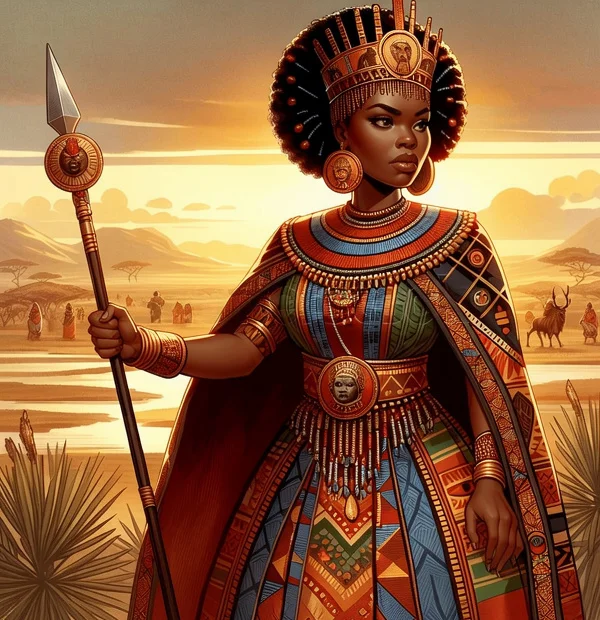
The Queen Who Refused to Surrender
Nzinga Mbande was born around 1583 into the royal family of Ndongo, a Mbundu-speaking kingdom in what is now northern Angola. She came to power in 1624, after the death of her brother Ngola Mbande, and would spend the next four decades — until her death in 1663 at approximately age 80 — resisting Portuguese military invasion, Portuguese-backed slave raiding, and the dismantling of the independent kingdoms of West Central Africa.
She ruled two kingdoms. She negotiated with the Portuguese, the Dutch, and the Vatican. She commanded armies in the field. She harbored escaped slaves — called kilombo — and granted sanctuary to those fleeing bondage. She died still reigning, having never fully surrendered her sovereignty or her territory to Portugal.
She was written about during her lifetime by Portuguese administrators, Catholic missionaries, and Dutch merchants. The historical record on her is unusually rich — and it shows a ruler who understood power, who used diplomacy and force with strategic intelligence, and whose resistance delayed the Portuguese consolidation of Angola by decades.
"She is a cunning and prudent woman, so adroit in all affairs of peace and war that she might have been compared to Queen Elizabeth of England."
— Giovanni Antonio Cavazzi da Montecuccolo, Italian Capuchin missionary, c. 1660s
She was baptized as a Christian — taking the name Ana de Sousa — in 1622 as part of a diplomatic strategy. She later reverted to traditional Mbundu religious practice, then returned to Christianity near the end of her life, reportedly at her own initiative. She was buried in full royal regalia, her bow and arrows placed in her hands, in the church she had built in Matamba — a detail that captures the complexity with which she navigated between cultures, on her own terms.
The Chair That Wasn't There: Diplomacy as Power
In 1621, Nzinga traveled to Luanda — the Portuguese colonial capital — to negotiate a peace treaty on behalf of her brother, who was king of Ndongo. The Portuguese governor João Correia de Sousa received her in a formal audience. A chair had been provided for the governor. No chair had been provided for Nzinga.
This was not an oversight. It was a protocol of domination — the colonial administrator seated, the African dignitary standing, the hierarchy made physical and visible.
Nzinga responded by directing one of her attendants to kneel on all fours. She sat on the attendant's back and conducted the entire negotiation as an equal.
The 1621 treaty included Portuguese recognition of Ndongo's sovereignty, an agreement to return escaped enslaved Africans, and a halt to Portuguese-backed raids. Portugal violated nearly all of it within a few years. But the negotiation demonstrated Nzinga's strategic intelligence: she understood that diplomacy required projecting equality, not accepting the terms the colonizer tried to set.
Four Decades of Documented Resistance
After Portugal violated the 1621 treaty and resumed military aggression, Nzinga transitioned from negotiation to armed resistance. She allied with the Imbangala — fierce warrior bands who operated outside both Portuguese and Mbundu political structures — to rebuild her military capacity. She conquered and became queen of Matamba, a neighboring kingdom, as a base for continued resistance. She allied with the Dutch against Portugal.
A Multifront Diplomatic Strategy in a Colonial World
What made Nzinga exceptional was not just military resistance — it was the sophistication of her diplomatic framework. She operated simultaneously across multiple strategic relationships, adjusting alliances as circumstances shifted while maintaining a consistent strategic goal: preserve African sovereignty over her territory.
None of these instruments were available to the typical African ruler facing Portuguese colonization. Nzinga assembled them through political intelligence, personal authority, and an understanding of European power dynamics — including religious politics — that most Portuguese administrators did not expect an African queen to possess.
Why She Was Written Out — and What Survives
Nzinga's story survives primarily in European sources — Portuguese administrative records, Catholic missionary accounts, Dutch commercial correspondence — because the Mbundu oral tradition was later disrupted by the very colonial project she spent her life resisting. That irony is itself part of the history.
What those European sources document, despite their bias, is a ruler who held two kingdoms, fought a European colonial power for four decades, used every instrument of statecraft available to her, and died having never been fully conquered. Portuguese consolidation of Angola required another 250 years of sustained military campaigns after her death.
In contemporary Angola, Nzinga is a national symbol. Her statue stands in Luanda's main square. She appears on Angolan currency. The Angolan independence movement of the 20th century drew on her as an image of resistance to colonial rule — the same Portugal, 300 years later.
In the United States, she is rarely taught. The standard curriculum for African history — when it exists — focuses on Egypt and the slave trade. The sophisticated African kingdoms and political figures of the 16th and 17th centuries, operating at the same moment as Queen Elizabeth I and Cardinal Richelieu, are absent. Nzinga was at least as consequential a figure in the geopolitics of her era as most European rulers who do appear in standard curricula.
The territory Nzinga defended became the colony of Angola — formally so in the late 19th century, after 250 years of Portuguese military campaigns she had slowed. Angola was Portugal's last African colony, gaining independence only in 1975. The wars of that independence included a civil war that lasted until 2002. What Nzinga resisted — the dismantling of sovereign African governance in favor of extractive colonial rule — is the direct ancestor of every subsequent conflict over Angolan land, resources, and self-determination.
Read: African EmpiresShe Was a Head of State
Nzinga of Ndongo and Matamba was not a resistance fighter operating outside power — she was a reigning queen who used every instrument of statecraft available to her. She held sovereignty until the day she died.