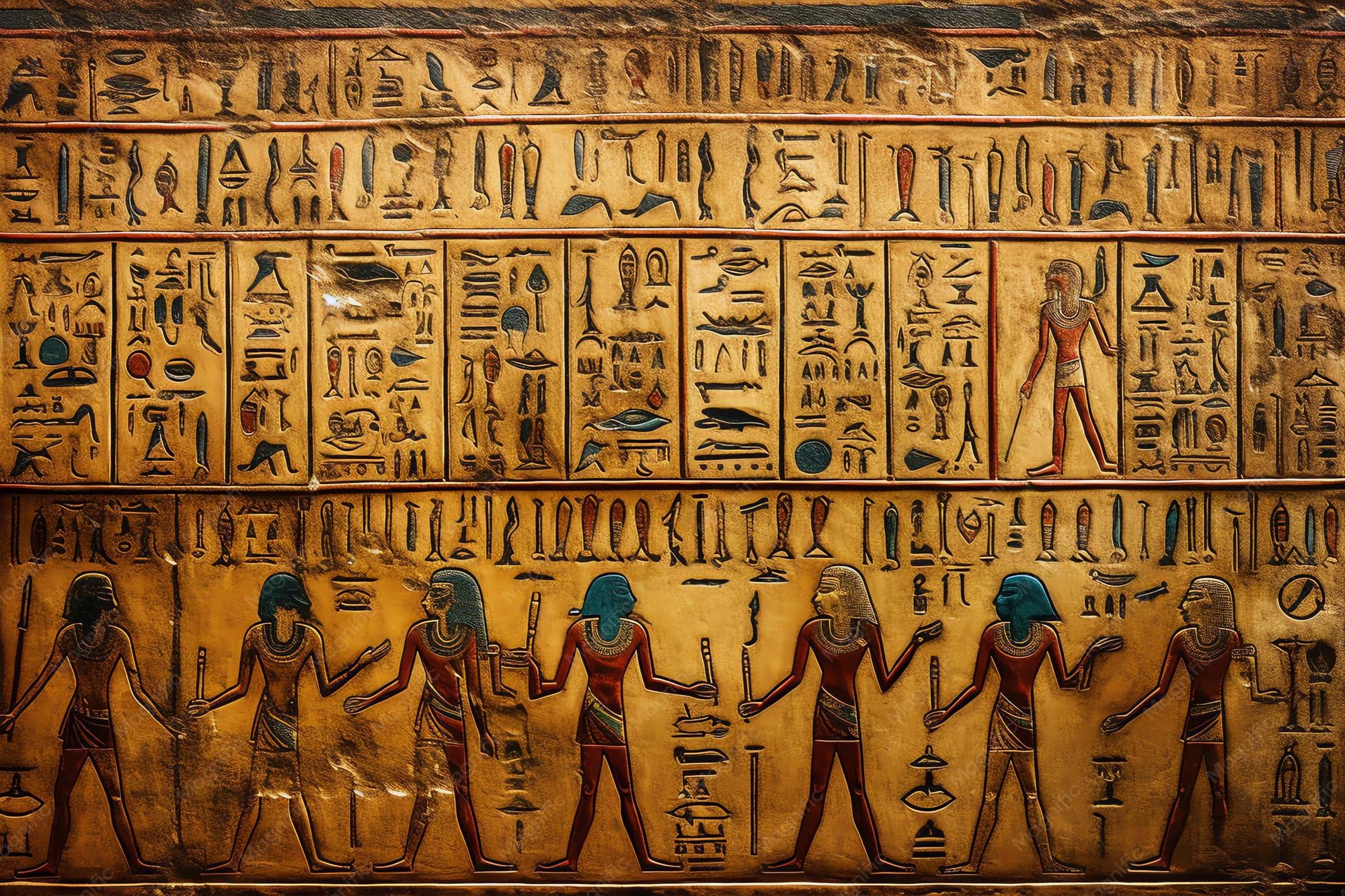
Identity Thread: Black people are Yoruba, Akan, Igbo, Wolof — descendants of the world's oldest civilizations. This thread is about who they are, what was taken, and what survived.

Identity & Diaspora Thread · Ancient Africa to Present

Before, During,
and After: Who Black People Are

The story of Black people does not begin with slavery. It begins with some of the oldest civilizations on Earth — with empires of gold, universities of manuscript, mathematicians, astronomers, architects. What the slave trade took was not just labor. It was language, name, religion, family, and the knowledge of origin. This thread is about what was, what was taken, what survived, and who Black people built themselves into on the other side.

Period
Ancient Africa – Present
Diaspora Population
~200 million across the Americas
African Continent Population
~1.4 billion
The thread's argument

Black people are not a race defined by slavery. They are the descendants of the Yoruba, Akan, Igbo, Wolof, Mandé, BaKongo, Fon, and dozens of other peoples with histories, philosophies, and civilizations that predate European contact by millennia. The slave trade attempted to erase that — to replace specific, named identity with a generic racial category useful to the people doing the enslaving. It did not succeed. What survived the Middle Passage, what was rebuilt in the Americas, what was asserted in art and resistance and scholarship — that is the actual story of who Black people are. It does not begin in 1619. It does not end there either.

Era I · Before the Trade: The Peoples and Civilizations
Ancient – 1500s CE

Not a Monolith: The Specific Peoples the Slave Trade Took

West and Central Africa · Over 50 Distinct Ethnic Groups
2,000+
distinct ethnic groups across the African continent
~1,500
languages spoken in Africa — more linguistic diversity than any other continent
50+
distinct peoples primarily targeted by the transatlantic slave trade

The word "African" — like the word "Black" — is not how the people it describes primarily understood themselves. Before the slave trade, before colonialism, before the imposition of racial categories, the people of the African continent understood themselves primarily through specific ethnic, linguistic, and political identities: Yoruba, Igbo, Akan, Wolof, Mandé, Fon, BaKongo, Hausa, Fulani, Zulu, Xhosa, Maasai, and hundreds of others.

Africa is the most ethnically and linguistically diverse continent on Earth. It contains over 2,000 distinct ethnic groups speaking more than 1,500 languages. The peoples of the Sahel have different histories, religions, and political traditions than the peoples of the forest zones or the eastern highlands. A Yoruba person and a Wolof person in 1600 shared no more cultural identity than a Norwegian and a Greek — and they knew it.

The slave trade deliberately erased this specificity. On the ships and in the markets of the Americas, these distinct people were reduced to one category: "Negro," "African," "slave." Their names were taken. Their languages were prohibited. Their religions were suppressed. The destruction of specific identity was not a side effect of the slave trade — it was one of its functions. A person who does not know where they come from is harder to organize around their origin.

West Africa
Yoruba
Nigeria, Benin, Togo. Sophisticated city-states including Ile-Ife and Oyo. Complex theology, art, and jurisprudence.
West Africa
Akan / Ashanti
Ghana, Ivory Coast. Gold trade, matrilineal succession, Asante Empire at its peak rivaled European powers.
West Africa
Igbo
Nigeria. Decentralized, egalitarian political structure. Known for resistance — high rates of escape and rebellion in the Americas.
West Africa
Wolof
Senegal, Gambia. Oral literary tradition, Islamic scholarship, significant presence in early New World enslaved population.
West Africa
Fon / Dahomey
Benin. Vodun religious tradition (origin of Haitian Vodou and American Hoodoo). Complex royal court and art tradition.
Central Africa
BaKongo
Congo, Angola. The largest single source of enslaved people in the Americas. Their cosmology survives in Afro-Brazilian and Afro-Cuban religious practice.
The Erasure Was the Point

The prohibition on African languages, the replacement of African names with European ones, the suppression of African religion — these were not incidental to slavery. They were its ideological infrastructure. A person without a remembered origin can be told their origin is servitude. Erasing the specific peoples was the first step in constructing "Black" as a racial category defined by subordination.

300 BCE – 1600 CE

What Was There: The Civilizations Deliberately Unrecognized

Mali Empire · Songhai · Great Zimbabwe · Kingdom of Kongo · University of Timbuktu
1,000,000
manuscripts in the Timbuktu libraries — mathematics, astronomy, medicine, law
1324
Mansa Musa's pilgrimage to Mecca — he gave away so much gold he crashed the Egyptian economy
11 stories
height of Great Zimbabwe's stone towers — built without mortar, without European contact

The pseudo-scientific racism of the 18th and 19th centuries required a specific claim: that Africans had no history, no civilization, no intellectual tradition worth preserving — and therefore that enslaving and "civilizing" them was justified, even beneficial. This claim was a lie, and not a subtle one.

The Mali Empire (c. 1235–1600) under Mansa Musa was, at its height, the wealthiest state on Earth. Musa's 1324 pilgrimage to Mecca was so ostentatious — he traveled with 60,000 people and distributed so much gold — that he caused a decade-long inflation in North Africa and the Middle East. The University of Sankore in Timbuktu had a library of up to one million manuscripts covering mathematics, astronomy, medicine, Islamic law, and natural philosophy. Arab scholars corresponded with Timbuktu's scholars as intellectual equals.

The Kingdom of Kongo (c. 1390–1857) was a sophisticated centralized state with a diplomatic tradition that included written treaties with Portugal. When the Portuguese arrived in 1483, the Kongo king received them as a foreign dignitary, not as a superior. The BaKongo had complex bureaucratic governance, a market economy, and a cosmological system so coherent it survived the Middle Passage and persists in modified form in Afro-Cuban and Brazilian religion today.

Great Zimbabwe's stone towers — built without mortar using interlocking granite blocks — were so perfectly constructed that 19th-century European archaeologists initially refused to attribute them to Africans, proposing instead that they were built by Phoenicians or Arabs. The scientific consensus established in the 20th century confirmed what oral tradition had always said: they were built by the ancestors of the Shona people between 1100 and 1450 CE.

"The Africans who were enslaved were not savages plucked from darkness. They were, in many cases, more literate, more numerically sophisticated, and more legally organized than the Europeans who enslaved them."

— Henry Louis Gates Jr., Africa's Great Civilizations, 2017

Era II · The Middle Passage: What Was Taken
1619–1808 — The Atlantic

What the Slave Trade Took Beyond Labor

The Middle Passage · The Plantation · Cultural Annihilation as Policy
~50
distinct African languages spoken on a single slave ship
100%
of enslaved people given European names — their birth names prohibited
2–3 gen.
generations before African-born language was gone among the enslaved in most regions

The slave trade took twelve and a half million people across the Atlantic. It took more than their labor. It attempted to take everything: name, language, religion, family structure, political tradition, knowledge of origin.

Names were the first casualty. On arrival, enslaved people were given European names — often classical ones (Caesar, Pompey, Cato) as a kind of ironic commentary, or simply common English names (John, Mary, Tom). Their African names were prohibited. Within two generations, the original names were often lost. The practice of taking African names — common in the 20th century — is an act of recovery, not tradition.

Languages were systematically suppressed. Enslavers deliberately mixed people from different linguistic groups to prevent communication and organized resistance. The approximately 50 distinct languages represented on a typical slave ship were replaced, within two to three generations, by English, Spanish, Portuguese, or French creoles. In the United States, African languages essentially disappeared among enslaved people by the early 1800s. In isolated communities — the Gullah Geechee people of the South Carolina and Georgia Sea Islands — African linguistic structures persisted longer, and their language retains the clearest documented African linguistic inheritance in North America.

Religion was suppressed and then co-opted. Slaveholders initially resisted converting enslaved people to Christianity — a free person in Christ created awkward theological questions. When conversion became policy in the 18th century, it was deployed as a mechanism of control: the Christianity enslaved people were taught emphasized obedience, patience, and reward in the afterlife rather than equality in the present.

What Survived Anyway

The suppression was not total. Rhythmic musical structures from West Africa survived in work songs, field hollers, and spirituals — and became the foundation of blues, jazz, gospel, R&B, and hip-hop. Yoruba and Fon religious practice survived, transformed, as Candomblé in Brazil, Santería in Cuba, Vodou in Haiti, and Hoodoo in the American South. Foodways survived: okra (from the Igbo okuru), black-eyed peas, yams, rice cultivation techniques specific to West African traditions. Stories survived in the Brer Rabbit tradition — originally Anansi the spider, a West African trickster figure. What was carried across the ocean in human memory proved more durable than what the system tried to replace it with.

Era III · Rebuilding: The Construction of Black American Identity
1800s–1920s

The Making of "Black": A New Identity Built From the Wreckage

Enslaved Communities · Black Church · HBCU Tradition · Early Black Press
1827
Freedom's Journal — first Black-owned newspaper in the US, asserting Black humanity in print
1837
Institute for Colored Youth (later Cheyney University) — first HBCU, 29 years before the Civil War
100+
HBCUs founded between 1865 and 1900 — building Black intellectual infrastructure

Stripped of specific ethnic identity, scattered across plantations that deliberately mixed people from different origins, prohibited from African languages and religion — the enslaved people of the Americas constructed something new. They built a shared Black American identity out of the common experience of enslavement, out of the surviving threads of African culture, and out of the specific conditions of American life. This was not a consolation prize. It was an act of creation under the most adverse conditions imaginable.

The Black Church was the first institution. Under slavery, religious gatherings were one of the few forms of assembly permitted — and the enslaved people used them. The "invisible church" — worship held in secret, at night, in the woods — preserved oral tradition, organized community, and encoded resistance in song. "Steal Away to Jesus" was a signal song for escape. "Follow the Drinking Gourd" (the Big Dipper, pointing north) was navigation instruction. The spirituals were simultaneously religious expression and covert communication.

After emancipation, Black communities built institutions with extraordinary speed: churches, schools, newspapers, mutual aid societies, banks, and eventually the Historically Black Colleges and Universities that produced Thurgood Marshall, Martin Luther King Jr., Toni Morrison, and a significant portion of Black American professional and intellectual life. The HBCU tradition began before the Civil War — the Institute for Colored Youth was founded in 1837 — and accelerated dramatically during Reconstruction. These institutions were built by people who had been legally prohibited from literacy a generation earlier.

The Black Church
First institution of Black communal life. Encoded resistance in spirituals. Organized freedom movement from the beginning.
📰
The Black Press
Freedom's Journal (1827). Frederick Douglass's North Star (1847). 500+ Black newspapers by 1900.
🎓
HBCUs
100+ founded 1865–1900. Built Black intellectual tradition when white universities barred Black students.
1910s–1930s — Harlem, New York

The Harlem Renaissance: Black People Define Themselves on Their Own Terms

Harlem, New York · The New Negro Movement · Langston Hughes · Zora Neale Hurston
1.6M
Black Americans who migrated North 1910–1930 — the First Great Migration that built Harlem
1925
Alain Locke publishes The New Negro — the intellectual manifesto of the movement
500+
novels, poems, plays, and musical compositions produced by Harlem Renaissance artists

Between 1910 and 1930, 1.6 million Black Americans left the South — fleeing Jim Crow, lynching, and economic exploitation — and settled in Northern cities, particularly New York. In Harlem, a concentrated Black community of unprecedented scale produced one of the most significant cultural explosions in American history: the Harlem Renaissance.

What made the Harlem Renaissance distinct was not merely its artistic output — extraordinary as it was — but its intellectual project: Black Americans asserting, for the first time on a mass scale, the right to define themselves. Langston Hughes's poetry celebrated Black vernacular life without apology. Zora Neale Hurston's anthropological work documented the richness of Black Southern culture that the dominant culture dismissed as primitive. W.E.B. Du Bois's concept of "double consciousness" — the experience of being both Black and American, always seeing oneself through the eyes of the dominant culture — named an internal condition that millions recognized immediately.

The Harlem Renaissance produced jazz as a concert art form, gave rise to the blues as documented literary tradition, introduced the Harlem stride piano tradition, and created a body of literature — Hughes, Hurston, Countee Cullen, Claude McKay, Jean Toomer — that is now part of the American literary canon. Marcus Garvey's Pan-African movement, centered in Harlem, articulated for the first time a mass political vision of Black global identity and dignity. All of this happened within one generation of people who had been enslaved.

"I am not tragically colored. There is no great sorrow dammed up in my soul, nor lurking behind my eyes. I do not mind at all. I do not belong to the sobbing school of Negrohood who hold that nature somehow has given them a lowdown dirty deal."

— Zora Neale Hurston, How It Feels to Be Colored Me, 1928

Era IV · Resistance, Culture, and Assertion, 1950s–Present
1865–Present

The Cultural Contribution: What Black America Gave the World

Jazz · Blues · Gospel · R&B · Hip-Hop · Literature · Visual Art · Dance
1619→Now
unbroken line from West African drum to hip-hop
~$200B
annual global music industry revenue — majority built on Black American musical foundations
1 in 4
words in American English with African origin — more than any non-European language

The most consequential cultural exports in American history — jazz, blues, gospel, R&B, rock and roll, soul, funk, hip-hop — were created by Black Americans. This is not a marginal contribution to American culture. It is the foundation of what the world recognizes as American culture.

The line runs directly and documentably. West African polyrhythmic drumming traditions crossed the Atlantic in the bodies of enslaved people who remembered them. On the plantations of the American South, those traditions transformed into work songs, ring shouts, and field hollers — constrained by the prohibition on drums (feared as a means of communication for organizing resistance). The blues emerged from this tradition in the Mississippi Delta at the end of the 19th century: pentatonic scales, call-and-response structures, and an emotional directness that reflected the specific conditions of Black Southern life. Jazz emerged from New Orleans in the early 20th century, synthesizing blues with European harmony and West African rhythm into something entirely new. Gospel took the blues' emotionality and directed it toward spiritual expression. R&B, soul, funk, and hip-hop followed from there — each one a direct descendant, documented in musicology and in the musicians' own accounts.

In literature: Toni Morrison, James Baldwin, Zora Neale Hurston, Ralph Ellison, August Wilson, Gwendolyn Brooks, Amiri Baraka, Alice Walker — a body of work that has permanently altered American literary tradition. In visual art: Jacob Lawrence, Romare Bearden, Jean-Michel Basquiat, Kara Walker. In dance: tap, jazz dance, modern dance, hip-hop. In language: approximately one in four words in American English with African origin, including dozens of common words absorbed through enslaved communities — "okay" (from the West African waw-kay), "jazz," "juke," "yam," "banana," "tote," "bogus."

Appropriation Without Credit

The cultural contribution came with a consistent pattern: Black artists created forms that were then adopted, popularized, and monetized by white artists and industry with far greater commercial return. Elvis Presley recording Black artists' songs. Rock and roll presented as a white genre. Hip-hop owned primarily by white-run labels. The cultural contribution is undeniable. The economic benefit of that contribution to its creators is a separate and much smaller number.

1955–1968 and beyond

The Civil Rights Movement: Black Americans Assert Their Place in America — and Expand It for Everyone

Montgomery · Greensboro · Birmingham · Selma · Washington D.C.
381
days of the Montgomery Bus Boycott — sustained economic action that ended bus segregation
1965
Voting Rights Act — directly won by the movement, covering all Americans previously excluded
28M
new voters registered 1965–1990 under Voting Rights Act — including millions of non-Black voters

The Civil Rights Movement was not simply a movement for Black rights. It was a movement that forced American democracy to become what it claimed to be. The Civil Rights Act of 1964 and the Voting Rights Act of 1965 — won through the sustained, organized action of Black Americans at enormous personal cost — extended legal protections and voting rights to every American. The women who organized the Montgomery Bus Boycott were applying tactics developed over decades of Black civic life. The lawyers who argued Brown v. Board of Education were trained at Howard University School of Law — an HBCU built by and for a people who had been legally barred from the institutions whose standards they were now setting.

The institutions, tactics, and moral framework of the Civil Rights Movement were built entirely within Black America before they were presented to the country. The NAACP, the SCLC, the SNCC — these were Black-led, Black-funded organizations that had been doing the work for decades before the televised confrontations of the 1960s made it visible to white America. Rosa Parks was not a tired seamstress who spontaneously refused to give up her seat. She was a trained activist and NAACP secretary who had been preparing for this moment for years.

The movement's achievements belong to the people who built it. They belong, specifically, to Black women — Ella Baker, Fannie Lou Hamer, Diane Nash, Septima Clark, Claudette Colvin, Jo Ann Robinson — whose central roles have been systematically minimized in the popular history of the movement.

1500s–Present

The African Diaspora: One People, Countless Forms

Brazil · Haiti · Cuba · Jamaica · Trinidad · United Kingdom · France
~200M
people of African descent in the Americas — the African diaspora
55%
of enslaved Africans transported to the Americas went to Brazil and the Caribbean
1804
Haiti — first free Black republic in the world, won through the only successful slave revolution in history

The African diaspora is not one community. The descendants of enslaved Africans in Brazil — approximately 56 million people, the largest African diaspora population in any country — speak Portuguese, practice Candomblé, eat feijoada, and celebrate Carnaval in forms that preserve specific West and Central African cultural elements more visibly than anywhere in North America. Their experience of race and identity is distinct from Black Americans, shaped by Brazil's specific colonial history and its different forms of racial hierarchy.

Afro-Caribbean identity — Jamaican, Haitian, Trinidadian, Barbadian — was forged in the most brutal labor systems the slave trade produced: the sugar plantations, where death rates were so high that the enslaved population required constant replacement through new imports. Haiti's 1804 revolution — the only successful slave revolution in human history — produced the first free Black republic in the world, defeating Napoleon's army and terrifying every slaveholding society in the Americas into new levels of suppression.

The African diaspora also includes those who never left: the continent's 1.4 billion people, whose post-colonial identity is shaped by the specific national boundaries drawn by European powers at the Berlin Conference of 1884, which ignored existing ethnic and political boundaries entirely. The borders of modern African nations are, in most cases, the borders of European colonial extraction, not of the peoples who live within them.

Present Day

Who Black People Are: The Ongoing Answer

United States · The Diaspora · The Continent
47M
Black Americans — 14% of the US population
4.6M
African-born immigrants in the US — the fastest-growing immigrant group
3,000+
years of continuous documented African civilization before European contact

"Black" as an identity in the United States today includes: descendants of enslaved people whose African origins were deliberately erased and who rebuilt identity through community, resistance, and cultural creation; recent African immigrants who bring specific national and ethnic identities from the continent; Caribbean-born Americans who carry a distinct colonial and post-colonial history; and people across all these backgrounds who navigate American racial categories while holding multiple, layered identities.

"Black" is not a race in the biological sense — race, as a biological category, does not exist. What exists is a political and social category, constructed under specific historical conditions, that has real consequences for the people it describes. Black Americans are treated as a group by institutions, by law enforcement, by housing markets, by the healthcare system — and so the category has social reality even if it has no biological foundation.

But beneath and beyond the category, the people are Yoruba, Akan, Igbo, BaKongo. They are the builders of Timbuktu and Great Zimbabwe and the Asante Empire. They are the composers of the blues, the architects of jazz, the inventors documented in the thread on Black inventors, the soldiers who won a war for a country that didn't protect them, the organizers who forced American democracy to expand. They are James Baldwin and Toni Morrison and Harriet Tubman and Frederick Douglass and Malcolm X and Fannie Lou Hamer and the 180,000 men who carried rifles for the Union and the three men who rowed across the James River to Fort Monroe in 1861 and declared themselves free before anyone had given them permission.

They are not defined by what was done to them. They are defined by what they built, preserved, created, and asserted in spite of it.

"To be a Negro in this country and to be relatively conscious is to be in a state of rage almost all of the time — and in one's work, and despite the rage, or perhaps because of it, one is trying to make the world a more human dwelling place."

— James Baldwin, 1961

The Full Picture

Now: why was race invented in the first place?

Knowing who Black people are raises the next question: why did whiteness need to be constructed as a category at all? The answer is documented — and it starts with a rebellion in 1676.