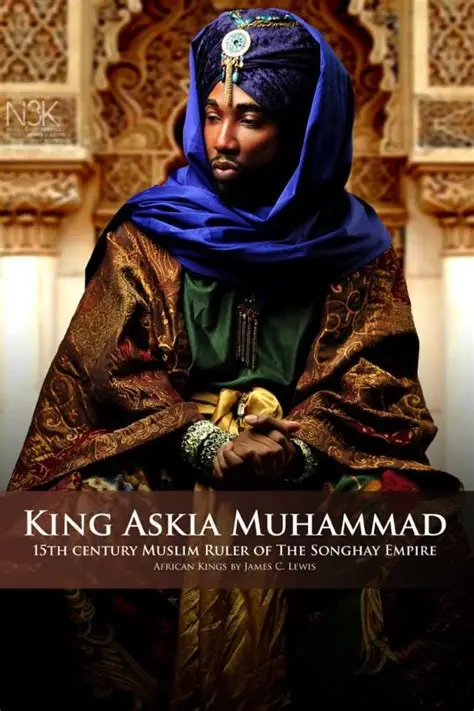
Askia the Great: The Administrator Who Built an Empire
Askia Mohammed I — also called Askia the Great — was the emperor of the Songhai Empire from 1493 to 1528. He did not inherit the throne: he was a general who overthrew the son of Sunni Ali, the empire's founder, in 1493, arguing the new ruler was insufficiently committed to Islamic governance. He then spent 35 years building what became the largest empire in the history of West Africa — stretching from the Atlantic coast of modern-day Senegal across all of modern Mali and Niger to the Hausa states of modern-day Nigeria.
What distinguished Askia Mohammed was not just military conquest but administrative genius. He inherited a powerful but loosely organized state. He left it with standardized weights and measures, a professional civil service, an agricultural tax system, and Timbuktu as arguably the most important center of Islamic scholarship in the world — hosting scholars, jurists, and students from across North Africa, the Middle East, and sub-Saharan Africa.
He was deposed in 1528 by his own son, spent years exiled on an island in the Niger River, and died in approximately 1538 at an estimated age of 95. His tomb — the Askia Tomb in Gao — remains standing today and is a UNESCO World Heritage Site.
The Reforms That Made Songhai a State
Before Askia Mohammed, the Songhai Empire was a military power that extracted tribute from conquered territories but governed them loosely. Askia transformed it into an administered state — standardized systems, professional bureaucrats, and consistent rule of law across a territory the size of Western Europe.
Leo Africanus — a Moorish scholar who visited Timbuktu circa 1510–1513 — described the city in terms that astonished European readers: tremendous commerce, great scholars, manuscript libraries, and civic order. His account, written for Pope Leo X, was one of the primary sources through which Europeans learned that a literate, governed, wealthy civilization existed in West Africa.
Timbuktu Under Askia: The World's Classroom
Timbuktu had been important under the Mali Empire, but under Askia Mohammed it became something exceptional: perhaps the most important center of Islamic scholarship outside Cairo and Baghdad. The Sankore Mosque — rebuilt and expanded under his patronage — enrolled approximately 25,000 students from across the Islamic world in law, astronomy, mathematics, medicine, history, and Quranic studies.
The scholars of Timbuktu were consulted by rulers and jurists across the Muslim world. Askia Mohammed himself sought legal rulings from leading Islamic jurists — including the Egyptian scholar al-Maghili — on questions of governance, taxation, and the treatment of non-Muslim subjects. These exchanges survive in written form and document a ruler who governed by consultation with a global scholarly community.
"In Timbuktu there are numerous judges, learned men, and clerics, all receiving good salaries from the king. He pays great respect to men of learning. There is a big demand for books in manuscript, imported from Barbary. More profit is made from the book trade than from any other line of business."
— Leo Africanus, Description of Africa, c. 1526
An estimated 700,000 manuscripts were held in Timbuktu's private and institutional libraries during Songhai's height. In 2012, when Islamist militants occupied Timbuktu, local residents and scholars smuggled approximately 300,000 manuscripts out of the city to protect them — a modern act of preservation for documents that Askia Mohammed's patronage had helped create.
The Caliph of the Bilad al-Sudan
In 1496–97, Askia Mohammed undertook the hajj to Mecca with an entourage befitting an emperor and approximately 300,000 gold pieces to distribute as alms and gifts. In Mecca, he met with the Sharif of Mecca and was granted the title Caliph of the Bilad al-Sudan — the recognized religious and political representative of Islam in sub-Saharan Africa.
This title was not ceremonial. It gave Askia Mohammed's rule a religious legitimacy extending beyond military power. He returned with the title, with scholars and architects recruited from Cairo and elsewhere, and with enhanced diplomatic standing across the Islamic world. The hajj transformed a powerful emperor into a recognized world figure within the most important transnational political system of the 15th and 16th centuries.
The Fall of Songhai — and What It Means
Askia Mohammed was deposed by his son Musa in 1528 — blind and aged, exiled to an island in the Niger River. The succession struggles triggered by his deposition weakened the empire over the following decades. The Songhai Empire collapsed in 1591 when a Moroccan invasion force crossed the Sahara with gunpowder weapons. At the Battle of Tondibi, the vastly larger Songhai army was routed by muskets and cannons. The Moroccan force then occupied and partially destroyed Timbuktu, looting its libraries and deporting its scholars to Marrakech.
The gunpowder gap that ended the Songhai Empire was not a failure of African civilization — it was the consequence of geography and trade access. Gunpowder weapons reached North Africa through Ottoman and European trade networks; sub-Saharan West Africa was on the far side of the Sahara from those supply lines. The civilization Askia Mohammed built was destroyed not by backwardness but by a specific military technology that arrived from outside before it could be acquired within.
The Songhai Empire's collapse in 1591 opened the region to new dynamics — including the expanding Atlantic slave trade. The populations Askia Mohammed had governed, educated, and administered under Islamic law became targets of the largest forced migration in human history. Timbuktu's scholars were deported. The libraries were scattered. The administrative systems were dismantled. What replaced them was colonial extraction.
Read the full thread: African Empires and the Origins of the DiasporaThe largest empire in West African history.
Askia Mohammed built a governed state, a world-class university city, and a diplomatic standing that made him a recognized leader across the Islamic world. He was not at the margins of history. He was at its center.