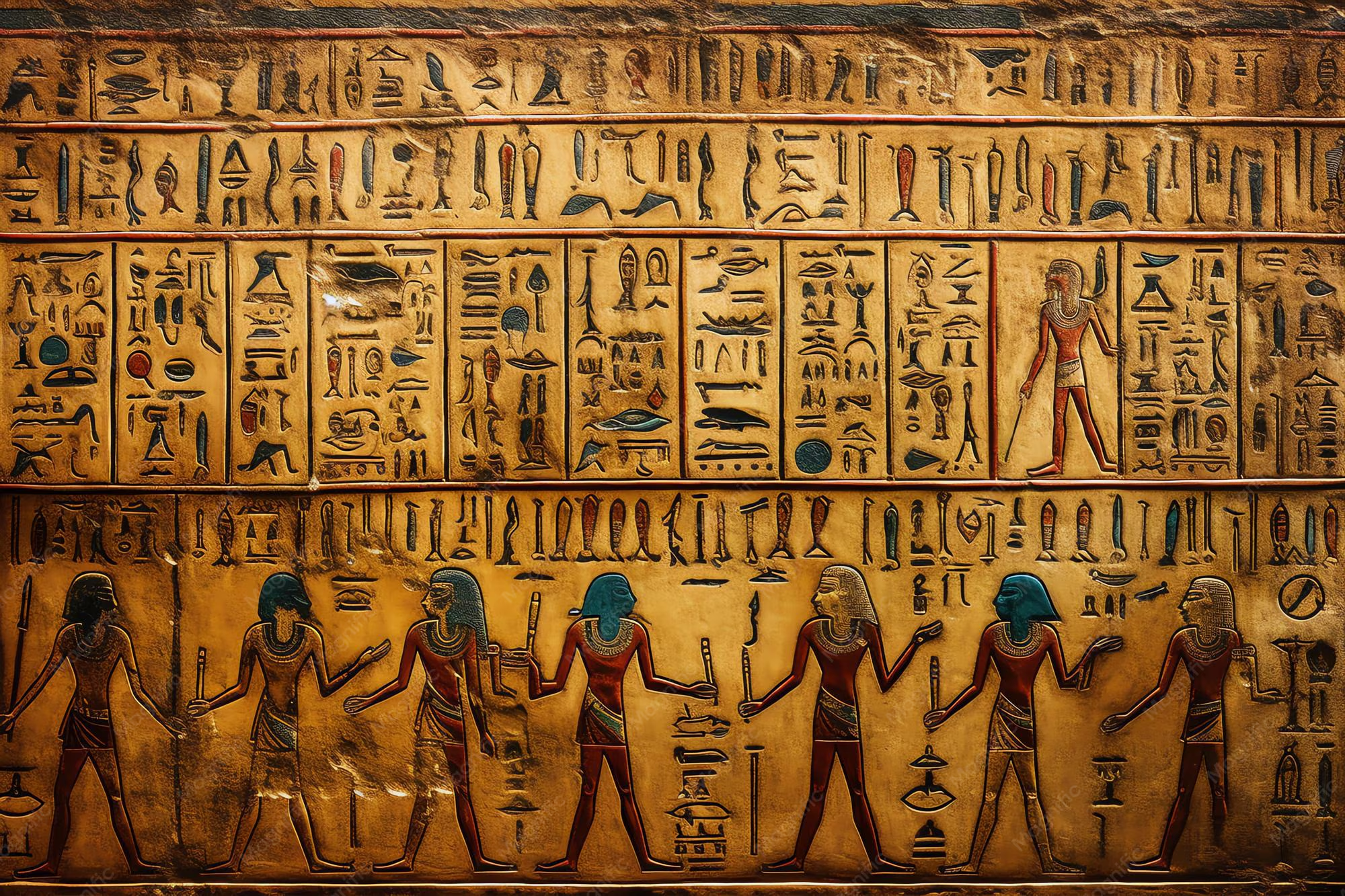
Origins: A Civilization on Both Sides of the Red Sea
The Kingdom of Saba — known in the Hebrew Bible as Sheba, in Arabic as Saba', in Ge'ez as Saba — was not a single-continent civilization. It straddled the Red Sea, with populations and cities on both the African (Horn of Africa) and Arabian (modern Yemen) coasts. The Red Sea was not a barrier — it was a highway, narrow enough in places to cross in a day, connecting two coastlines that shared a climate, a trade economy, and eventually a shared culture and writing system.
The earliest evidence of Sabaean civilization in Africa comes from Yeha, in the Tigray highlands of modern Ethiopia — where archaeologists have uncovered a temple dating to the 8th–7th century BCE built in a distinctly South Arabian architectural style, with inscriptions in the ancient Sabaean script. This is not a colonial outpost. It is a full urban center, indicating that the Sabaean cultural sphere was continental from its earliest phases. Africa was not downstream of Arabia. It was coequal.
The Sabaean language — written in an alphabet of 29 consonants, ancestor of the Ge'ez script still used in Ethiopian liturgy today — appears on inscriptions across both continents. The material culture at Yeha is virtually identical to that at Ma'rib, the great Sabaean capital in Yemen. These were not two separate kingdoms in contact. They were one civilization organized around the Red Sea as its central artery.
The Incense Road: How Saba Controlled the Ancient World's Most Valuable Commodity
The wealth of Saba was built on frankincense and myrrh — aromatic resins harvested from trees native to the Horn of Africa and southern Arabia that were, in the ancient world, as commercially valuable as gold. Every temple in Egypt, every altar in Greece and Rome, every royal court from Persia to India burned frankincense. The demand was insatiable. The supply was geographically concentrated in exactly the region Saba controlled.
The Sabaeans organized the overland and maritime transport of incense across thousands of miles — north through Arabia to the markets of Egypt, the Levant, and Mesopotamia; east across the Indian Ocean to Persia and India; west across the Red Sea between the African and Arabian coasts. The Incense Road was the ancient world's equivalent of a global oil pipeline — and the Sabaeans were its operators, taxing every camel load that passed through their territory.
"No nation in the world produces frankincense except Arabia, and of that Arabia, only a portion. The entire world smells of Arabia."
— Pliny the Elder, Natural History, c. 77 CE — reflecting the Roman perception of Arabian monopoly that Sabaean control producedThe Ma'rib Dam — built by the Sabaeans in the 8th century BCE in modern Yemen — is one of the great engineering achievements of the ancient world: a stone and earthwork structure nearly 700 meters long that redirected the floodwaters of the Wadi Dhana across 10,000 hectares of agricultural land. It irrigated a civilization. When it finally collapsed in the 6th century CE, the event was catastrophic enough to be recorded in the Quran (Surah 34:16) as divine punishment. Saba did not just trade — it built.
The Queen of Sheba: History, Legend, and the Three Traditions That Remember Her
The Queen of Sheba is one of the most persistent figures in world religious memory — appearing in three distinct major traditions with different names, different stories, and different implications. In all three, she is a powerful, wealthy, and wise ruler who engages with a great king as an intellectual and political equal. In all three, her kingdom is associated with Africa and the Horn of Africa region.
In the Hebrew Bible (1 Kings 10), she travels to Jerusalem to test King Solomon's wisdom, arrives with an enormous retinue of camels bearing gold, spices, and precious stones, engages him in a contest of riddles, and declares his wisdom surpassing everything she had heard. The text describes her kingdom's wealth in terms that match the Sabaean incense trade precisely. Her name is never given. She is simply the Queen of Sheba — a title, not a name, suggesting her fame was so well established that no further identification was needed.
"When the Queen of Sheba heard of the fame of Solomon... she came to test him with hard questions. She arrived in Jerusalem with a very great retinue, with camels bearing spices, and very much gold, and precious stones."
— 1 Kings 10:1–2, Hebrew BibleIn the Quran (Surah 27: An-Naml), she is named Bilqis — a queen who rules a prosperous kingdom, worships the sun, and is brought to monotheism through her encounter with the Prophet Suleiman (Solomon). She is portrayed as intelligent, politically shrewd, and ultimately divinely guided. In the Kebra Nagast — the Ethiopian national epic compiled in the 13th century from much older traditions — she is Makeda, Queen of Ethiopia, who travels to Jerusalem, bears Solomon's son Menelik I, and returns home with the Ark of the Covenant. Ethiopian emperors, including Haile Selassie, traced their dynastic legitimacy through this lineage to the present day.
Peak Saba: Architecture, Literacy, and a Civilization That Built Dams
At its height, Saba was one of the most literate and architecturally sophisticated civilizations in the ancient world. The Sabaean script — a consonantal alphabet related to Phoenician — was used for religious inscriptions, commercial records, royal dedications, and legal texts. Thousands of Sabaean inscriptions survive, making it one of the best-documented ancient languages of the Arabian-African world. The script directly gave birth to Ge'ez, the liturgical language of the Ethiopian Orthodox Church, which in turn gave birth to Amharic, spoken today by over 30 million Ethiopians.
The great temple of Awwam (the Moon Temple) at Ma'rib — dedicated to the Sabaean moon god Almaqah — was one of the largest religious structures in the pre-Islamic Arabian world, with an oval enclosure 354 meters long, a hypostyle hall, and monumental entrance pylons. Its African counterpart at Yeha is the oldest standing building in Ethiopia — a temple whose precise stone-cutting and monumental scale rival anything in the contemporary Mediterranean world.
"The Sabaean inscriptions are so numerous and so well preserved that they give us a more complete picture of daily economic and religious life than almost any other ancient civilization outside Greece and Rome."
— Christian Robin, epigraphist, CNRS Paris, leading authority on ancient South Arabian inscriptionsSabaean society was organized around a temple-centered economy in which the moon god Almaqah — the national deity — served as the theoretical owner of agricultural land, commercial caravans, and military victory. Taxes were paid to the temple. Wars were fought in the god's name. The king was the god's representative on earth. This theocratic commercial structure was remarkably stable — the kingdom maintained recognizable continuity for nearly a thousand years.
Decline and Succession: Himyar, Aksum, and the End of Sabaean Power
By the 1st century BCE, Saba's dominance over the incense trade was being challenged from two directions. To the north, the Nabataean Kingdom — centered at Petra in modern Jordan — was capturing an increasing share of the overland caravan trade with Rome. To the south, the Himyarite Kingdom, a rival South Arabian state, was consolidating military power. By 25 BCE, the Himyarites had conquered the Sabaean heartland in Arabia, though Saba continued as a subordinate polity for another three centuries.
On the African side of the Red Sea, Sabaean cultural influence transformed into the rising power of Aksum — the kingdom that would become the direct successor to Saba's trans-Red Sea civilization. The Aksumite kings adopted the Sabaean script (transforming it into Ge'ez), inherited the Sabaean commercial networks, and eventually conquered the Himyarite Kingdom of Arabia in 525 CE, briefly reuniting both sides of the Red Sea under African rule for the first time since Saba's peak.
The final collapse of Sabaean independence around 275 CE did not end the civilization — it transformed it. The Ge'ez language, the Sabaean architectural traditions, the commercial networks, and the sacred kingship model all survived in the Ethiopian highlands through Aksum and its successors. The Kebra Nagast, compiled in the 13th century, was a deliberate act of historical memory — an assertion that Ethiopia was the legitimate heir of Solomon, Sheba, and the entire Sabaean civilizational legacy. It was written precisely because that legacy was in danger of being forgotten.
The Erasure: How Scholarship Made Sheba Arabian and Erased Its African Roots
For most of Western academic history, the Kingdom of Sheba was placed exclusively in Arabia — specifically in modern Yemen — and its African dimension was minimized, dismissed, or simply ignored. This was not a neutral scholarly position. It followed from the same assumption that drove the misattribution of the Ife bronzes, the Atlantis claim at Mapungubwe, and the "gone native" argument about the 25th Dynasty pharaohs: that sophisticated ancient civilizations could not have had African roots.
The Ethiopian tradition — preserved in the Kebra Nagast and in the continuous institutional memory of the Ethiopian Orthodox Church — was dismissed as legend rather than history. Yet Ethiopian claims rest on physical evidence: the temple at Yeha, thousands of Sabaean-script inscriptions found on Ethiopian soil, the direct linguistic descent of Ge'ez from Sabaean, and archaeological continuity between Sabaean and early Aksumite material culture. The evidence for a substantial African Saba is as strong as the evidence for an Arabian one. The reason one tradition was treated as history and the other as myth is not archaeological. It is racial.
"The persistent Western insistence on placing Sheba entirely in Arabia — despite the Ethiopian evidence — reflects not archaeology but a discomfort with the idea of an ancient African queen negotiating as an equal with the biblical King Solomon."
— Stuart Munro-Hay, Ethiopia, the Unknown Land, 2001The Queen of Sheba is remembered in three world religions, depicted in medieval European cathedrals from Chartres to Canterbury, celebrated in Ethiopian national identity, and central to Rastafarian theology — which identifies her explicitly as an African queen and traces the lineage of Haile Selassie through Menelik I to the present. She is one of the most remembered women in human history. The African kingdom she ruled — spanning two continents, controlling the ancient world's most valuable trade commodity, and giving birth to the Ge'ez script still used today — deserves to be known on its own terms.